
VIETNAM CHAMBER OF COMMERCE AND INDUSTRY
Liên Đoàn Thương Mại Và Công Nghiệp Việt Nam
Thu, Oct 02, 2025, 07:07:00
THE HANOI TIMES — Hanoi is stepping up efforts to become Vietnam’s innovation hub, with universities and global tech partners rolling out training programs in artificial intelligence and semiconductors to meet national development goals.
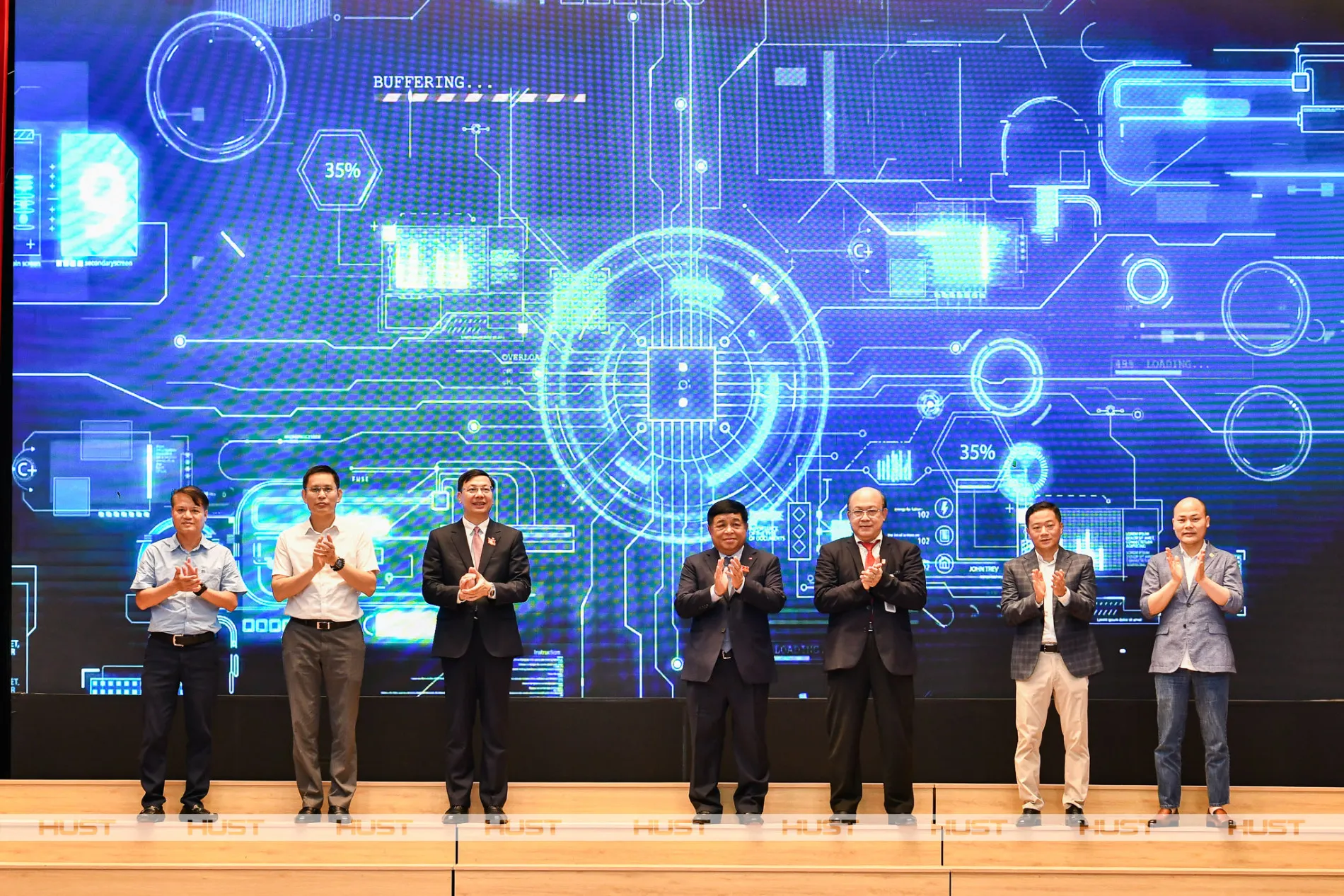
Deputy Prime Minister Nguyen Chi Dung (fourth from right) presides over the launching ceremony of the “AI Vietnam Academy” program. Photo: HUST
Some 1,500 students across Vietnam have joined the opening session of the Global Consumer Intelligence (GCI) program last week, marking a new push to build digital skills among the country’s youth.
Launched by the Japan International Cooperation Agency (JICA) in partnership with the Hanoi University of Science and Technology (HUST) and Tokyo University’s Matsuo-Iwasawa Lab, the project is designed to show how data science can help solve social challenges while encouraging AI-driven entrepreneurship.
In the first lecture, Professor Yutaka Matsuo addressed 300 HUST students, noting the rising expectations for AI in Vietnam. “I truly hope many of you will harness AI to drive positive change in society,” he said.
Adding to these efforts, HUST partnered with US tech giant NVIDIA in August to launch Vietnam’s first AI Academy. The academy expects to train 2,000 students, officials and business leaders in its first year, expanding to 10,000 by its third year.
Participants will gain access to NVIDIA’s advanced technologies while acquiring practical skills to help businesses and localities adopt AI.
In the same month, the Vietnam National University-Hanoi (VNU-Hanoi) teamed up with CT Group in a strategic move to advance semiconductor research and production.
The partnership aims to build local expertise in chip design, manufacturing and commercialization.an urgent priority as Vietnam seeks to reduce dependence on foreign suppliers and safeguard its digital infrastructure.
For Vietnam, mastering semiconductor technology is no longer just an industrial goal but a matter of national security, ensuring autonomy in the era of rapid digital transformation.
The collaboration between VNU-Hanoi and CT Group underscores how academic research and private investment can converge to address strategic challenges.
Companies with their own ecosystem and policy backing
Beyond individual projects, Hanoi is developing an ecosystems where universities provide talent, research institutes generate ideas and corporations bring products to market.
Major players such as FPT Corporation, CMC Corporation and Phenikaa Group have built their own ecosystems to support innovation and market-driven technology development.
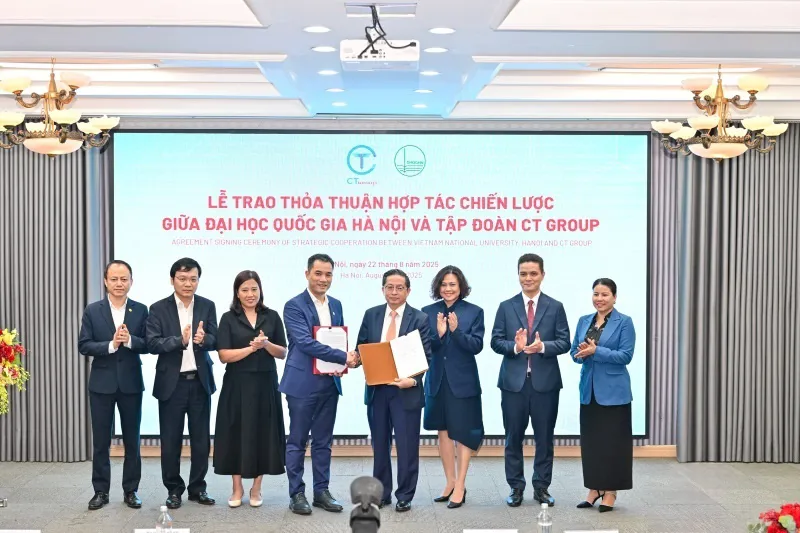
The signing ceremony of strategic cooperation between the VNU-Hanoi and CT Group. Photo courtesy of the university
The model maximizes intellectual resources, creates employment opportunities and nurtures a culture of creativity across sectors.
Business ecosystem enables companies to nurtur talents to fit growing strategies, maximize these individuals' capabilities by sending them to member companies in the ecosystem for training and learning, and give them job opportunities upon their graduation.
At the city level, the Innovation Center at Hoa Lac Hi-Tech Park is emerging as a strategic hub.
Operated under a Special Purpose Vehicle (SPV) model, the center combines public assets, private management and social resources to connect research units, train human resources, support startups and promote “Make-in-Vietnam” products from concept to commercialization.
One of its key missions is to ease infrastructure constraints for small technology firms and startups, particularly in areas such as high-performance computing, data storage and server capacity. These resources are accessible only to large corporations.
These efforts align with national priorities. The Politburo’s Resolution 57-NQ/TW and government strategies on digital transformation, artificial intelligence and semiconductor development provide a strong policy framework, with a target of training 50,000 engineers in these fields and prioritizing 11 strategic technology sectors.
Globally, artificial intelligence alone is projected to add some US$5 trillion to the world economy by 2030. For Vietnam, tapping into this transformation requires coordinated action between government, academia and enterprises.
Hanoi’s three-pillar model of state, universities, and enterprises is beginning to deliver results, from AI training and university spin-offs to city-level innovation centers.
The challenge now is to scale up infrastructure, strengthen human resources and maintain policy agility in the face of rapid technological change.
Hanoi’s strategy is beginning to yield results, from AI training programs and university spin-offs to city-level innovation platforms. The challenge now is to scale up these efforts, modernize infrastructure and maintain policy agility in the face of rapid technological change.
If successful, the capital’s collaborative model could serve as a blueprint for other localities, demonstrating how Vietnam can harness science and technology to drive socio-economic growth while securing its technological future.