VIETNAM CHAMBER OF COMMERCE AND INDUSTRY
Liên Đoàn Thương Mại Và Công Nghiệp Việt Nam
Tue, Apr 28, 2026, 15:11:00
Household businesses strive to maintain operations
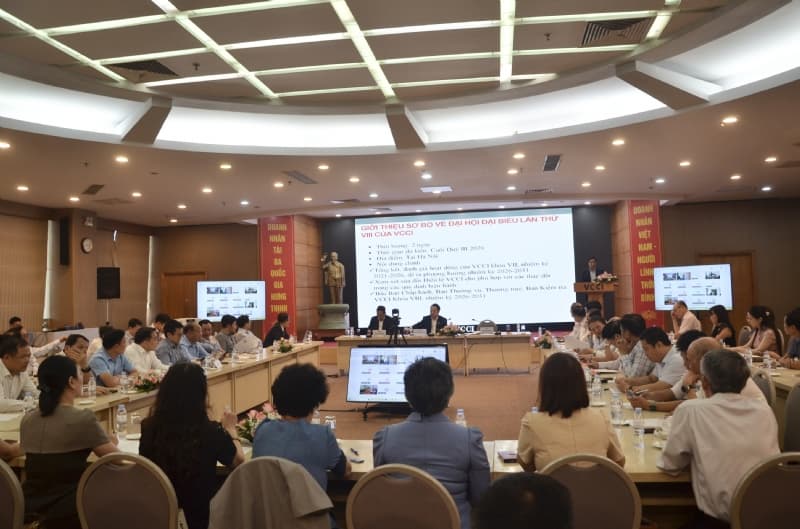
On the morning of April 23 in Hanoi, VCCI held a workshop to announce the survey results on household businesses, in the context that the legal framework on taxation, business registration, and support policies is entering an important transition phase.
Speaking at the workshop, Mr. Dau Anh Tuan – Deputy Secretary General and Head of the Legal Department of VCCI, said that from previous surveys related to the implementation of e-invoices under Decree 123, many practical issues of the household business sector have been revealed. From small-scale traders to high-revenue households, all face confusion when choosing an operating model.
Mr. Tuan cited a remark by Mr. Tran Quoc Khanh – former Deputy Minister of Industry and Trade – last year: “The 5–6 million household businesses not only create 8 million jobs and contribute to GDP, but more importantly, they bring flexibility and dynamism to the economy.”
The survey, conducted by VCCI from February to April 2026 across more than 1,000 household businesses in 34 provinces and cities, shows a less positive picture of the sector’s “health.” Specifically, nearly 74% reported only small profits or no profits. More than 81% experienced revenue declines and 75% saw a reduction in customers; only 1.9% achieved expected profit levels.
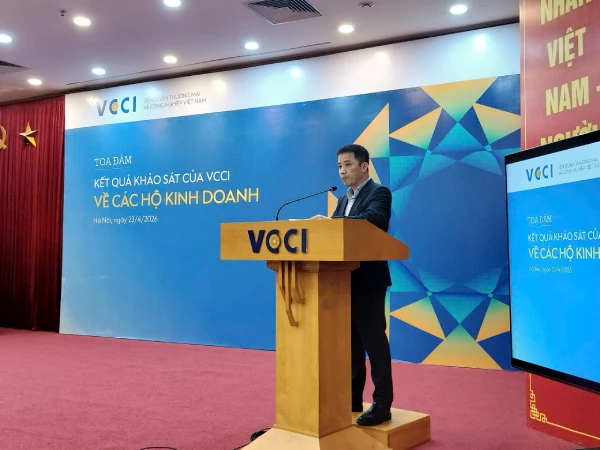 Mr. Dau Anh Tuan – Deputy Secretary General and Head of the Legal Department of VCCI.
According to Mr. Tuan, most household businesses are operating with very thin profit margins, “enough to survive but not enough to accumulate or withstand shocks.” This has led to a defensive mindset, with 60.8% planning to maintain their current scale over the next two years, 33% tending to downsize, and only 1.8% planning to expand.
“The dominant state of the household business sector today is no longer the pursuit of growth but the effort to sustain existence,” Mr. Tuan noted.
Meanwhile, legal difficulties are considered the greatest pressure, with 73.3% of households stating that these issues have a more serious impact than input or market challenges.
Time spent on compliance is also a major factor, with 73% rating its impact as high. According to VCCI, compliance costs are not only financial but also include opportunity costs in terms of time, effort, and psychological pressure.
A notable finding is that the compliance burden does not decrease as household businesses scale up but tends to increase with revenue. When compliance costs and system complexity exceed capacity, the motivation to expand or convert into enterprises declines.
Regarding conversion, the survey shows that only 15.6% of households intend to become enterprises within the next two years. The majority remain hesitant due to concerns about more complex regulations, higher insurance costs, heavier accounting obligations, and increased risks of inspections and audits.
Further elaborating on this issue, Mr. Pham Ngoc Thach – Deputy Head of the Legal Department of VCCI – stated that viewing household businesses as a source to achieve the target of 2–3 million enterprises in the future will face many challenges, as the enterprise model is not yet seen by most households as a natural development path.
 Most household businesses do not want to convert into enterprises.
The survey results also show that the level of policy awareness significantly influences conversion decisions: only 13% of those with limited understanding intend to convert, while the rate rises to 33% among those with a clear understanding of regulations.
In terms of motivation, nearly 40% of households want legal entity status to sign large contracts; about 35% aim to expand scale; nearly 33% seek to benefit from incentives; 31% want better access to capital; and 24% aim to build a brand.
Meanwhile, the biggest barriers remain compliance costs and obligations: 93.4% are concerned about tax procedures; 91.7% about accounting; 91.3% about insurance costs; 91.2% about increased taxes and fees; and 88.9% about more frequent inspections.
Need for more substantive support packages
Based on the survey results, the research team suggests that policies to promote conversion should not be applied broadly but should segment the household business sector, identifying groups with potential for targeted support.
“A more appropriate strategy is to segment the household business sector, correctly identify those with strong growth potential, and then focus on creating sufficiently substantive support packages to turn demand into actual conversion decisions,” Mr. Thach emphasized.
Regarding specific recommendations, the research team proposed five measures. First, simplify regulations on tax, accounting, and e-invoices to better match the actual capacity of household businesses, especially micro-scale, low-skilled, and older groups.
Second, develop low-cost, user-friendly compliance support tools such as simple accounting software and easy-to-understand filing guidelines, while strengthening direct local support instead of expecting household businesses to adapt on their own.
Third, support policies should clearly categorize groups: those fully dependent on household business activities should be prioritized for resilience; micro businesses need support in compliance and basic governance; while larger-scale groups with demand for B2B transactions, contract signing, and capital mobilization should be the focus for conversion into enterprises.
Fourth, conversion policies should focus on reducing actual costs and risks after conversion; otherwise, the willingness to transition into enterprises will remain low.
Finally, it is necessary to reposition household businesses in policy thinking, not only as subjects of management but also as a sector that needs support for sustainable development.