VIETNAM CHAMBER OF COMMERCE AND INDUSTRY
Liên Đoàn Thương Mại Và Công Nghiệp Việt Nam
Wed, Mar 15, 2023, 00:28:00

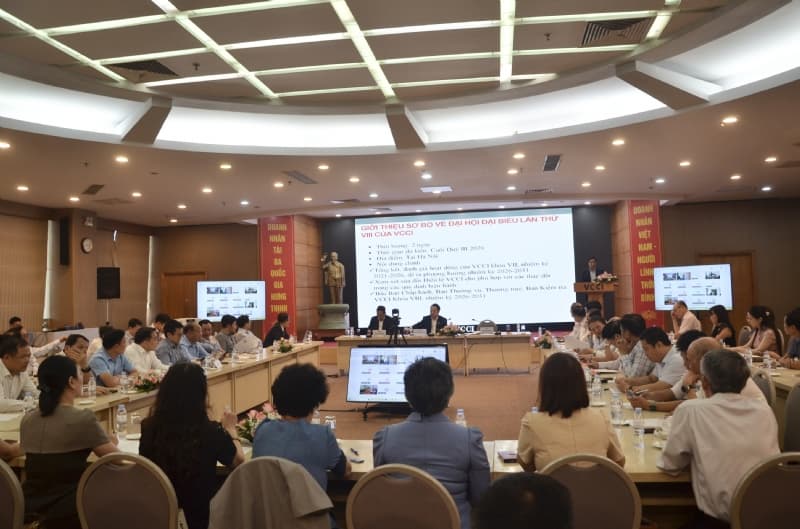
Leaders of 6 provinces in the Southeast region and Long An together with leaders of VCCI and representatives of businesses at the meeting with VCCI Xuan Quy Mao. Photo: Q.Tuan
Speaking at the meeting, Chairman of the Vietnam Chamber of Commerce and Industry (VCCI) Pham Tan Cong affirmed, Resolution No. 24-NQ/TW on the development of the Southeast region and Resolution No. 31 dated December 30, 2022 on the development of Ho Chi Minh City to 2030, with a vision to 2045, will be a great opportunity for provinces and cities in the region to develop rapidly.
Accomplish 3 goals
VCCI Chairman Pham Tan said that since the 7th VCCI National Congress in December 2021, VCCI has had a new vision and operational strategy, associated with the goal of building a strong business community, prosperous country. With a new vision, VCCI is strongly shifting its activities towards serving the development needs of businesses and localities.
In the coming time, VCCI will focus on promoting cooperation activities with provinces and cities to jointly achieve three goals: Promote the development of entrepreneurs, businesses and local business associations; Expand domestic and international trade and investment cooperation; Build a favorable business environment, promote local economic growth, and at the same time, develop in a green and sustainable direction.
Also talking about cooperation opportunities, Chairman of the Ho Chi Minh City People's Committee Phan Van Mai assessed that Resolution 24 and Resolution 31 are the orientations, political bases, and legal bases for the development of the Southeast region. as well as Ho Chi Minh City in accordance with the role of a key economic region. In which, Ho Chi Minh City is the locomotive, the center and the growth pole of the Key Economic Zone.
Especially for Resolution 24, the Central Government has assigned the City to implement important projects such as: Project to build International Exhibition Center; The project to build Ho Chi Minh City into an international financial center; The project to build Ho Chi Minh City into a center connecting technology exchanges with innovation centers across the country; Investment project to build a container transshipment port in Can Gio; Project to form industrial belt, urban area, logistics services along the Ring Road 3, Ring Road 4 of Ho Chi Minh City and highways and Project to develop urban industrial chain Moc Bai - Ho Chi Minh City - Cai Mep….
These projects are the basis for Ho Chi Minh City to perform the leading role connecting provinces in the region for cooperation and development. Thereby, the Southern Key Economic Zone will have the opportunity to break through to become a leading economic center of the country.
More challenges
Entrepreneur Tran Ba Duong - Vice Chairman of VCCI, Chairman of Thaco Group said that developments in transport infrastructure, technical infrastructure, and social infrastructure are means and tools to contribute to economic development. However, economic development must also be competitiveness, both within the region and larger than in international economic integration.
“The economy of a region, or of a province, requires integration and complementarity. In assigning responsibilities to local leaders, as well as to localities in the Southeast region, it is also necessary to create integration and complementarity. In addition, localities need to focus on developing industries at focal levels, industries requiring deep processing, high technology content suitable to the human level and river level of each locality. ", said Mr. Duong.
From the perspective of an expert, Mr. Dau Anh Tuan - Deputy General Secretary, Head of the Legal Department of VCCI assessed that the Southeast region is an area with high development speed and rapid urbanization. Localities in the region contribute nearly 32% of the country's GDP and attract many workers from rural areas, where livelihoods for millions of workers from other areas are settled.
However, the Southeast region is facing major challenges in economic development such as infrastructure, environmental pollution and quality of public administration.
From the above challenges, Mr. Dau Anh Tuan made recommendations to the Southeast provinces, specifically: Thoroughly study and implement action programs to implement Resolution No. 24-NQ/TW; Promote regional integration in a comprehensive way, with the immediate priority being infrastructure development; In addition, more attention should be paid to action plans on green economic development and environmental protection; At the same time, continuing efforts to improve the quality of public administration and create a favorable business environment...
Ms. Tran Tue Hien - Chairman of Binh Phuoc Provincial People's Committee:
Listen to business proposals
Binh Phuoc is urgently coordinating with other provinces to speed up the construction progress and procedures for the construction of expressways connecting with Ho Chi Minh City, with Long Thanh international airport and Cai Mep - Thi Vai deep-water port.
In addition, with a good foundation of 4 (Good infrastructure - Good human resources - Good policies - Good public services), Binh Phuoc determines the target is to meet the needs and satisfy investors when to invest in the province. Provincial leaders always listen to the opinions and suggestions of businesses and then direct professional agencies to focus on solving difficulties and obstacles for businesses, ensuring discipline and discipline for officials and employees in the performance of their official duties and ready to handle violations related to corrupt officials causing troubles for businesses as well as people.
On the basis of the Government's Action Plan and the implementation of Resolution 24 of the Central Government, the province clearly identifies the key task that is to focus on developing strategies and development planning in a correct and synchronous manner, create strength for the system, bring into play its strengths, overcome all difficulties so that Binh Phuoc can develop in accordance with the role and strategic position of the province in the Southeast region, becoming a modern development locality, civilized and sustainable ecology. Currently, the province has built more than 60 projects and plans with orientation in various fields.
Mr. Le Ngoc Khanh - Vice Chairman of Ba Ria - Vung Tau Provincial People's Committee:
Acting as a regional "gateway"
In Resolution 24, the Politburo identified five groups of goals to develop Ba Ria - Vung Tau province into a national marine economic center, including industry, seaports and tourism; continue to develop and modernize the international "gateway" port of Cai Mep - Thi Vai into a large international transshipment port of Asia and international stature; Developing Vung Tau city into a world-class high-quality tourism center.
As a basis for implementing the Resolution, and at the same time creating favorable conditions for enterprises to develop production and business in the province, the province is focusing on implementing inter-regional transport infrastructure projects to ensure the required schedule. Bridges such as: Bien Hoa - Vung Tau Expressway, Phuoc An Bridge, Ring Road 4 of Ho Chi Minh City passing through the province, coastal road of Vung Tau - Binh Thuan, essential technical infrastructure projects of Con Island...
These are very urgent projects in the immediate and long-term, creating new motivations, forming new economic development spaces to promote growth, create a foundation for sustainable development, and at the same time maximize the advantages and potentials of the province, so that Ba Ria-Vung Tau can confidently and firmly become a growth pole of the whole country in the spirit of Resolution 24 of the Politburo.
Mr. Dang Hong Anh - Chairman of Vietnam Young Entrepreneurs Association:
Local leaders meet with banks
The issue has never ceased to be hot, especially in the current period. Although, in order to solve the credit bottleneck for the real estate sector, recently, the State Bank of Vietnam had a meeting to listen to the opinions of real estate businesses.
We propose to organize meetings with local bank leaders to get specific and clear information about the criteria and limits for each field. For real estate, there should be clear criteria for businesses to look at their projects to assess whether those criteria are appropriate. When there is clear and specific information from the bank, a better approach will partly solve the difficulties for current capital.
Since then, leaders of Ho Chi Minh City as well as localities invited leaders of banks to meet to discuss specific policies. Thereby, leaders of banks will also provide information from a decision-making angle at the bank. At the same time, for the development of local banks, banks will also help local businesses better.
In addition, we suggest that Ho Chi Minh City and VCCI need to organize free training courses on digital transformation for businesses, in order to encourage small and medium enterprises to understand the basics of digital transformation to apply to businesses.
Mr. Le Ngoc Lam – General Director of BIDV
Ensure market liquidity stability
Vietnam has external influences, as well as domestic influences, which are often slower than other economies in the world. The impact from rising interest rates and slower inflation, therefore, the operation of banks in 2022 is still effective. However, in 2023, there will be certain challenges because the difficulties of the economy will begin to manifest. In particular, in the last 2 months of 2022, deposit interest rates have started to increase, leading to an increase in lending rates.
As a large financial institution, we will work with the SBV to ensure the stability of market liquidity to control input interest rates, in order to control output interest rates. In the past time, big banks have also tried not to increase input interest rates.
Regarding the real estate sector, recently, BIDV also met and worked with 15 large enterprises in the field of real estate, after that, the Governor of the State Bank also held a meeting and worked with 20 enterprises in this field.
In order for the bank to be able to support businesses, we suggest that local leaders need to pay attention to support businesses and investors to soon complete legal procedures, to complete the loan procedures at the bank. As for the bank, we are committed to working with each investor to hear about the difficulties and obstacles so that the two sides can have companionship, share and find a common voice.