VIETNAM CHAMBER OF COMMERCE AND INDUSTRY
Liên Đoàn Thương Mại Và Công Nghiệp Việt Nam
Thu, Oct 01, 2026, 14:49:00
From “Made in Vietnam” to Increasing Vietnamese Value
Speaking at the seminar “US Market 2026: Opportunities, Challenges and Breakthrough Solutions for Vietnamese Enterprises”, organised by the Vietnam Chamber of Commerce and Industry (VCCI) on the morning of September 25, Mr. Tran Thanh Hai, Deputy Director General of the Import-Export Department under the Ministry of Industry and Trade, said that Vietnam–US economic relations have undergone a development journey marked by many important milestones.
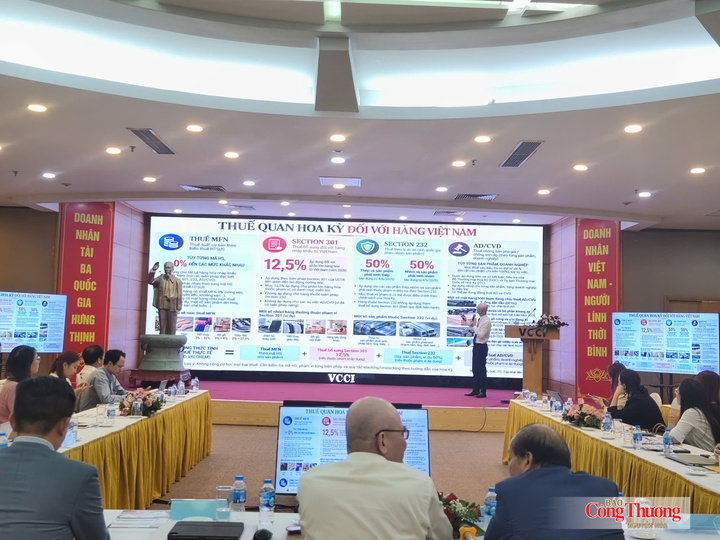
Mr. Tran Thanh Hai delivers a presentation at the seminar “US Market 2026: Opportunities, Challenges and Breakthrough Solutions for Vietnamese Enterprises”.
According to Mr. Tran Thanh Hai, in 1995, Vietnam and the United States normalised diplomatic relations. In 2000, the Vietnam–US Bilateral Trade Agreement was signed, laying the foundation for strong growth in trade between the two countries. In 2007, Vietnam joined the World Trade Organization (WTO); in 2013, the two countries established a Comprehensive Partnership, which was upgraded to a Comprehensive Strategic Partnership in 2023.
Alongside the development of bilateral relations, Vietnam–US trade has grown rapidly in both scale and level of integration. Two-way trade increased from approximately US$450 million in 1995 to US$209.5 billion in 2025, equivalent to an increase of around 465 times over 30 years. The average annual growth rate reached nearly 17%.
The United States is currently Vietnam’s largest export market, while Vietnam is increasingly playing a significant role in the United States’ trade relations within ASEAN. However, according to the Deputy Director General of the Import-Export Department, economic relations between the two countries are no longer limited to Vietnamese goods being sold to the United States, but are increasingly expanding into investment, technology and supply chains.
The structure of goods traded between the two sides also demonstrates a relatively clear degree of complementarity. Vietnam exports various groups of products to the United States, including electronics, machinery, textiles and garments, footwear, wooden products, agricultural products and seafood. In the opposite direction, Vietnam imports machinery, technology, raw materials, agricultural products and various inputs for production from the United States.
One issue particularly emphasised by Mr. Tran Thanh Hai is the need to shift from “Made in Vietnam” to “Made with Vietnam Value”. Accordingly, the objective is not merely to manufacture goods in Vietnam, but also to increase the technological, knowledge and innovation content of products.
This transformation is associated with a shift from processing and assembly towards technology, research and development, while also increasing Vietnam’s presence in higher-value sectors such as semiconductors, artificial intelligence, green energy, the digital economy, logistics and innovation.
According to Mr. Tran Thanh Hai, Vietnam has a number of advantages, including its location in Southeast Asia, its ability to connect with international trade routes, its increasingly expanding production capacity, its network of free trade agreements, and its connectivity with the ASEAN market. However, to capitalise on these opportunities, Vietnam still needs to increase localisation rates, develop high-quality human resources, strengthen the capacity of domestic enterprises, and better meet requirements for sustainable development.
For enterprises, opportunities in the US market in the coming period will not lie solely in selling larger volumes, but also in shifting from quantity to value. Potential product groups include electronics, machinery and equipment, wooden products, textiles and garments, footwear, food, agricultural products and green products. The common requirement is that enterprises must improve quality, increase technological content, better meet sustainable development requirements, and thereby enhance the added value of Vietnamese products in the US market.
Conversely, increased imports from the United States could also support the upgrading of Vietnam’s production capacity. Vietnam could import more machinery, equipment, digital technologies, semiconductors, aviation equipment, energy, raw materials and agricultural products from the United States.
US-sourced raw materials and technologies, when incorporated into production in Vietnam, would create further conditions for enterprises to increase added value, develop industry, promote the green transition, and produce products of higher quality and value.
In addition to traditional trade, there is also significant room for cooperation between the two countries in emerging areas such as semiconductors, digital products and artificial intelligence (AI), green energy, aviation, logistics, automated manufacturing, agriculture and food, education and healthcare.
Proactively Adapting to Expand Export Opportunities
Alongside the significant opportunities, Mr. Tran Thanh Hai noted that Vietnamese enterprises are operating in a new trading environment with increasingly stringent requirements.
US trade policy is increasingly linked to factors such as reciprocal trade, trade balance, economic security, the promotion of domestic production and supply chain security. In 2025, Vietnam and the United States entered a new framework for negotiations on reciprocal trade, towards a fairer and more balanced trade relationship.
In this context, the challenges facing Vietnamese enterprises do not lie solely in tariffs. One important issue is rules of origin. Increasingly stringent requirements mean that enterprises must maintain complete records and documentation and be able to demonstrate the origin of goods. This can no longer be treated as a matter to be addressed only at the time of export, but must be controlled from the sourcing of raw materials throughout the entire production process.
Enterprises must also pay attention to the risk of trade remedy measures, such as anti-dumping, countervailing and safeguard measures. At the same time, requirements to prevent illegal transshipment and origin fraud are becoming increasingly important.
Another challenge comes from increasingly stringent standards, ranging from technical standards and food safety to environmental, labour and sustainable development requirements. The traceability of supply chains has also become an important requirement.
This means that enterprises not only need to know where the final product is manufactured, but must also be able to control where the raw materials come from, how production processes are carried out, and whether they have sufficient capacity to demonstrate the transparency of their supply chains.
As the United States places greater emphasis on trade balance, increasing imports from the United States presents both new requirements and additional opportunities for Vietnam to access machinery, technology, raw materials and energy for production.
In light of these changes, Vietnamese enterprises need to take a more proactive approach to adapting to the US market. First and foremost, enterprises must clearly understand relevant policies, particularly regulations on tariffs, technical barriers, rules of origin, trade remedies and anti-transshipment measures.
At the same time, origin control must become a comprehensive requirement throughout the entire process. Documentation must be complete and transparent, and enterprises must be able to explain the origin of their goods and effectively control their sources of raw materials.
Supply chain transparency is also becoming increasingly important. Enterprises need to manage suppliers, production, transportation and related processes, while diversifying sources of raw materials to strengthen their ability to respond proactively.
Environmental, social and governance (ESG) requirements also need to receive greater attention from enterprises. At the same time, enterprises should build Vietnamese brands based on quality, credibility, differentiation and product value; invest in technology and automation; and strengthen production capacity. Proactively seeking US partners is also considered an essential direction for enterprises seeking to participate more deeply in supply chains.