VIETNAM CHAMBER OF COMMERCE AND INDUSTRY
Liên Đoàn Thương Mại Và Công Nghiệp Việt Nam
Thu, Oct 01, 2026, 14:24:00
Recommendations to Prioritise Resources for Effective Post-Inspection
Completing the legal framework on food safety to protect consumer health, enhance the competitiveness of Vietnamese goods, and meet the requirements of international integration is a policy priority of the Government and has attracted considerable attention from the business community.
At the seminar “Comments on the Draft Amended Food Safety Law” held in Hanoi on the afternoon of September 4, Mr. Dau Anh Tuan, Deputy Secretary-General of VCCI, said that this is a law with a very broad scope of impact, directly relating to the daily meals of more than 100 million people and the livelihoods of millions of business households, cooperatives and enterprises, ranging from farmers and fishing vessel owners to export processing plants and e-commerce platforms.
The business community has expressed strong support for the direction of reform this time, particularly the shift in the focus of management towards post-inspection, granting enterprises greater autonomy alongside corresponding responsibilities, and concentrating state resources on high-risk groups. This is also a common management trend around the world.
One of the issues of concern to VCCI and industry associations is the lack of consistency between risk classification and the level of procedures set out in the draft. Article 43 classifies food into two risk groups, while Article 46 establishes a three-tier procedural framework. According to VCCI, this approach may result in management resources not being focused on the areas where they are most needed.
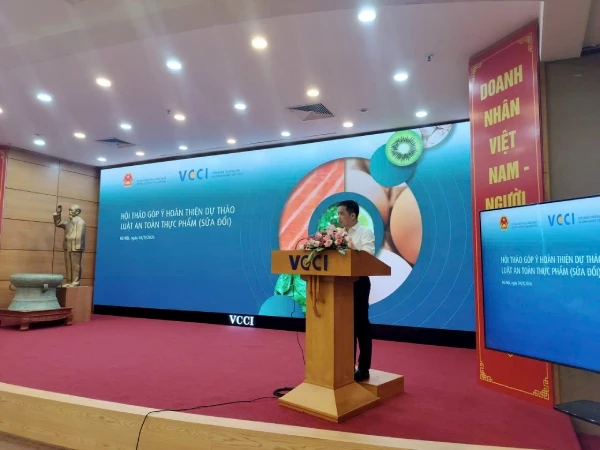
Mr. Dau Anh Tuan, Deputy Secretary-General of VCCI.
Meanwhile, the 2023 FAO guidelines on risk classification and the Law on Product and Goods Quality both divide risks into three levels: high, medium and low. Therefore, VCCI proposes standardising the classification and terminology, while clarifying the criteria set out in Clause 2, Article 46. Concepts such as “products with health-related recommendations”, “use by vulnerable groups” and “effects of maintaining or enhancing bodily functions” currently have broad scopes of interpretation, which may lead to different understandings between enterprises and agencies receiving applications.
VCCI assesses that requirements such as scientific evidence demonstrating product efficacy, product development research reports, and stability study results may be appropriate for health supplements and other specific product groups. However, if these requirements are applied generally to ordinary food products, particularly traditional products made by craft villages and small enterprises, their feasibility should be carefully considered.
At the same time, the draft needs to clarify whether enterprises may put products into circulation immediately after submitting their dossiers or whether they must wait for the competent authorities to receive and publish them. This is a decisive factor in determining the nature of the product standard declaration mechanism.
A representative of the Vietnam Dairy Association (VDA) expressed concern that the new regulations could create bottlenecks in pre-inspection. According to the Association, the current mechanism requires self-declaration dossiers to include two types of documents and registration dossiers to include four types, with processing times ranging from 0 to 7 days. Although the current mechanism still has limitations, such as focusing mainly on safety indicators without fully controlling quality indicators and lacking clear post-inspection regulations, it nevertheless enables enterprises to bring products to market quickly.
Meanwhile, the draft increases the number of documents required in a dossier to 14, equivalent to 3.5–7 times the current number. Some requirements, such as scientific evidence demonstrating product efficacy, product development research reports, and stability study results, may be very difficult to meet for ordinary food products. Processing times would also increase to 15 days for self-declaration and 90 days for registration. VDA warned that this could leave many traditional products unable to complete the required dossiers and even face the risk of having to cease operations.
VDA proposed that, instead of continuing to increase pre-inspection requirements, regulatory authorities should prioritise resources for effective post-inspection. Dossiers could be supplemented with requirements for quality testing to control counterfeit and substandard goods, as well as letters of authorisation to strengthen the ability to manage products throughout the supply chain.
Risk-Based Management to Avoid Bottlenecks
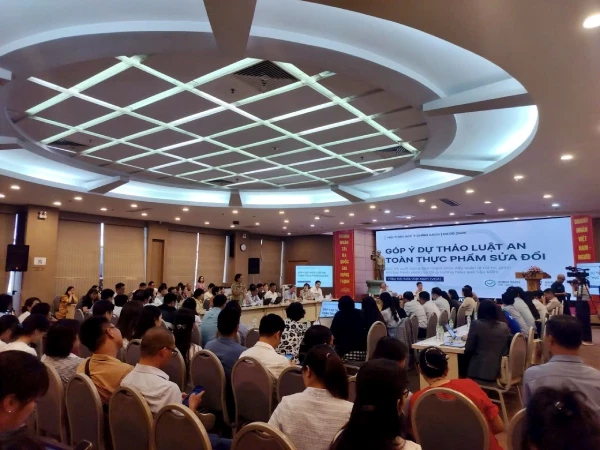
Large numbers of enterprises and business associations attended and spoke at the event.
For imported and exported food products, enterprises proposed that the draft adjust the control mechanism towards a risk-based approach that takes compliance history into account.
For imported goods, VCCI believes that requiring a notification confirming compliance for each consignment, even when reduced inspection is applied, could increase administrative procedures and the risk of congestion at border gates, particularly for fresh products. VCCI proposed considering exemptions from inspection for imported raw materials, additives and processing aids intended for internal use and not for direct circulation. Under the reduced inspection mechanism, only documentary checks should be required for establishments certified under GMP, HACCP, ISO 22000 or equivalent systems.
For exported goods, enterprises proposed clear regulations for cases where residues of substances are detected for which Vietnam has not established specific thresholds, in order to avoid situations where regulatory authorities, enterprises and testing laboratories lack a common basis for reaching conclusions. According to enterprises, establishing default thresholds would not mean lowering safety standards, but rather creating a consistent, transparent and scientific basis for assessment.
In addition, as exported products are manufactured for consumption in foreign markets, priority should be given to meeting the requirements of the importing market. VCCI proposed that this principle be stipulated consistently with the law on product and goods quality. At the same time, a risk- and compliance-history-based approach should also be applied to the inspection and certification of export consignments, rather than conducting blanket inspections.
According to Mr. Nguyen Nhu Tiep, an expert and representative of Minh Phu Seafood Group Joint Stock Company, the draft clearly demonstrates a shift towards risk-based management, but the criteria and procedures for classification need to be clearly defined. It should not simply list certain product groups as high-risk; instead, a specific set of assessment criteria is needed.
“The Ministry of Health has established a Risk Assessment Centre at the National Institute for Food Control. Based on risk assessments, it is possible to decide whether to classify risks into two or three levels. The number of levels is not the core issue; what matters is that the management approach is genuinely based on data and risk,” Mr. Tiep said.
In particular, Mr. Tiep said that the current “standard declaration” procedure is overly complicated and not significantly different from the product declaration registration process. Therefore, digital transformation should be leveraged to enable enterprises to self-declare their products and product standards through a single information portal and shared data platform. Regulatory authorities could use this data for risk analysis and post-inspection, rather than creating additional administrative procedures.
From the perspective of regulatory authorities, Mr. Nguyen Phuong Tuan, Deputy Chairman of the National Assembly Committee on Science, Technology and Environment, said that the draft Law uses two different terms, “hazard” and “risk”, and that their usage should be standardised.
Regarding pre-inspection and post-inspection, according to the Deputy Chairman of the National Assembly Committee on Science, Technology and Environment, this is a very difficult issue to decide immediately.
“I have heard many opinions suggesting that pre-inspection should be limited and shifted towards post-inspection. But the question is: at which stage should this shift to post-inspection take place? It is not possible to shift everything to post-inspection. For issues directly related to human health, if post-inspection is conducted only after people have consumed the products, it will already be too late.
Prevention is still better than remediation. Therefore, I propose that the drafting agency clarify which stages require pre-inspection and which areas should focus on post-inspection. We should not shift to post-inspection simply on the grounds that extensive pre-inspection could affect enterprises,” Mr. Nguyen Phuong Tuan said.