VIETNAM CHAMBER OF COMMERCE AND INDUSTRY
Liên Đoàn Thương Mại Và Công Nghiệp Việt Nam
Mon, May 04, 2026, 17:03:00
Household Business Landscape Shows Concerning Signs
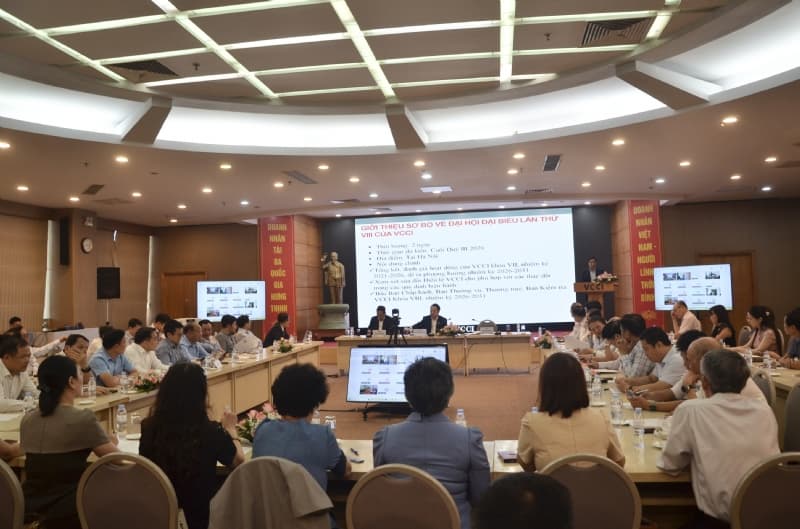
VCCI has recently published its survey report on household businesses. As of the end of 2025, Vietnam had approximately 6.1 million household businesses, generating jobs for nearly 10 million workers and contributing over VND 32.8 trillion to the state budget.
 The household business landscape shows many worrying signs.
The sector’s structure indicates a strong dependence on consumer markets. About 90.1% of household businesses operate in retail, 5.3% in food services, and 72% of their customers are individuals. This positions household businesses as the “frontline” of the economy, directly reflecting the health of consumer demand.
However, the current picture reveals serious concerns. Citing survey data, Mr. Dau Anh Tuan, Head of the Legal Department at VCCI, stated that the business outlook for household businesses in 2025 is rather bleak: 73.7% reported only “low profits,” more than 81% experienced revenue declines, and 75% saw a drop in customer numbers.
Notably, only 1.9% of surveyed households achieved their expected profit levels. According to Mr. Tuan, such profit margins are just enough to sustain operations, making it difficult to accumulate reserves or build resilience against future shocks.
In this context, the transition from household businesses to formal enterprises remains limited. Only 15.6% of respondents indicated plans to convert within the next two years, while 84.4% have no such intention.
The main reasons include concerns over complex tax procedures (93.4%), accounting difficulties (91.7%), rising insurance and financial obligations, and increased risks of inspections and audits.
Regarding taxation, Ms. Le Thi Duyen Hai, Vice President and General Secretary of the Vietnam Tax Consultants’ Association, noted that many household businesses still fail to clearly separate business expenses from personal spending. This leads to inaccurate financial assessments, especially when transitioning to more formal management models.
According to her, the issue is not tax avoidance, but rather the need for a simple, transparent, and easy-to-apply compliance framework particularly regarding penalty regulations. Many households remain concerned that even minor errors could lead to penalties.
She also acknowledged positive improvements, as communication and support systems for tax policies have significantly improved. Household businesses can now access information through multiple channels, including tax authorities, tax agents, and online platforms, with increasingly clear and consistent guidance.
Notably, even as revenues grow, the motivation to transition does not significantly improve, suggesting a “motivation gap” where businesses are large enough to fear change but not large enough to be compelled to formalize.
Experts also warn of potential market distortions if incentive policies are not properly designed. “If incentives for household businesses are too generous, small enterprises may revert to the household model to reduce costs,” one expert noted. A dedicated legal framework for household businesses is therefore necessary to ensure appropriate tax and management policies.
Tax Policy Should Shift Toward Reducing Costs
Based on survey findings, VCCI warns that without appropriate policy adjustments, the household business sector may fall into a stagnation cycle: unable to scale up, formalize, or accumulate resources to enhance competitiveness.
 Tax policy for household businesses should shift toward reducing costs.
VCCI recommends prioritizing reforms that simplify regulations, particularly in taxation, accounting, and e-invoicing, to improve ease of compliance. It also calls for the development of low-cost, user-friendly support tools, along with tiered policy approaches targeting groups with higher growth potential.
From an economic perspective, Dr. Le Duy Binh, Director of Economica Vietnam, emphasized that facilitating compliance would help reduce pressure while preserving the sector’s flexibility.
He proposed that household businesses essentially individual economic actors should be subject to personal income tax based on actual profits rather than revenue. “Some businesses generate billions in revenue but only earn modest profits, yet they are taxed similarly to high-margin sectors. That is unreasonable,” he said.
Regarding business conversion policies, VCCI stressed the need to focus on reducing actual costs and risks in the early stages rather than promoting mass transitions. Establishing a gradual compliance roadmap, along with financial and administrative support, will be key to encouraging more sustainable formalization.
In the long term, strengthening the resilience of household businesses is not only an economic priority but also a social one, contributing to the stability of livelihoods and the foundation of the private sector.
VCCI also emphasized the need to reposition household businesses as a core pillar of local economies, and to design policies that support their sustainable development.