VIETNAM CHAMBER OF COMMERCE AND INDUSTRY
Liên Đoàn Thương Mại Và Công Nghiệp Việt Nam
Wed, Apr 15, 2026, 15:10:00
Continuing the agenda of the First Session of the 16th National Assembly, at the meeting on April 9, delegates discussed in groups the Draft Law on Civil Status (amended); the Draft Law amending and supplementing a number of articles of the Law on Notarization; the Draft Law amending and supplementing a number of articles of the Law on Legal Aid; and the Draft Law on Access to Information (amended).
 Many opinions from delegates in Group 1 contributed to the Draft Law amending and supplementing a number of articles of the Law on Legal Aid.
Speaking at Group 1, the Hanoi National Assembly delegation, delegate Le Nhat Thanh stated that the Law on Legal Aid is an essential legal “support pillar” for ethnic minorities, especially those living in areas with particularly difficult socio-economic conditions.
According to the delegate, this is a humane policy of the Party and the State, aimed at ensuring human rights and citizens’ rights in accessing justice and equality before the law for the poor, ethnic minorities, and other policy beneficiaries. At the same time, it fully institutionalizes the Party’s guidelines and viewpoints as clearly stated in Resolution No. 66-NQ/TW dated April 30, 2025 of the Politburo on reforming law-making and law enforcement to meet the requirements of national development in the new era.
According to delegate Le Nhat Thanh, the development and promulgation of the amended Law on Legal Aid aim to further institutionalize the Party’s guidelines and the State’s policies and laws on legal aid in the current period; to overcome certain limitations and shortcomings of the 2017 Law on Legal Aid; to apply science and technology; and to meet the requirements of judicial reform, administrative reform, and the implementation of a two-tier local government model.
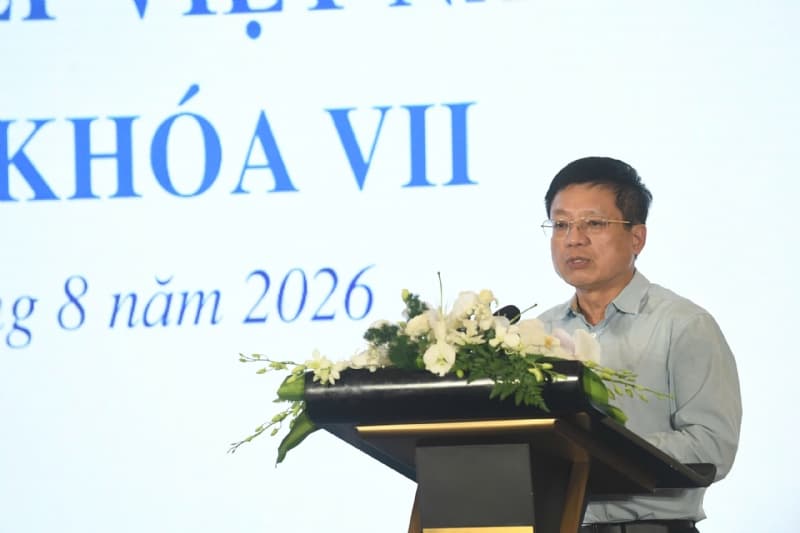
 Ho Sy Hung, President of the Vietnam Chamber of Commerce and Industry and a delegate of the Hanoi National Assembly delegation, gives comments on the draft law at Group 1.
Contributing to the Draft Law regarding beneficiaries of legal aid as stipulated in Clause 1, Article 1 of the Draft Law (amending Article 7 of the current Law), delegate Le Nhat Thanh proposed considering the expansion of legal aid beneficiaries to include ethnic minorities living in disadvantaged communes.
According to the delegate, this group still faces many barriers such as language, limited educational levels, fragmented terrain, and difficult socio-economic conditions.
“In the context of uneven educational levels and limited financial capacity, adding this group is not only a solution to protect the legitimate rights of citizens, but also an essential governance tool to narrow the gap in access to justice and ensure the substantive effectiveness of ethnic policies in the new context,” the delegate stated.
He also proposed revising the policy as follows: “6. Ethnic minorities residing in areas with difficult and especially difficult socio-economic conditions; ethnic minorities with very small populations.”
Regarding this draft law, at the session, Vietnam Chamber of Commerce and Industry President Ho Sy Hung, a delegate of the Hanoi National Assembly delegation, stated that the report clearly indicates that legal aid for vulnerable groups is typically implemented through both state and social mechanisms. Currently, Vietnam is applying a mixed legal aid model, including a system of social delegation as mentioned in this Law.
Although this is clearly stated in the report, the Draft Law (amended) has not emphasized this issue. In particular, it does not clarify forms of paid delegation to social actors or regulations requiring practicing lawyers in the market to allocate a certain proportion to legal aid activities.
Therefore, Ho Sy Hung suggested that this issue should be further reviewed and more strongly emphasized.
In addition to the above, according to the delegate, the Draft Law (amended) also assigns supervision of legal aid activities to the Vietnam Fatherland Front and its affiliated organizations. However, this issue needs to be reconsidered in terms of feasibility, as these organizations are not directly involved in legal aid activities and are not the entities that directly receive information.
Outline
The draft law consists of 3 articles:
Article 1: Amendments and supplements to a number of articles of the 2017 Law on Legal Aid (amending and supplementing 21 articles, abolishing 3 articles);
Article 2: Transitional provisions;
Article 3: Implementation provisions.
The Draft Law amending and supplementing a number of articles of the Law on Legal Aid has revised and improved provisions on beneficiaries of legal aid. Accordingly, it removes the condition of “having financial difficulties” for the following groups: biological parents, spouses, and children of martyrs and those who raised martyrs when they were young; victims of Agent Orange; and persons with disabilities, as these are groups with specific personal circumstances or affected in terms of physical and mental health.
The draft law consists of 3 articles:
Article 1: Amendments and supplements to a number of articles of the 2017 Law on Legal Aid (amending and supplementing 21 articles, abolishing 3 articles);
Article 2: Transitional provisions;
Article 3: Implementation provisions.
The Draft Law amending and supplementing a number of articles of the Law on Legal Aid has revised and improved provisions on beneficiaries of legal aid.