VIETNAM CHAMBER OF COMMERCE AND INDUSTRY
Liên Đoàn Thương Mại Và Công Nghiệp Việt Nam
Wed, Apr 15, 2026, 15:18:00
Continuing the agenda of the 1st Session of the 16th National Assembly, on the morning of April 10, National Assembly deputies held group discussions on socio-economic development and several draft resolutions, including: the Draft Resolution on coordination mechanisms and special policies to improve the efficiency of preventing and resolving international investment disputes; the Draft Resolution on environmental protection tax, value-added tax, and excise tax on gasoline, oil, and aviation fuel; and the Draft Law amending and supplementing a number of articles of the Law on Vietnamese Representative Missions Abroad.
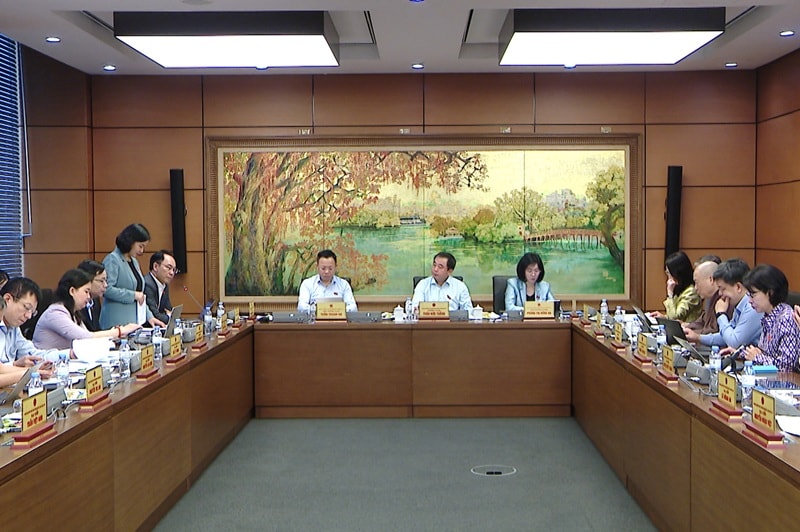 Delegates of the Hanoi National Assembly delegation discussing in Group 1 during the morning session on April 10.
Speaking at the session, Mr. Hồ Sỹ Hùng noted that input costs have increased significantly. For example, the textile and garment industry has seen increases of 15% to 20% due to rising polyester prices, while construction and building materials industries have experienced increases of around 33% to 35%. This situation poses risks, as investors and contractors are becoming hesitant to take on projects due to the inability to predict costs.
In addition, transportation and logistics have been disrupted, with delivery times significantly extended. Many goods related to petroleum have experienced bottlenecks.
“Previously, delivery times ranged from 5 to 10 days, but now they have been extended by an additional 14 to 20 days, leading to a clear increase in costs. At the same time, output markets have weakened, as businesses and markets elsewhere are also cautious, resulting in a sharp decline in exports, particularly to the Middle East, by more than 50%.
According to VCCI’s report, businesses are currently facing three simultaneous pressures: rising input costs, weakening demand, and prolonged logistics timelines. In addition to boosting public investment and domestic consumption, ensuring stable business development will be crucial to achieving growth targets for 2026,” Mr. Hùng stated.
He also emphasized that the National Assembly’s resolution on taxes related to fuel must clearly define its objectives, including supporting both citizens and businesses using petroleum products, helping them overcome current difficulties, especially those heavily affected by fuel-related costs.
“I strongly support the early issuance of this resolution. However, in the process of implementation, there must be mechanisms to ensure that fuel prices in the market do not fluctuate too abruptly or erratically.
In cases where prices fall to levels that allow for balance and stabilization, there should be a strategy to replenish the stabilization fund to prepare for future fluctuations.
Currently, the fund has been depleted. If the Government is authorized by the National Assembly to manage this, it must clearly define the objectives whether to support citizens, businesses, or stabilize markets,” he proposed.
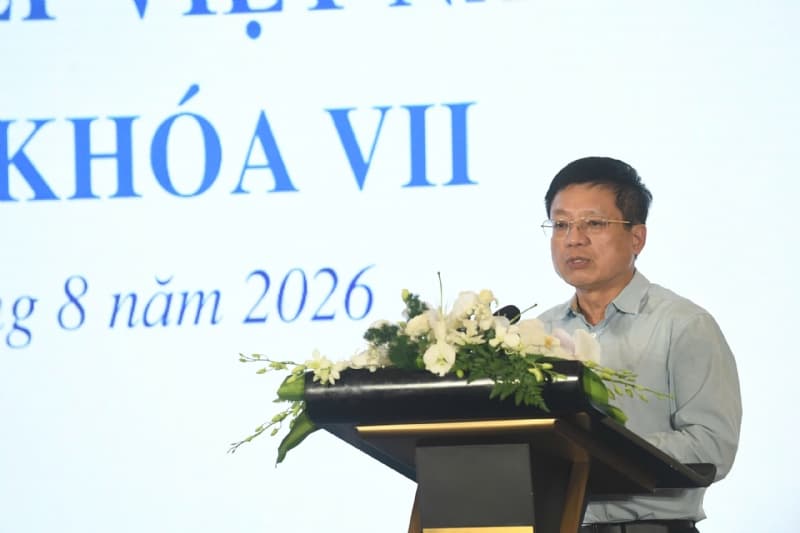
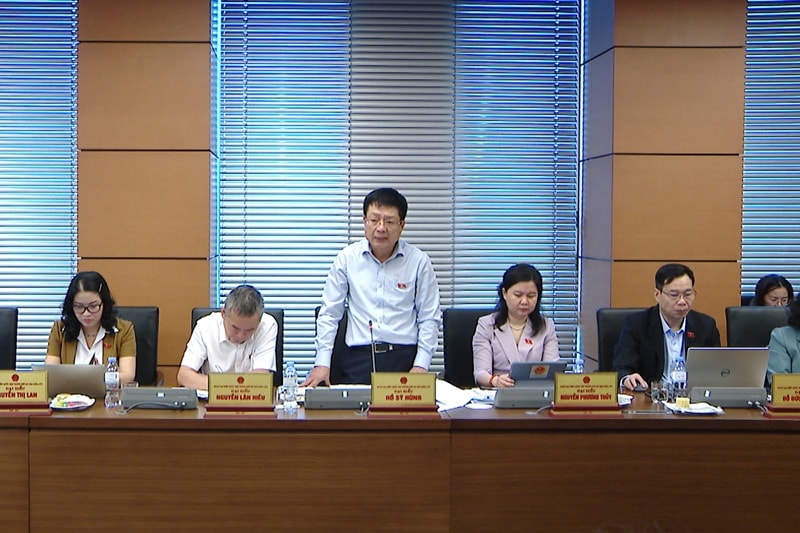 President of VCCI Hồ Sỹ Hùng speaking at the discussion session on April 10.
Regarding the issue of resolving international investment disputes, Mr. Hồ Sỹ Hùng expressed his view that establishing a dedicated center for prevention and settlement of such disputes is unnecessary.
He explained that matters related to international investment dispute resolution are governed by both domestic specialized laws and international legal frameworks. As a result, officials or lawyers cannot fully cover all aspects without specialization.
In practice, Vietnam still has to hire international lawyers for such cases, leading to two main barriers: language proficiency and the complexity of legal updates across jurisdictions.
“Therefore, both prevention and resolution should rely on specialized professionals. If the complexity exceeds domestic capacity, international legal experts will still be required.
In reality, no case proceeds without lawyers. Hence, instead of establishing a new center, resources should be focused on developing specialized legal expertise and socialized legal services, allowing external lawyers to participate when needed. This would be more cost-effective than maintaining such a center,” he added.
On socio-economic development, Mr. Hồ Sỹ Hùng also raised several key points. First, total factor productivity (TFP) for the 2021–2026 period is projected at around 47%, within the “moderate” range of 40–50%, indicating significant room for improvement. Achieving a level of 55% would be considered advanced and more efficient, thus setting a more ambitious target for the 2026–2030 period.
Second, public debt during 2021–2026 stands at 34.4% of GDP, well below the National Assembly’s ceiling of 60%. While this indicates a high level of safety, it also suggests unused capacity. From an efficiency perspective, a typical investment structure of 70% borrowed capital and 30% equity is considered optimal, meaning there is still room to leverage external financing for growth.
He also pointed out that although the Government has outlined 92 major tasks with tight timelines, more specific actions are needed. For example, the energy market and infrastructure are currently pressing issues, especially in the upcoming months.
However, bringing a power plant into operation takes considerable time, and Vietnam still relies heavily on foreign investors, leading to challenges in negotiating electricity prices and guarantees.
Therefore, he proposed creating conditions for domestic private enterprises to participate under similar frameworks as foreign investors. If this is achieved, private sector investment could increase significantly, given that electricity demand and pricing are already relatively secured.
Additionally, commenting on the amended Law on Vietnamese Representative Missions Abroad, Mr. Hồ Sỹ Hùng welcomed the Government’s inclusion of functions related to trade promotion, business support, and information provision.
“This is a fundamental shift, directly targeting businesses in external affairs activities,” he noted.
He also suggested clarifying consular protection for Vietnamese legal entities, emphasizing that the definition of “legal entity” may differ between domestic and international contexts, and proposing to explicitly refer to “Vietnamese enterprises.”
“From these expanded functions, I recommend that organizational structures and staffing should include a dedicated focus on businesses. While general references to economic sectors are not incorrect, they do not directly target enterprises.
Businesses are legal entities representing both current and future economic interests. Therefore, representative missions abroad should maintain coordinated relationships with domestic and international business associations to better support enterprises,” he concluded.