VIETNAM CHAMBER OF COMMERCE AND INDUSTRY
Liên Đoàn Thương Mại Và Công Nghiệp Việt Nam
Thu, Sep 03, 2026, 14:02:00
Continuing the agenda of the First Extraordinary Session of the 16th National Assembly, at the group discussion on the afternoon of August 4, delegates continued deliberations on the following: the draft amended Law on Petroleum; the draft Law amending and supplementing a number of articles of the Law on State Compensation Liability; and the draft National Assembly Resolution on specific mechanisms and policies for handling legal violations related to the State economy and private sector, as well as the application of science and technology, innovation and digital transformation.
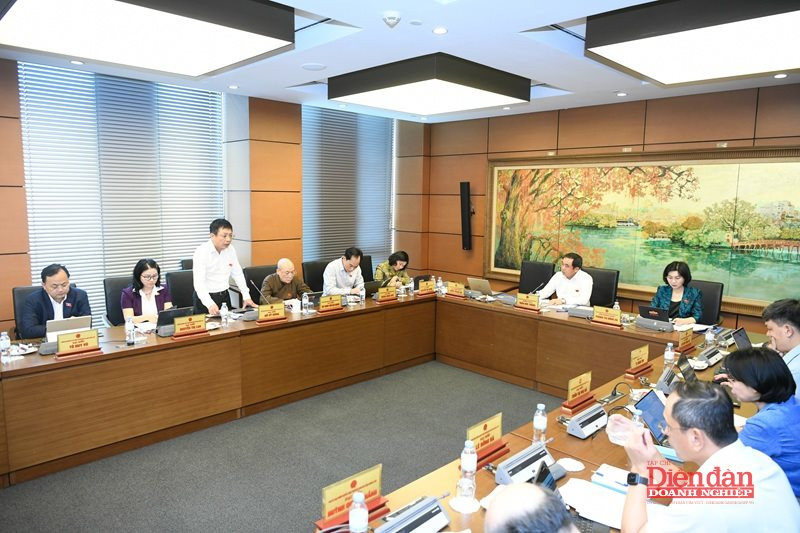
Delegates of the Hanoi National Assembly Delegation participate in the group discussion at the afternoon session on August 4.
Commenting on the draft National Assembly Resolution on specific mechanisms and policies for handling legal violations related to the State economy and private sector, as well as the application of science and technology, innovation and digital transformation, at Group 1, Mr. Ho Sy Hung, President of Vietnam Chamber of Commerce and Industry (VCCI) and a delegate of the Hanoi National Assembly Delegation, expressed strong support for the necessity of adopting the Resolution. He noted that the Resolution would provide a legal basis, as well as serve as a “safeguard” for those willing to take bold action and implement initiatives in a context where the legal framework is still being further developed.
“From the business perspective, I strongly support the provision that civil or administrative relations should not be criminalized where they do not involve corruption, deliberate violations of regulations or fraud. This is highly appropriate for general investment and business activities,” President Ho Sy Hung emphasized.
Providing detailed comments on several provisions of the draft Resolution, President Ho Sy Hung noted that Clause 6, Article 3 stipulates that persons exempted from criminal liability would be subject to administrative penalties at the highest applicable level.
According to President Ho Sy Hung, this provision appears to adopt a form of “compensation” between the two types of liability. If criminal liability is not imposed, the administrative penalty should correspond to the severity of the violation. Automatically applying the highest level of administrative penalty, however, could be considered disproportionate and may not genuinely encourage businesses and individuals to take initiative.
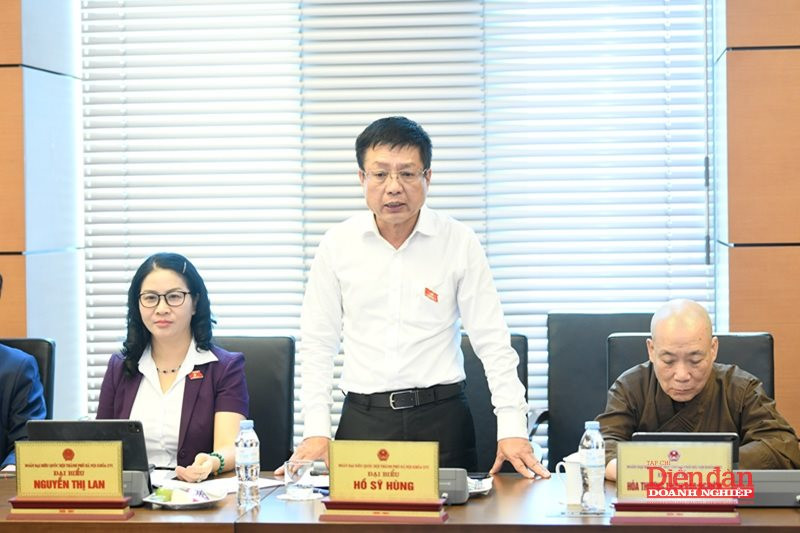
VCCI President Ho Sy Hung, a delegate of the Hanoi National Assembly Delegation, gives comments during the group discussion on the afternoon of August 4.
In addition, commenting on Clause 2, Article 6 of the draft Resolution, which provides for exemption from liability for damages arising in the fields of science and technology, innovation and digital transformation in cases where the relevant matters are not yet regulated by law or where legal provisions remain contradictory or overlapping, President Ho Si Hung proposed expanding the scope to other areas of investment, production and business where positive results are achieved but similar legal barriers are encountered, rather than limiting the provision to science and technology.
Regarding Clause 3, Article 9 on the maximum two-year period for suspending the handling of denunciations and crime reports and the investigation of cases, the VCCI President said that the two-year limit was somewhat rigid. Where necessary, an extension could be permitted if the resolution process is progressing well and the effectiveness of such an extension has been demonstrated in practice.
Sharing the same view, delegate Nguyen Lan Hieu of the Hanoi National Assembly Delegation, who also commented on the draft Resolution, called on the drafting body to further consider and review several provisions.
Specifically, regarding risks associated with innovation, the delegate proposed further clarification, particularly concerning the overlap in provisions on the exclusion of criminal liability for risks causing damage in the application of science and technology and innovation.
According to the delegate, it is currently unclear whether the provisions apply to the person causing the damage or the person suffering the damage.
He therefore proposed clearly distinguishing three levels of risk and applying appropriate forms of handling:
First, risks arising from the technology itself. In such cases, criminal liability should be excluded. Where an error results from technology, machinery or a new process under trial, the person implementing it should not be subject to disciplinary or criminal liability.
Second, errors resulting from negligence. In such cases, conduct that might previously have been subject to criminal liability could instead be handled through administrative, disciplinary or civil measures.
Third, intentional violations. Where an act is determined to constitute an intentional violation of regulations and causes serious consequences, it must continue to be dealt with strictly in accordance with applicable laws.
Regarding the controlled testing mechanism, or “Sandbox,” delegate Nguyen Lan Hieu said this was a particularly important mechanism for scientific and technological research. Therefore, businesses, research institutes and State agencies should be permitted to test certain new products, services, technologies or business models that are not yet regulated by existing laws or are even currently prohibited.
“Such testing would be conducted within defined limits in terms of time, geographical scope and target customers – the ‘Sandbox’ mechanism. With such a mechanism in place, we would have the confidence to move forward. For example, if a hospital wishes to apply artificial intelligence (AI) in medical examination and treatment, under current laws, an error involving AI that affects people’s health could expose the person implementing it to criminal liability. Therefore, a ‘Sandbox’ is needed to give innovators the confidence to implement new solutions,” the delegate said.
He also proposed adding a separate provision on a national “Sandbox,” allowing entities to register for trials lasting from 24 to 36 months. During the testing period, if participants comply with the approved testing scheme and submit periodic reports, they should not be subject to criminal prosecution. The Government should be tasked with issuing a list of priority areas, such as healthcare, artificial intelligence (AI), semiconductors and biotechnology.
In addition, regarding financial policies and incentives for businesses, delegate Nguyen Lan Hieu proposed stronger tax policies to encourage businesses to invest in science and technology.
“Under Resolution No. 98/NQ-CP and regulations issued since 2015, private-sector businesses may allocate up to 20% of taxable income to establish a science and technology development fund. However, this limit should be increased to 30% in the current period. In particular, for high-tech and innovative start-up enterprises, expenditures on science and technology that result in risks should also be recognized as deductible expenses for tax purposes. Tax exemptions and reductions could even be increased to as much as 50% to encourage businesses to take greater risks in pursuing innovation,” the delegate proposed.