VIETNAM CHAMBER OF COMMERCE AND INDUSTRY
Liên Đoàn Thương Mại Và Công Nghiệp Việt Nam
Wed, Feb 04, 2026, 15:10:00

With a population exceeding 3 million and an area of nearly 12,000 square kilometers - more than 10 times its previous size, the newly expanded Danang is positioning itself as Vietnam’s largest centrally-governed city and a future “most livable city” of Asian stature by 2050.
The country currently has six centrally-governed cities, namely Hanoi, Hai Phong, Danang, Hue, Can Tho, and Ho Chi Minh City.
Under the revised plan, by 2030, Danang will serve as a core hub for science-technology, innovation, digital transformation, tourism, trade, finance, and logistics.
The city is also positioned as a center for high-tech industrial production, supporting industries, high-quality education and training, and high-quality health care. Its development will be aligned with green growth, climate change adaptation, and national defense and security.
Looking ahead to 2050, Danang aspires to become a model “most livable city” of Asian stature, achieving harmonious economic and ecological development while improving residents’ quality of life.
A highlight of the revised plan is the restructuring of socio-economic space into three main functional zones, linked to economic corridors and growth-driving clusters.
Accordingly, the eastern coastal urban-industrial-service zone will serve as the primary growth engine, concentrating on finance, trade, tourism, and high-quality services.
The western midland and mountainous zone will focus on agriculture and forestry, eco-economy development, resource conservation, and water security.
Meanwhile, the marine and island zone is set to promote the marine economy, logistics, and renewable energy.
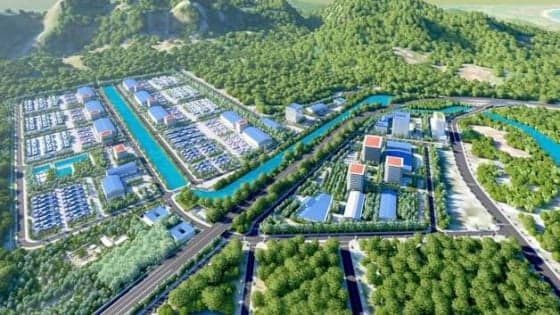
In this planning adjustment, Danang has redefined three key growth-driving clusters. The first is the northern urban-commercial-financial-tourism-heritage-cultural cluster centered in the Danang-Hoi An-Dien Ban area.
The second is the North-South industrial-commercial-service-tourism-new urban cluster in the Nam Hoi An area (Duy Xuyen-Thang Binh-Que Son), while the third is the southern industrial-service-logistics-science-technology cluster in the Chu Lai-Tam Ky-Nui Thanh area.
Danang also sets a target of having 30 urban areas by 2030. In addition to 20 existing urban areas (including seven expanded and 13 upgraded and renovated ones), there will be 10 new urban areas meeting the standards of a centrally-governed city’s administrative units under Resolution No. 112 of the National Assembly.
The city will also invest in improving urban standards and quality, ensuring that at least 15 wards achieve the status of a Tier-2 urban area.
Reshaping the entire development space
Nguyen Duc Dung, Chairman of the Danang People’s Council, stated at a meeting on Friday that before the administrative reorganization last July, the master plans of Danang and Quang Nam for 2021-2030, with a vision to 2050, had already been implemented and served as important foundations for urban and rural planning, socio-economic development programs, growth promotion, infrastructure improvement, and enhancing urban quality and living standards.
After the merger and the implementation of a two-tier local government model (only city and ward/commune levels, with the district level removed), he said Danang has assumed a completely new scale, position, and development character, creating an urgent need for a master plan aligned with the new administrative boundaries and governance model to ensure socio-economic development, national defense, and security.
“Master plan revision is an extremely heavy and challenging political task. It is not merely technical work, but a blueprint to reshape and reorganize the city’s entire development space under a multi-polar, multi-axis and multi-functional model linked to a new growth model, ensuring unity and comprehensiveness,” Dung stressed.
It aims toward sustainable development, harmony among regions, social equity, and improved living standards, based on maximizing the potential, advantages, and synergies of the former Danang and Quang Nam, he added.
The new Danang covers nearly 12,000 square meters with a population of over 3 million. It comprises 94 ward/commune-level administrative units, including 23 wards, 70 communes, and one special zone. It has become the city with the largest natural area among Vietnam’s six centrally-governed cities.