VIETNAM CHAMBER OF COMMERCE AND INDUSTRY
Liên Đoàn Thương Mại Và Công Nghiệp Việt Nam
Tue, Aug 26, 2025, 03:47:00
Many challenges for business households
The Vietnam Chamber of Commerce and Industry (VCCI) has just sent a document with comments to the Ministry of Finance on the Draft Decree amending Decree 125/2020/ND-CP, in which it proposes a humane policy: no administrative penalties for the first 2 years for business households that make mistakes when converting to electronic invoices.
VCCI believes that requiring business households and individuals with revenue of VND 1 billion/year or more to use electronic invoices from cash registers according to Decree 70/2025/ND-CP is a correct policy, but is posing many major challenges.
To clarify these difficulties, VCCI conducted a quick survey with 1,368 business households nationwide in June 2025. The survey results showed that the level of understanding of business households is still limited. Although 94% of business households know about the new regulations, up to 68% only have a preliminary understanding or are unclear about what to do, and 21% admit that they do not fully understand.
The challenge of skills and habits is also noteworthy. In particular, the biggest obstacle is the lack of knowledge and technological skills (73%) and the difficulty in changing old management habits (90%).
In addition, there is the burden of costs and psychological concerns. 66% of business households expect operating costs to increase, 64% are concerned about decreased profits. The fear of retroactive prosecution and tax collection accounts for a large proportion, although in reality, no cases have been punished.
VCCI believes that requiring business households and individuals with revenue of VND1 billion/year or more to use electronic invoices from cash registers is a correct policy but is posing many big challenges.
According to VCCI, the above challenges, along with limited resources, will make business households susceptible to invoice violations in the early stages, especially errors in form such as incorrect targets and incorrect invoice issuance at the wrong time.
"These are unintentional errors due to unfamiliarity with new ways of doing things and lack of proficiency in technology, not intentional tax evasion," VCCI emphasized.
From these analyses, VCCI proposed that the drafting agency add a provision that administrative sanctions will not be applied to business households that violate formality regulations in the first 2 years. During this period, business households are still responsible for correcting errors and paying the full amount of tax (if any) incurred.
Need for synchronous implementation policies in line with the spirit of Resolution 68
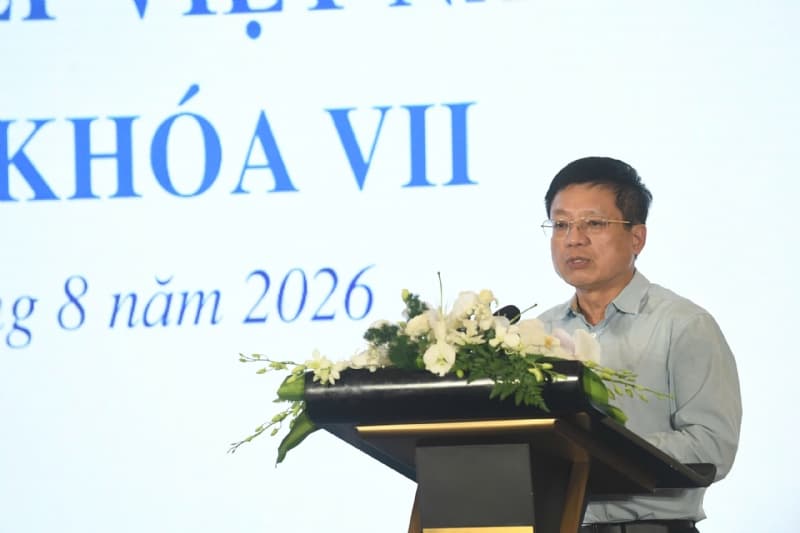
Speaking at the first meeting of the National Steering Committee for the implementation of Resolution 68-NQ/TW on private economic development, Mr. Dau Anh Tuan - Deputy General Secretary and Head of the Legal Department of VCCI mentioned the difficulties of small enterprises and business households.
"The large business community is very excited about the spirit of Resolution 68, but "small enterprises and business households still have a certain mentality. "In order for the policy to be effectively implemented and gain consensus, there needs to be substantial support solutions," Mr. Tuan stated.
Based on the survey conducted by VCCI, the Deputy General Secretary of VCCI recommended that tax authorities should promote Q&A programs, forums, and "hands-on" training for business households.
There needs to be a transition period for business households to adapt, along with a clear commitment to not retroactively or collect additional taxes during this time to strengthen trust.
Simplifying procedures is something that needs to be kept in mind. For example, Mr. Tuan gave an example: if a business household has connected its cash register to the tax authority, the system can automatically calculate and print declarations, instead of forcing them to make a complicated settlement.
The cost of buying a cash register connected to the tax authority (about 11 million VND) is a large investment for households in remote areas. The State needs to have a policy to support this cost.
In the long term, Mr. Tuan emphasized that the group of micro enterprises and business households are very sensitive to policy changes, so a simple, transparent and stable management mechanism is needed.
"The key factor to effectively implement Resolution 68 is that the criteria for private enterprise development need to be considered the most important criteria to assess the level of task completion of authorities at all levels. Only then can we create strong policy implementation momentum at the local level," Mr. Tuan concluded.