VIETNAM CHAMBER OF COMMERCE AND INDUSTRY
Liên Đoàn Thương Mại Và Công Nghiệp Việt Nam
Tue, Aug 26, 2025, 03:46:00
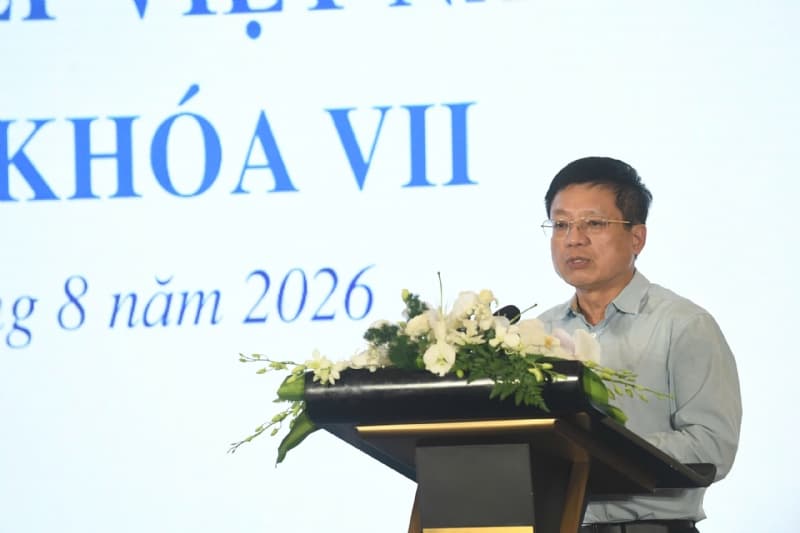
Speaking at the working session, Mr. Nguyen Phuong Lam - Director of the Vietnam Chamber of Commerce and Industry, Mekong Delta Branch (VCCI-Mekong Delta) assessed that after the merger, Can Tho City's economic growth is slightly higher than the national average. In addition, Can Tho has great strengths in trade and services; total export turnover reached 4.3 billion USD; economic scale is about 282,000 billion VND...

Mr. Nguyen Phuong Lam - Director of VCCI-Mekong Delta speaking at the meeting - Photo: Thanh Liem VNA
However, in addition to the strengths, Mr. Lam also pointed out some limitations of Can Tho, and at the same time, proposed some solutions to develop Can Tho City in the coming time.
First, about the number of enterprises. According to Mr. Lam, Can Tho currently has only 5.4 enterprises/1,000 people, lower than the national average (9.2 enterprises/1,000 people). According to Resolution 68 of the Politburo, the goal by 2030 is to have 2 million enterprises nationwide (an average of 20 enterprises/1,000 people), so Can Tho must make 400% more effort than at present.
From that, Mr. Lam said that the economy will find it difficult to develop without the business force, which is an important driving force. Therefore, in the development strategy, the city needs to focus on developing enterprises not only in terms of quantity but also in terms of scale and capacity of enterprises.
Second, in terms of attracting foreign direct investment (FDI). Mr. Lam said that after the merger, Can Tho has about 130 FDI projects, with a total investment capital of 3.4 billion USD. Except for Tay Ninh, Can Tho ranks 4th out of the remaining 5 provinces of the Mekong Delta (only higher than Ca Mau because it specializes in shrimp production) in attracting FDI capital.
He assessed that Can Tho is the center of the region, has priority and specific resolutions, has the best basis and conditions in terms of science and technology, human resources, and geographical location, but FDI attraction is poor.
“To attract investment, there are two important things to do, which are infrastructure development and human resource development. Can Tho is currently inheriting a transport infrastructure system, especially highways. However, it is necessary to focus on infrastructure connecting localities, inter-provincial roads and inner-city roads. Regarding human resources, Can Tho is also inheriting a system of 11 colleges and universities, the problem is the policy and conditions to attract and create jobs for workers," Mr. Lam commented.
Third, regarding the city's infrastructure, Mr. Lam said that it is not enough to meet and serve the development. He cited some examples such as a VSIP representative who had the opportunity to talk with him once said that no VSIP in Vietnam has been built for so long and taken so much time. Or like the logistics center in Can Tho has been in the pipeline for 7 years, approved for 5 years but currently has no shape; The centralized science and technology center has also been approved for 5 years but has not been implemented...
Fourthly, regarding the city's development strategy, Mr. Lam suggested that the city needs to orient a number of key industries because the city is currently developing very evenly. Explaining this, Mr. Lam said that the experience from a number of large cities, especially cities with high economic development levels, is that they all focus on key areas for breakthroughs.
Also according to Mr. Lam, Can Tho is located in the Mekong Delta region, with agricultural strengths, so he suggested that Can Tho City should focus on the processing industry. Along with that, the city needs to set out a direction for green economic development and green tourism.
In addition, Can Tho needs to pay attention to the strategy of building for itself 2-3, or even 5 large enterprises, leading enterprises. To have these businesses, we do not need to give them unusual incentives, but we need to give them priorities in utilizing city resources, from which they will have the responsibility to contribute back to developing community businesses and developing the locality according to the city's direction.

Standing Vice Chairman of Can Tho City People's Committee Nguyen Van Hoa speaks at the meeting - Photo: Thanh Liem VNA.
Speaking at the meeting, Standing Vice Chairman of Can Tho City People's Committee Nguyen Van Hoa, Standing Vice Chairman of Can Tho City People's Committee basically agreed on the contents of cooperation with VCCI-Mekong Delta in the coming time, with the aim of developing Can Tho City in line with its potential and advantages.
Mr. Hoa assigned the Department of Finance after this meeting to summarize the contents proposed by VCCI-Mekong Delta, complete the official proposal, and report to the Standing Committee of the City People's Committee to agree on the contents of cooperation.
Mr. Hoa also hopes that VCCI-Mekong Delta will study from now until the end of 2025 and in the coming time, what Can Tho City needs to do for the economic development program, especially double-digit growth; How to grow, what to do, what to do to attract investors, what steps to prepare when completing infrastructure... At the same time, help the city position the period 2026-2030, with the space of the new Can Tho city, which areas to attract businesses to, and act as a bridge connecting businesses with the government.