VIETNAM CHAMBER OF COMMERCE AND INDUSTRY
Liên Đoàn Thương Mại Và Công Nghiệp Việt Nam
Mon, Aug 18, 2025, 08:08:00

Workshop to seek opinions on the policy development orientation of the Law on Tax Administration (replacement), organized by the Department of Taxation - Ministry of Finance on August 1, in Ho Chi Minh City
Speaking at the workshop, Mr. Nguyen Van Duc - Deputy Head of the Legal Department, Vietnam Chamber of Commerce and Industry, Ho Chi Minh City Branch (VCCI-HCM) said that the Law on Tax Administration 2019 has marked an important step forward in reforming administrative procedures and modernizing tax work.
However, after more than 5 years of implementation, from the reflection of the reality of enterprises and business households. Especially in the past time, VCCI has conducted a number of survey activities related to small and medium-sized businesses. Therefore, Mr. Duc proposed a number of contents related to general tax policies, as well as the Law on Tax Administration, for business households.
Firstly, regarding the roadmap, transition time and revenue threshold for applying electronic invoices (E-invoices) from cash registers for business households and individuals, Mr. Duc said that Decree 70/2025/ND-CP (amending Decree 123/2020/ND-CP), effective from June 1, 2025, stipulates: business households and individuals paying lump-sum tax with revenue of VND 1 billion/year or more must use E-invoices from cash registers connected to tax authorities.
According to information from the Ministry of Finance, out of more than 5 million business households nationwide, about 3.6 million households are under tax management, but only 37,000 households with revenue of over VND 1 billion must apply E-invoices from cash registers connected to tax authorities, that is, less than 1% of the total number of households. These are all business households with very large lump-sum revenue.

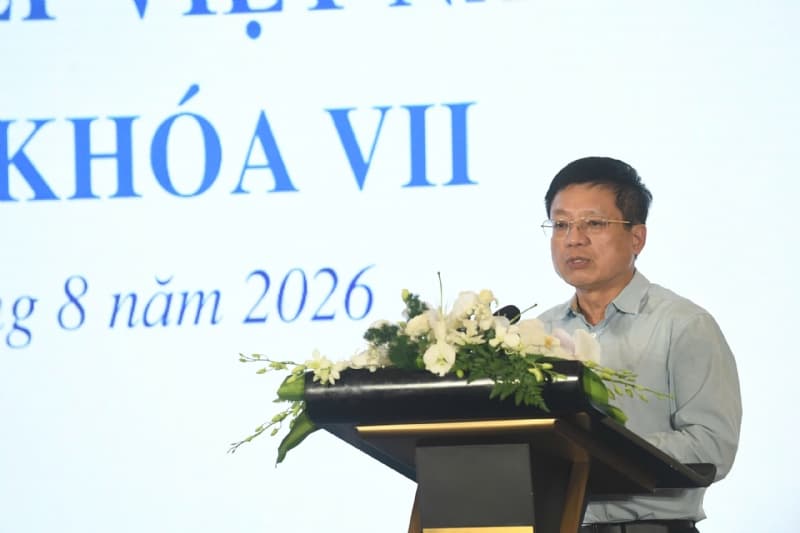
Mr. Nguyen Van Duc - Deputy Head of the Legal Department of VCCI-HCM spoke at the Workshop
However, the threshold of 1 billion VND is causing many concerns. In some industries (grocery stores, food services), revenue exceeds 1 billion but profits are very thin, applying electronic invoices from cash registers connected to tax authorities and paying taxes based on revenue can cause households to fall into a situation of "high revenue but low profits or losses".
"Recently, we conducted a number of surveys related to this issue, the results showed that the level of understanding of the obligation of electronic invoices from cash registers for business households was 11.4% said that they clearly understood the obligation, while 68% of business households did not clearly understand what to do to comply, and 10.7% did not understand or knew but did not know how to do it...", Mr. Duc informed.
From there, Mr. Duc made some recommendations for this content such as: It is necessary to clearly stipulate a minimum transition period of 1 year and not impose penalties in the initial stage so that business households have time to prepare; Raise the threshold for applying electronic invoices to connect with tax authorities from 1 billion to 1.5-2 billion VND/year, in line with reality; Allow small retail households (grocery stores, restaurants) to use simple invoices, not requiring immediate connection; Have a mechanism to exempt/reduce taxes for the first 6-12 months and support software and cheap cash registers, especially for vulnerable households. Second, regarding tax administrative procedures for business households, Mr. Duc said that the Draft requires households to both use electronic invoices and establish input accounting books. This provision creates some burdens for small business households that do not have an accounting department for costs, leading to non-compliance or incorrect declaration, increasing the risk of being fined...
Therefore, Mr. Duc proposed allowing electronic invoices to replace accounting books, and at the same time clearly regulating the issuance and storage of electronic invoices to meet tax management requirements. Small business households do not have to establish additional accounting books; applying a minimalist accounting regime is in line with the spirit of administrative procedure reform.
Third, regarding the frequency of tax inspections and audits. According to Mr. Duc, through the feedback of businesses as well as business households, tax inspections and audits many times a year cause disruption to business operations as well as costs for businesses. The new draft outlines risk management rules, but there is no specific limit on the frequency of inspections and audits, so the overlap has not been overcome.
“Therefore, we recommend adding a principle of “once a year”, except in cases where there are signs of serious violations; publicize the criteria for selecting inspections to ensure transparency in inspections and audits”, the representative of VCCI-HCM suggested.
Fourth, regarding the rights of taxpayers. The draft stipulates the rights of taxpayers, but they are general, general, and not specific, while the obligations are stipulated in quite detail. This makes taxpayers, especially small businesses, feel that they are not fully protected.
Therefore, Mr. Duc suggested that it is necessary to add a separate chapter on taxpayer rights, including: the right to timely explanation, free legal support, the right to independent complaints and denunciations; and increase the accountability of tax authorities.