VIETNAM CHAMBER OF COMMERCE AND INDUSTRY
Liên Đoàn Thương Mại Và Công Nghiệp Việt Nam
Wed, May 24, 2023, 03:38:00
Accordingly, on May 12th, in Hanoi, the Vietnam Chamber of Commerce and Industry (VCCI) collaborated with the Ministry of Construction to organize a workshop titled "Enterprises' Feedback on the Draft Law on Housing (amendment) and the Draft Law on Real Estate Business (amendment)." These are two draft laws expected to be submitted for public opinion at the National Assembly meeting in May 2023 and passed in the October 2023 session.

VCCI, cooperated with the Ministry of Construction to organize a workshop titled "Enterprises' Feedback on the Draft Law on Housing (amendment) and the Draft Law on Real Estate Business (amendment)."
In his opening remarks at the workshop, VCCI Chairman Pham Tan Cong stated that the issue of land and real estate always receives the attention of society. As housing is a fundamental need for individuals, providing "settling down for a stable livelihood," the Law on Housing and Real Estate Business plays a crucial role in meeting people's needs.
According to Chairman Pham Tan Cong, the real estate market is particularly important for the economy. The experience in many developed countries has shown that the real estate market plays a significant role in industrialization and modernization. If the real estate market develops unstably, it can lead to housing shortages and excessively high rent prices for both residential and office spaces. Recent times have demonstrated that excessively high real estate prices also pose challenges to business operations and the overall economy.

Deputy Minister of Construction, Nguyen Van Sinh, presented on the two draft laws at the workshop.
Regarding the Draft Law on Housing (amendment), Deputy Minister Nguyen Van Sinh stated that it consists of 13 chapters and 196 articles. Compared to the 2014 Law on Housing, the draft amendment has increased by more than 13 articles. It removes 7 articles from the current law, retains 47 articles, amends and supplements 104 articles, and introduces 34 new articles. It also converts 11 articles from decrees into law.
As for the Draft Law on Real Estate Business, it comprises 10 chapters and 92 articles. The law has been submitted by the government to the National Assembly for opinions and is scheduled for approval during the session taking place in October 2023.

Mr. Nguyen Quoc Hiep, Chairman of the Vietnam Association of Construction Contractors, provided feedback on the draft laws.
Regarding the issues addressed in the draft laws, Mr. Nguyen Quoc Hiep evaluated that the current draft of the Law on Real Estate Business provides more detailed and comprehensive provisions on real estate business compared to the previous 2014 law.
However, there is a discrepancy between Article 57, which states that "real estate transactions must be conducted through real estate trading floors as regulated by this Law," and Article 60, which only requires real estate trading floors to have "technical facilities that meet requirements and financial capabilities."

"We believe that such regulations are too rigid, aren't they? Currently, many real estate investment companies, who are also developers, employ a flexible approach by coordinating between their own sales force and external trading floors. However, in practice, the sales volume achieved by the developer's sales team is always higher than the volume sold by external trading floors, and the commission fees for external floors are always twice as high as those for the developer's own sales team. This is a reality that the drafting committee needs to consider. Should we introduce an additional intermediary step while we are trying to reduce intermediate procedures to lower costs?" expressed Mr. Hiep.
Based on this, Mr. Hiep proposed an amendment to Article 57: "Real estate transactions must be conducted openly and transparently through trading floors organized by developers themselves or through intermediary trading floors (if developers cannot organize their own). Regarding the criteria for trading floors, Mr. Hiep also suggested the need for more specific guidelines, such as "what constitutes technical facilities that meet the requirements?" for both physical and electronic trading floors.

Mr. Nguyen Manh Ha, Deputy Chairman of the Vietnam Real Estate Association, provided his opinion at the workshop.
According to Mr. Nguyen Manh Ha, there are still certain provisions in the draft law that raise concerns for businesses, and they desire to contribute feedback to improve it. Specifically, regarding the structure of the Draft Law on Housing, Chapter 5 focuses on regulations related to construction and renovation of apartment buildings, while Chapter 9 deals with the management and use of apartment buildings.
These two sections are quite similar, and Mr. Nguyen Manh Ha proposed, "Perhaps the drafting committee should consider merging them to make it easier to read."

Mr. Nguyen Van Dinh, an independent expert in the fields of land, construction, and real estate, provided his feedback at the workshop.
Regarding the draft amendment of the Law on Business in Real Estate, Mr. Nguyen Van Dinh believes that Article 32 of the draft has set conditions for the transfer of land use rights with existing technical infrastructure in real estate projects for individuals to self-build residential houses. It stipulates: "The provincial People's Committee, based on specific conditions, shall determine the areas where project investors can transfer the land use rights with existing technical infrastructure through plot subdivision for individuals to self-build residential houses."
Furthermore, within Article 32 of the draft amendment of the Law on Business in Real Estate, it also states: "Before signing a contract to transfer the land use rights with existing technical infrastructure through plot subdivision in a real estate project, the project investor must send a written notification to the competent authority in charge of managing real estate business at the provincial level regarding the eligibility of the land use rights for transfer. Within 15 days from the date of receiving the notification from the project investor, the competent authority in charge of managing real estate business at the provincial level is responsible for verifying the conditions of the land use rights for business purposes and providing a written response to the project investor regarding the eligibility of the land use rights with existing technical infrastructure for transfer through plot subdivision for individuals to self-build residential houses..."

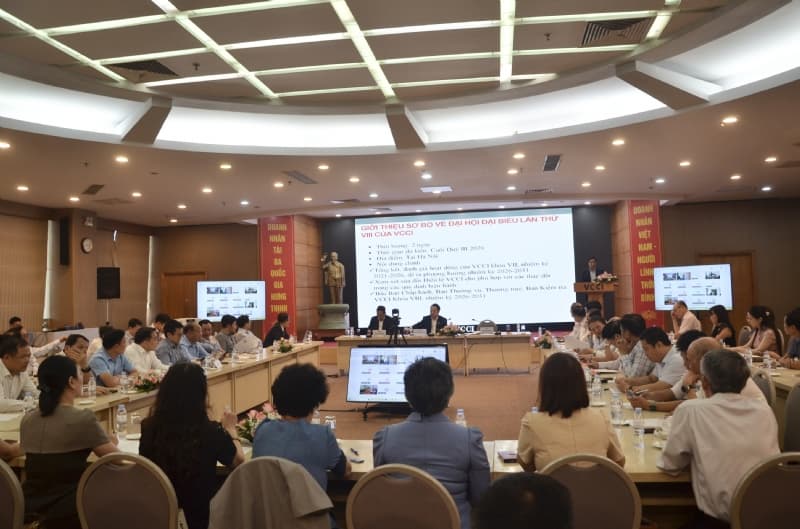
Experts, Associations participated in the Workshop
According to Mr. Dinh, the process of transferring land use rights for individuals to self-build residential houses will become complex. Firstly, the project must be located in an area identified as eligible for the transfer of land use rights through plot subdivision. Next, when preparing to put the land use rights into operation, the project investor must go through the procedure of "requesting" confirmation from the provincial authority responsible for managing real estate business (Department of Construction) that the land use rights are eligible for business purposes. This will create administrative procedures, increase compliance costs for businesses, and create a potential negative mechanism of "requesting-confirming".
Based on this, Mr. Dinh suggests that the drafting agency consider reducing the conditions and procedures for transferring land use rights for individuals to self-build residential houses through plot subdivision.

Representatives of the Ministry of Construction answered a number of concerns at the Workshop
At the workshop, in response to the concerns raised by experts and businesses, representatives from the Ministry of Construction also provided initial clarifications and requested feedback from participants at the workshop. They expressed their commitment to further refine the drafts based on the input received. The representatives from the Ministry of Construction addressed several issues of concern during the workshop.