VIETNAM CHAMBER OF COMMERCE AND INDUSTRY
Liên Đoàn Thương Mại Và Công Nghiệp Việt Nam
Mon, Jun 22, 2026, 16:06:00
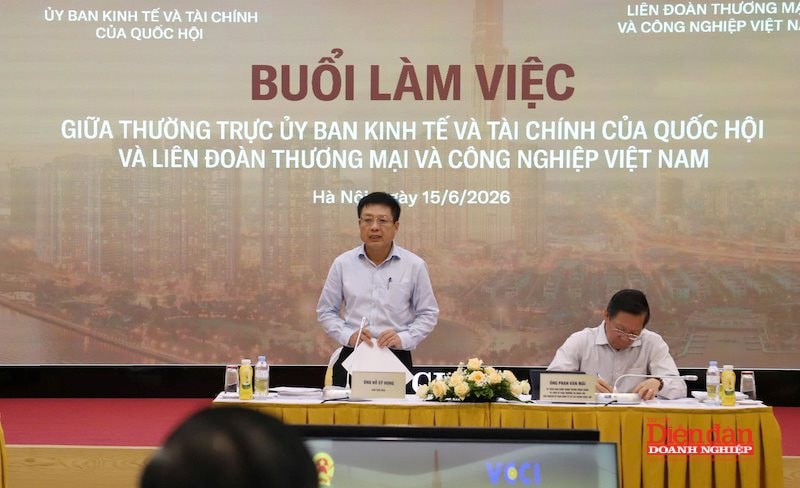 Assoc. Prof. Dr. Ho Sy Hung, President of VCCI (left), and Mr. Phan Van Mai, Chairman of the National Assembly’s Economic and Financial Committee (right), co-chaired the working session.
At a working session between the Standing Committee of the National Assembly’s Economic and Financial Committee and the Vietnam Chamber of Commerce and Industry (VCCI), Assoc. Prof. Dr. Ho Sy Hung, President of VCCI, emphasized that Vietnam is entering a phase of economic institutional reform with an unprecedented pace and spirit.
According to the VCCI President, Resolution No. 68 of the Politburo has affirmed that the private sector is one of the most important drivers of the national economy.
At the same time, legislative thinking is shifting strongly from a control-oriented approach to one that fosters development; the administrative apparatus is being streamlined to become more efficient and closer to the people. A distinctive feature of the current reform period is that the depth of reform is being realized primarily through legislative activities.
In this context, the VCCI President noted that the role of the Economic and Financial Committee is particularly important, as most laws directly affecting the investment and business environment—such as those related to land, investment, bidding, planning, taxation, credit and business support—must undergo the Committee’s review and consultation process.
The quality of Vietnam’s business environment in the coming years will depend significantly on the quality of the laws developed and refined during this period.
The VCCI President stated that the current National Assembly term’s legislative agenda is exceptionally large and being implemented at a rapid pace. This is necessary to remove development bottlenecks, but it also places high demands on quality.
“An economic law only truly has value when it can be effectively implemented in practice, aligns with the actual capabilities of enterprises, and provides sufficient stability for businesses to plan their investment and business activities,” the VCCI President said.
Based on extensive engagement with the business community, VCCI has identified three major expectations. First is the need for a stable legal system with a high degree of predictability. Second is the requirement for consistency and clarity in legislation to minimize overlaps and contradictions. Third is narrowing the gap between policies on paper and their implementation in practice.
According to VCCI President Ho Sy Hung, the private sector is currently facing dual pressures from long-standing structural constraints within the economy and increasingly unpredictable external developments. Small and medium-sized enterprises and household businesses are the most vulnerable groups. Therefore, every timely and appropriate legislative decision plays an important role in strengthening the resilience of the business community.
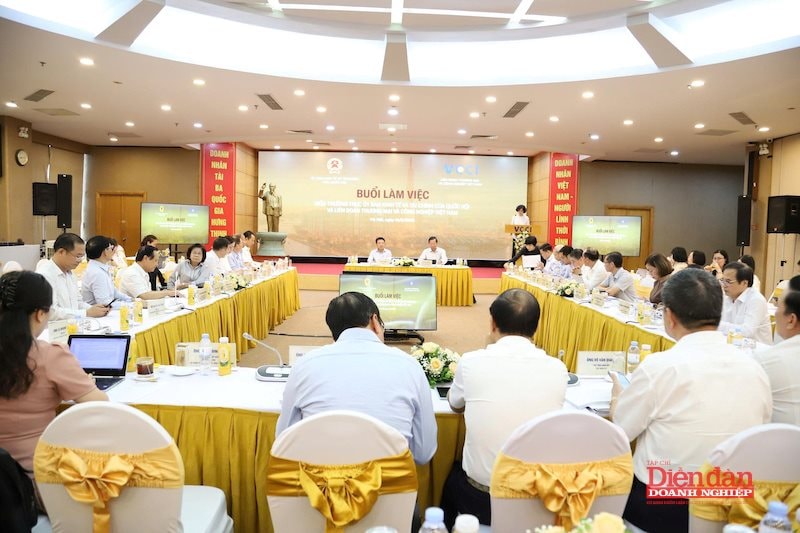 Working session between the Standing Committee of the National Assembly’s Economic and Financial Committee and the Vietnam Chamber of Commerce and Industry (VCCI)
Regarding the Draft Law on Support for Small and Medium-sized Enterprises (amended), VCCI highly appreciates many of its new provisions. However, according to the VCCI President, an effective support policy must ensure that enterprises can independently read, understand and access support measures, with support levels clearly quantified in the law rather than merely outlined as general principles.
The VCCI President also expressed his desire for VCCI and the Economic and Financial Committee to establish a more systematic and substantive cooperation mechanism to better support the development and improvement of policies and legislation.
Accordingly, the VCCI President proposed seven areas of cooperation in the coming period.
First, establishing a regular mechanism for information exchange and sharing with the business community. VCCI is ready to serve as a focal point for collecting and conveying feedback from practical production and business activities. However, given limited resources, particularly in legal and policy affairs, the VCCI President suggested closer coordination with National Assembly agencies to jointly analyze emerging issues and propose appropriate solutions.
Second, strengthening consultation with the business community during the policy-making process. VCCI hopes to establish regular working mechanisms with the Economic and Financial Committee on specific themes and issue groups, ensuring that practical business perspectives are more fully reflected in policymaking.
Third, studying mechanisms to institutionalize formal consultation with the business community in the process of developing legal normative documents.
Fourth, strengthening mechanisms for commissioning and assigning policy research tasks. The VCCI President noted that VCCI has been entrusted by various Party, National Assembly and Government agencies to conduct research assignments.
“We hope to further cooperate with the Economic and Financial Committee in providing information, conducting thematic studies and assessing policy impacts, while also establishing mechanisms to ensure adequate resources for carrying out these tasks effectively,” the VCCI President said.
Fifth, enhancing VCCI’s role as an information focal point in National Assembly working and supervisory missions. The participation of business community representatives would help ensure that supervisory activities are more closely aligned with practical realities while improving the dissemination of policies and guidelines to enterprises.
Sixth, coordinating the organization of forums, conferences and thematic working sessions between legislative bodies and the business community.
Seventh, jointly conducting and publishing studies on the business environment, institutional quality and economic development issues. Research reports produced by VCCI would have greater influence and reference value for policymakers and local authorities if developed with the participation of the Economic and Financial Committee.
As the national organization representing the business community, VCCI is ready to serve as a channel for evidence-based information and an objective consultation focal point for legislative and policy review activities. Reflecting the voices of businesses in a timely and comprehensive manner will contribute to improving the quality of legislation and the effectiveness of national governance.
Dual pressures from structural bottlenecks and external shocks
A VCCI research report shows that the private enterprise sector has continued to expand rapidly in number, from approximately 811,000 operating enterprises in 2020 to more than one million enterprises in 2025, accounting for 96.6% of all enterprises in the economy and providing jobs for approximately 9.27 million workers.
However, according to Mr. Dau Anh Tuan, Deputy Secretary General of VCCI and Director of the Legal Department, growth in quantity has not necessarily translated into improvements in business quality and health. In 2025, approximately 35,800 enterprises dissolved, up 66.9% compared with the previous period, while 112,700 enterprises suspended operations. A notable characteristic of the private sector remains that it is “large in number but small in scale,” with nearly 70% of non-state enterprises having capital of less than VND 10 billion and more than 81% employing fewer than 10 workers.
The average capital size of private enterprises was only around VND 49.2 billion, significantly lower than the VND 496 billion average for FDI enterprises and more than VND 7,030 billion for state-owned enterprises.
Operational efficiency also remains limited, with a profit margin of only around 1.4% in 2023. Capacity for innovation, technology adoption and corporate governance remains low, with only 7.5% of enterprises introducing new products or services within the past three years; 37.9% using at least one digital technology; and as many as 92.6% having owners who simultaneously serve as the highest-ranking managers.
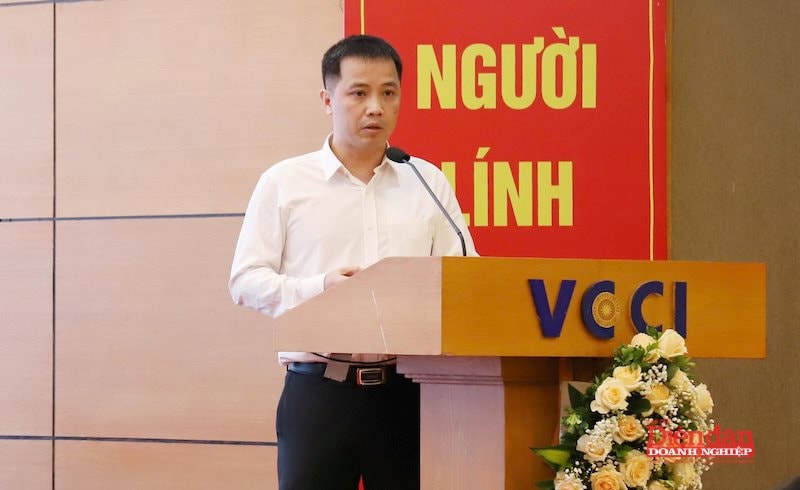 Mr. Dau Anh Tuan, Deputy Secretary General of VCCI and Director of the Legal Department, presenting VCCI’s report at the working session.
Notably, Mr. Tuan pointed out that business difficulties have shifted significantly from input factors to output markets. The proportion of enterprises facing difficulties in finding customers increased from 45.3% to 60.2%, equivalent to the most difficult period of the COVID-19 pandemic. This has heightened defensive sentiment, with 54.8% of enterprises planning to maintain their current scale of operations.
Access to capital remains a structural bottleneck. Up to 75.5% of enterprises cannot obtain loans without collateral, and 93.5% of loans require secured assets. Meanwhile, businesses’ ability to predict policy changes remains very low, with only around 6–8% of enterprises confident in forecasting policy developments. Informal costs continue to be a significant burden in many sectors.
For household businesses, approximately 6.1 million households currently provide employment for 10 million workers, but their resilience is clearly weakening. Up to 81.5% reported declining revenue in 2025, while 73.3% said legal difficulties had a major or severe impact on their operations. At the same time, the transition from household business status to enterprise status remains slow, with only 15.6% expressing an intention to convert due to concerns about tax, accounting, insurance and inspection obligations.
Against the backdrop of these structural bottlenecks, the business community has also been affected by the conflict in the Middle East since early March 2026. Fuel prices and many input materials increased sharply, international logistics costs rose two to three times, and more than half of manufacturing enterprises experienced a decline in export orders.
Although signs of easing appeared by June 2026 due to falling global oil prices and support policies related to fuel taxes and fees, negative impacts remain because of cost transmission lags and existing business contracts.
According to the VCCI Deputy Secretary General, the greatest risk facing the private sector in 2026 is that cost increases may outpace revenue growth, leading to declining profits, weakened cash flows and reduced capacity to maintain employment.
In addition to the overall picture of business performance, the report also identified numerous bottlenecks in the investment and business environment. Although the National Assembly and the Government have amended many important laws and introduced special mechanisms to address obstacles facing investment projects, systemic limitations remain in implementation capacity and coordination at the local level.
The most prominent issues involve planning, site clearance, land allocation, determination of land-related financial obligations and lengthy administrative procedures. In particular, delays in approving specific land prices are considered one of the most common bottlenecks at present.
The report also noted shortcomings in newly issued legal documents, including inconsistencies between laws and decrees, as well as legal gaps relating to infrastructure investment, online investment, energy, chemicals and foreign investment.
Regarding administrative reform, although 2025 saw positive results with thousands of procedures and business conditions being removed or simplified, VCCI surveys indicate that a considerable gap remains between regulations and implementation.
Around 25% of enterprises reported that procedures were not implemented as publicly announced; 33.33% said processing times exceeded legal requirements; 38.18% still had to pay informal costs; and more than 24% were forced to cancel or postpone business plans.
Based on these realities, the VCCI Deputy Secretary General said VCCI recommends five key groups of solutions: flexible financial and credit support for enterprises; reform of tax, accounting and e-invoice compliance requirements; development of tiered support policies for household businesses; strengthened measures to respond to short-term external shocks; and continued shifting of reform efforts toward development facilitation, ensuring fair competition and improving the quality of business support.
Mr. Tuan emphasized that this is a pivotal moment for economic institutional reform, requiring synchronized, decisive and sufficiently strong actions to enhance the competitiveness of the private sector and create a foundation for sustainable growth in the coming period.