VIETNAM CHAMBER OF COMMERCE AND INDUSTRY
Liên Đoàn Thương Mại Và Công Nghiệp Việt Nam
Thu, Oct 01, 2026, 08:53:00
On September 17, in Ho Chi Minh City, under the direction of the Vietnam Chamber of Commerce and Industry (VCCI), Business Forum Magazine organised a seminar entitled “Voluntary Pension Strategies: Tax Optimisation and Enhancing Corporate Positioning”.
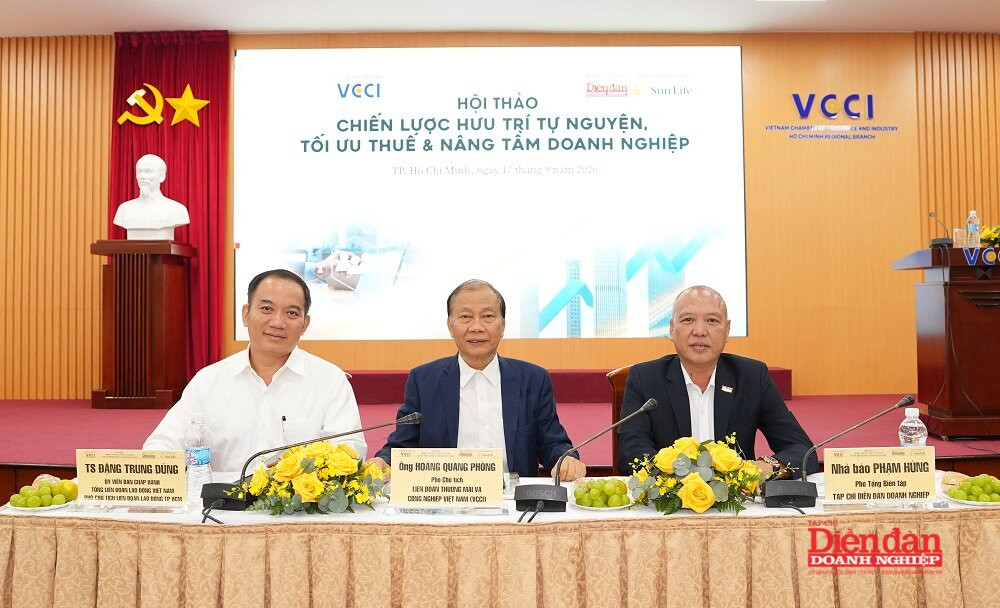
From left to right: Dr. Dang Trung Dung, Member of the Executive Committee of the Vietnam General Confederation of Labour and Vice President of the Ho Chi Minh City Federation of Labour; Mr. Hoang Quang Phong, Vice President of VCCI; and journalist Phạm Hùng, Deputy Editor-in-Chief and Head of the Ho Chi Minh City Representative Office of Business Forum Magazine, co-chairing and moderating the seminar.
The seminar was attended by Mr. Hoang Quang Phong, Vice President of VCCI; Mr. Tran Ngoc Liem, Deputy Secretary-General of VCCI and Director of the VCCI Ho Chi Minh City Branch (VCCI-HCM); Ms. Ly Thu Thuy, Head of the Life Insurance Division of the Insurance Supervisory Authority, Ministry of Finance; Dr. Dang Trung Dung, Member of the Executive Committee of the Vietnam General Confederation of Labour and Vice President of the Ho Chi Minh City Federation of Labour; Ms. Lay Hoon Tan, General Director of Sun Life Vietnam; Dr. Pham Viet Thuan, Director of the Institute of Natural Resources and Environment Economics of Ho Chi Minh City; Mr. Le Khanh Lam, Chairman of the Members’ Council and Deputy General Director in charge of Tax and Advisory Services at RSM Vietnam; Mr. Nguyen Hong Son, Representative of the HDBank leadership; Mr. Pham Van Chinh, PTI lecturer, Human Resources Management Consultant and former Human Resources Director of Samsung Vina; and Ms. Ly Ngoc Tran, Deputy General Director of Talennet Joint Stock Company.
Representing the Organising Committee was journalist Pham Hung, Deputy Editor-in-Chief and Head of the Ho Chi Minh City Representative Office of Business Forum Magazine. The seminar was also attended by representatives of business associations and enterprises in Ho Chi Minh City.
Speaking at the seminar, VCCI Vice President Hoang Quang Phong emphasised the decisive role of high-quality human resources in the development of the private economic sector. According to VCCI Vice President Hoang Quang Phong, the 14th National Party Congress set the target of achieving an average annual GDP growth rate of at least 10% during the 2026–2030 period, with the goal of making Vietnam a developing country with a modern industrial sector and upper-middle income by 2030, and moving towards becoming a developed, high-income country by 2045.
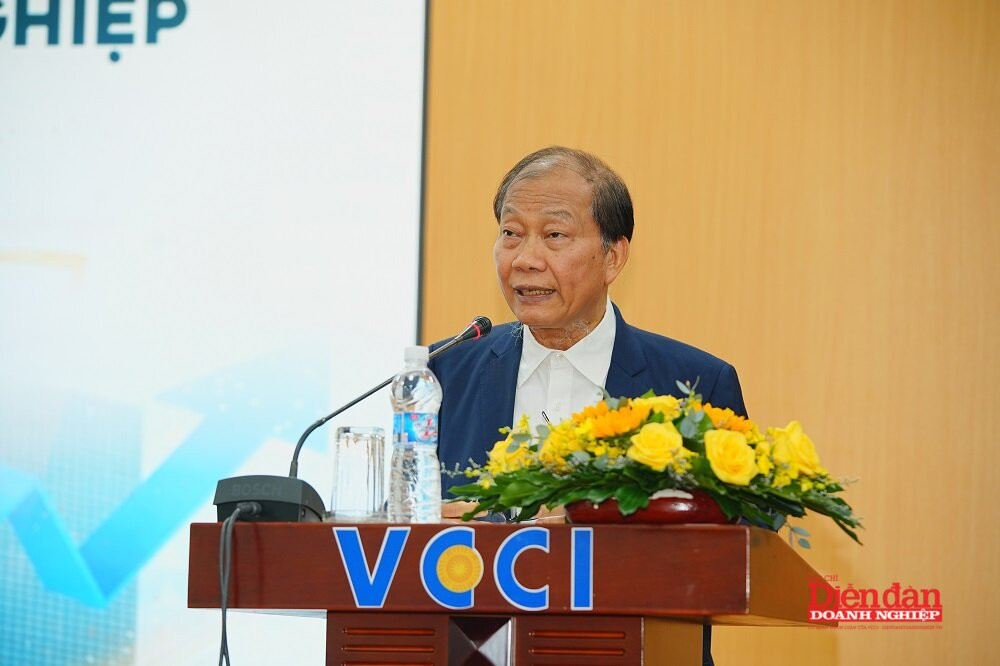
Mr. Hoang Quang Phong, Vice President of VCCI, delivers the opening remarks at the seminar.
To realise this ambition, the Party and the State have clearly identified the central role of the private economic sector. Resolution No. 68-NQ/TW dated May 4, 2025 of the Politburo on private sector development affirms that the private sector is the most important driving force and a pioneering force of the national economy, with the target of having 2 million operating enterprises nationwide and at least 20 large enterprises participating in global value chains by 2030. At the same time, Resolution No. 57-NQ/TW dated December 22, 2024 on breakthroughs in the development of science and technology, innovation and national digital transformation also calls for enterprises to play a pioneering role in innovation.
Furthermore, demographic studies indicate that Vietnam is one of the countries with the fastest ageing populations in Asia. At present, Vietnam has approximately 16 million people aged 60 and above, accounting for around 16% of the population, and this figure is expected to rise to approximately 18 million by 2030. If the current trend continues, by 2036 Vietnam will enter the stage of an “aged society”, when the proportion of older people exceeds 14% of the population. This means that Vietnam is entering a profound demographic transition at a much faster pace than developed countries experienced in the past. This highlights the need, more than ever, for Vietnam to adopt long-term policies and strategies to retain talent while ensuring social security for the future.
Therefore, Mr. Hoang Quang Phong noted that Vietnamese enterprises, particularly those in the private sector, can no longer continue to operate under traditional models, but must enhance their capabilities comprehensively: in terms of scale, governance, technology, and, equally importantly, organisational capacity and talent retention. In any growth cycle, particularly one driven by productivity, technology and innovation as targeted for the coming period, high-quality human resources are the decisive key.
“The question facing each enterprise today is not merely ‘how to achieve growth’, but ‘how to retain talent in an increasingly competitive labour market’. This is the context in which voluntary pension benefit strategies and pension insurance, which are widely adopted in developed economies, are inevitably becoming a strategic human resource management tool in Vietnam,” VCCI Vice President Hoang Quang Phong emphasised.
From a policy perspective, VCCI Vice President Hoang Quang Phong noted that the legal framework for the second tier of the social security system is becoming increasingly comprehensive. The issuance of Decree No. 85/2026/ND-CP on supplementary pension insurance, which took effect on May 10, 2026, together with regulations on commercial pension insurance under Decree No. 46/2023/ND-CP, has established a solid foundation for individual and employee group pension products.
At the same time, current tax policies have also created clear financial incentives for enterprises to implement such programmes, establishing a mechanism under which “individuals, enterprises and the State all benefit”. From a strategic corporate perspective, a well-designed voluntary pension programme is therefore viewed not merely as an employee benefit, but as a multi-purpose human resource management tool.
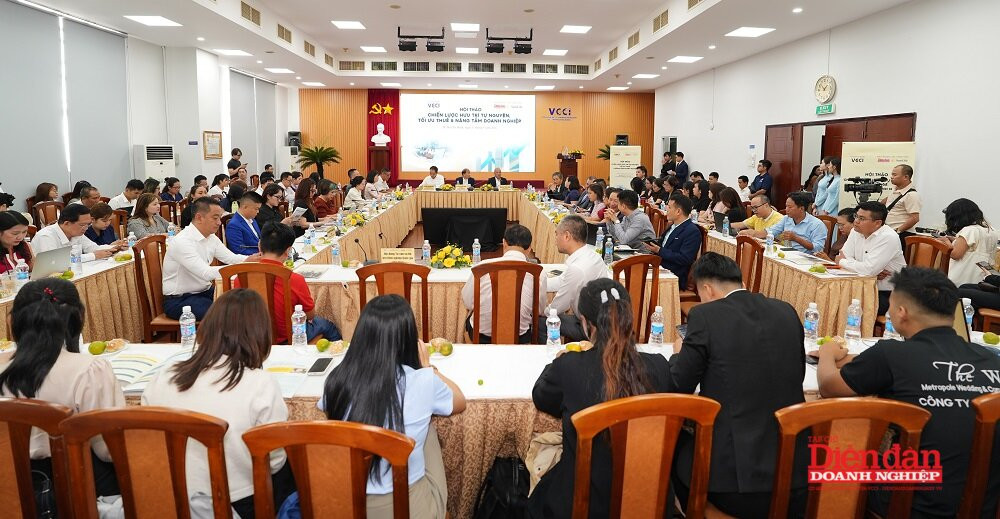
Overview of the seminar “Voluntary Pension Strategies, Tax Optimisation and Enhancing Corporate Positioning”.
VCCI Vice President Hoang Quang Phong affirmed that, as the organisation representing the Vietnamese business and entrepreneur community – the employers – VCCI has always identified one of its core missions as accompanying enterprises in accessing, understanding and effectively applying the Party and State’s new guidelines and policies to production and business activities.
Accordingly, the seminar organised by VCCI today aims to achieve three objectives. First, it seeks to help the business community gain a proper and comprehensive understanding of the legal framework and approaches to products designed to optimise taxes in accordance with relevant tax regulations, thereby ensuring proper implementation, avoiding legal risks and delivering effectiveness for all parties.
Second, it aims to provide a direct dialogue platform connecting State management agencies, financial and insurance experts, and the business community, bringing policy and business practices together, while ensuring that enterprises’ difficulties and concerns are heard and promptly communicated to policymakers.
Third, the seminar seeks to contribute to promoting a modern approach to corporate management, in which investment in people, including long-term retirement benefits, is viewed not as a cost burden but as a strategic investment in people, trust, social responsibility and, ultimately, the long-term competitiveness of Vietnamese enterprises.
“The road ahead for Vietnam’s business community is closely linked to the nation’s broader aspirations. Along this journey, every enterprise that strengthens its human resource management capabilities, and every worker who is better secured for the future, represents a building block contributing to the foundation of prosperous growth,” VCCI Vice President Hoang Quang Phong emphasised.
At the same time, Mr. Hoang Quang Phong highly appreciated the proactive efforts of Business Forum Magazine in addressing difficulties faced by enterprises and contributing to supporting businesses in corporate management. The seminar “Voluntary Pension Strategies, Tax Optimisation and Enhancing Corporate Positioning” is a notable example of such efforts.