VIETNAM CHAMBER OF COMMERCE AND INDUSTRY
Liên Đoàn Thương Mại Và Công Nghiệp Việt Nam
Thu, Sep 03, 2026, 15:00:00
In his opening remarks, Mr. Dau Anh Tuan, VCCI Deputy Secretary General and Head of the Legal Department, said that Resolution No. 21-NQ/TW dated July 28, 2026 of the Party Central Committee identifies land as a strategic resource, a competitive advantage and a driver of development. The real estate market and the land-use rights market are expected to serve as channels for allocating land in a rational, equitable and efficient manner.
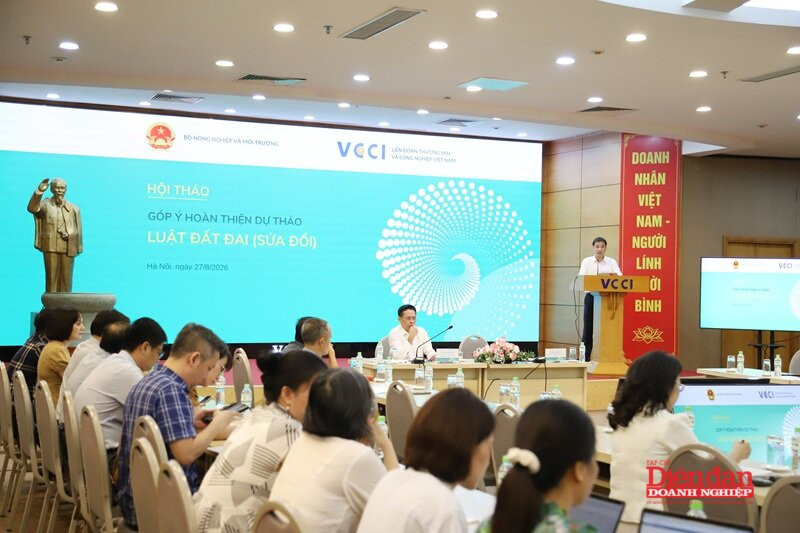
On the morning of August 27, VCCI, in coordination with the Ministry of Agriculture and Environment, organized a workshop to gather comments on the draft revised Land Law.
“The Resolution also sets out a principle that, in my view, should be consistently upheld throughout the drafting process: unlocking land resources without weakening management, and promoting development without allowing losses of public assets,” Mr. Tuan said.
Affirming that Resolution No. 21-NQ/TW has fundamentally changed the approach to land, Mr. Tuan highlighted four key points, including:
First, land is an input to production. According to Mr. Tuan, land-use rights should be recognized as a special type of commodity. For enterprises, land is associated with three critical questions: Is suitable land available? How much will it cost? And how long will it take to obtain the land? Establishing reasonable land prices will not only help enterprises reduce production costs but also enhance the competitiveness of the entire economy.
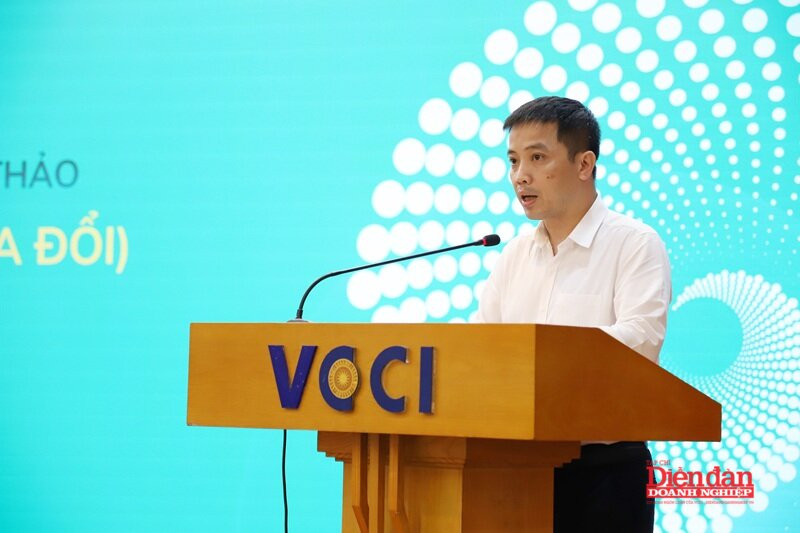
Mr. Dau Anh Tuan, VCCI Deputy Secretary General and Head of the Legal Department, delivers the opening remarks at the workshop on improving the draft revised Land Law.
Second, the consistency of the legal system. Mr. Tuan noted that a good draft law should not only be sound in its own provisions but also be “consistent” with other laws, such as the Law on Investment, the Law on Bidding and the Law on Construction. Enterprises need stability and predictability to feel confident in making long-term investments spanning 20–50 years.
Third, shifting from administrative management to modern governance. Mr. Tuan expressed support for a “framework law” approach, with fewer intermediary procedures and greater decentralization and delegation of authority. However, he stressed that decentralization must go hand in hand with consistency to avoid a situation where each locality applies a different process.
Fourth, openness and transparency. Mr. Tuan emphasized that transparency is not merely a matter of integrity but also a prerequisite for fair competition. When planning information and land prices are publicly disclosed, enterprises can compete based on their capacity to implement projects rather than their ability to gain access to “undisclosed” information.
Against this backdrop, Mr. Tuan highlighted six key groups of issues in the draft Land Law that need to be addressed and discussed by experts and businesses at the workshop, including: regulatory authority; land prices and financial obligations; preventing land speculation and land hoarding; access to agricultural land; the scope and limitations of the framework law approach; and transitional provisions.
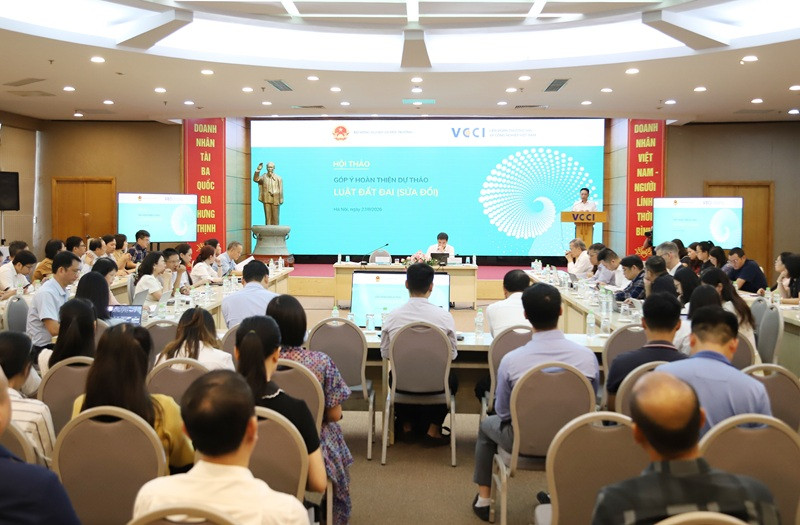
The workshop on improving the draft revised Land Law attracted considerable attention from representatives of State management agencies, experts and the business community.
Mr. Tuan expressed his hope that delegates would provide specific and practical comments on each provision of the draft Law, noting that insights from business practice would be valuable input for the drafting committee and reviewing agencies in finalizing a law that ensures effective management while maximizing the mobilization of land resources for national development.
According to Mr. Tuan, VCCI will comprehensively consolidate and incorporate all comments made at today’s workshop, as well as additional comments that may be submitted afterward, and provide them to management agencies, reviewing bodies, ministries and sectors, and committees of the National Assembly. This will help ensure that the discussions on the Land Law are informed by the fullest possible picture of business realities and the perspectives of the business community.
Speaking at the workshop, Mr. Dao Trung Chinh, Director General of the Department of Land Management under the Ministry of Agriculture and Environment, also highlighted key directions for fundamental reforms aimed at addressing existing difficulties and promoting socio-economic development.
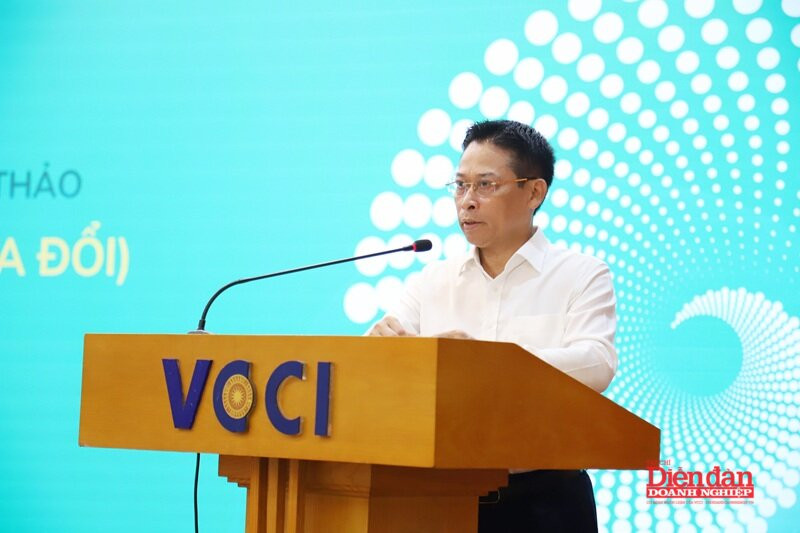
Mr. Dao Trung Chinh, Director General of the Department of Land Management under the Ministry of Agriculture and Environment, speaks at the workshop on improving the draft revised Land Law.
According to Mr. Chinh, the new Land Law is being designed to establish general, guiding principles, reducing the number of articles from approximately 260 to 110. Detailed provisions will be assigned to the Government, ministries and sectors for further guidance through decrees and circulars. This approach is intended to ensure greater flexibility and streamline the legal system.
Regarding reforms to land pricing and planning, Mr. Chinh said that land is regarded as an input to production. The State will determine land prices based on land price tables and adjustment coefficients, rather than relying on independent consultants. The objective is to keep land prices close to market prices while encouraging production and avoiding excessively high prices that could create difficulties for enterprises and citizens.
Regarding planning, the aim is to integrate different types of planning—including land-use, urban, rural and sectoral planning—into a single plan for each administrative unit. The drafting committee is studying ways to align the land classification system to ensure consistency in management and oversight.
In addition, regarding compensation, support and resettlement policies, Mr. Chinh said that the draft Law would represent a major shift from the concept of “compensating for losses” to “rebuilding livelihoods” for people whose land is recovered. The focus would be on ensuring livelihoods, employment and stable housing. The draft also considers giving local authorities greater discretion in determining additional support levels appropriate to the specific conditions of each region.
For delayed projects, instead of immediately recovering land after 24 months, the draft proposes using progressive taxation as a tool to encourage enterprises to put land into use. This would help address projects that have already invested substantially in their components but face relatively minor obstacles, thereby avoiding the waste of social resources.
Regarding the removal of obstacles for enterprises and the management of agricultural land, Mr. Chinh said that, in terms of procedures, the draft proposes harmonizing the procedures for project transfers under the Land Law, Law on Investment and tax legislation to facilitate investors.
With regard to land originating from agricultural and forestry farms, the draft firmly aims to resolve outstanding issues concerning such land, particularly by ensuring production land for local ethnic minority communities following the equitization of State-owned enterprises.
Notably, the draft also proposes removing notarization and certification procedures from the Law and regulating them by decree as part of the administrative process. Once the land database and population identification system are fully developed, further simplification of these procedures will be considered to reduce costs for society.
The Director General of the Department of Land Management also said that the drafting committee would incorporate successful pilot resolutions into the Law, such as allowing commercial housing projects on land that is not residential land, thereby establishing a consistent legal framework and creating new momentum for the sustainable development of the land market.