
VIETNAM CHAMBER OF COMMERCE AND INDUSTRY
Liên Đoàn Thương Mại Và Công Nghiệp Việt Nam
Wed, Nov 11, 2026, 15:23:00
The 4th Vietnam New Economy Forum 2026 (VNEF) was held under the theme “Breakthrough Policies and the Growth Momentum of Localities and Businesses”, with content co-chaired by the Central Commission for Policy and Strategy, the Vietnam Chamber of Commerce and Industry (VCCI), and the Vietnam Economic Science Association.
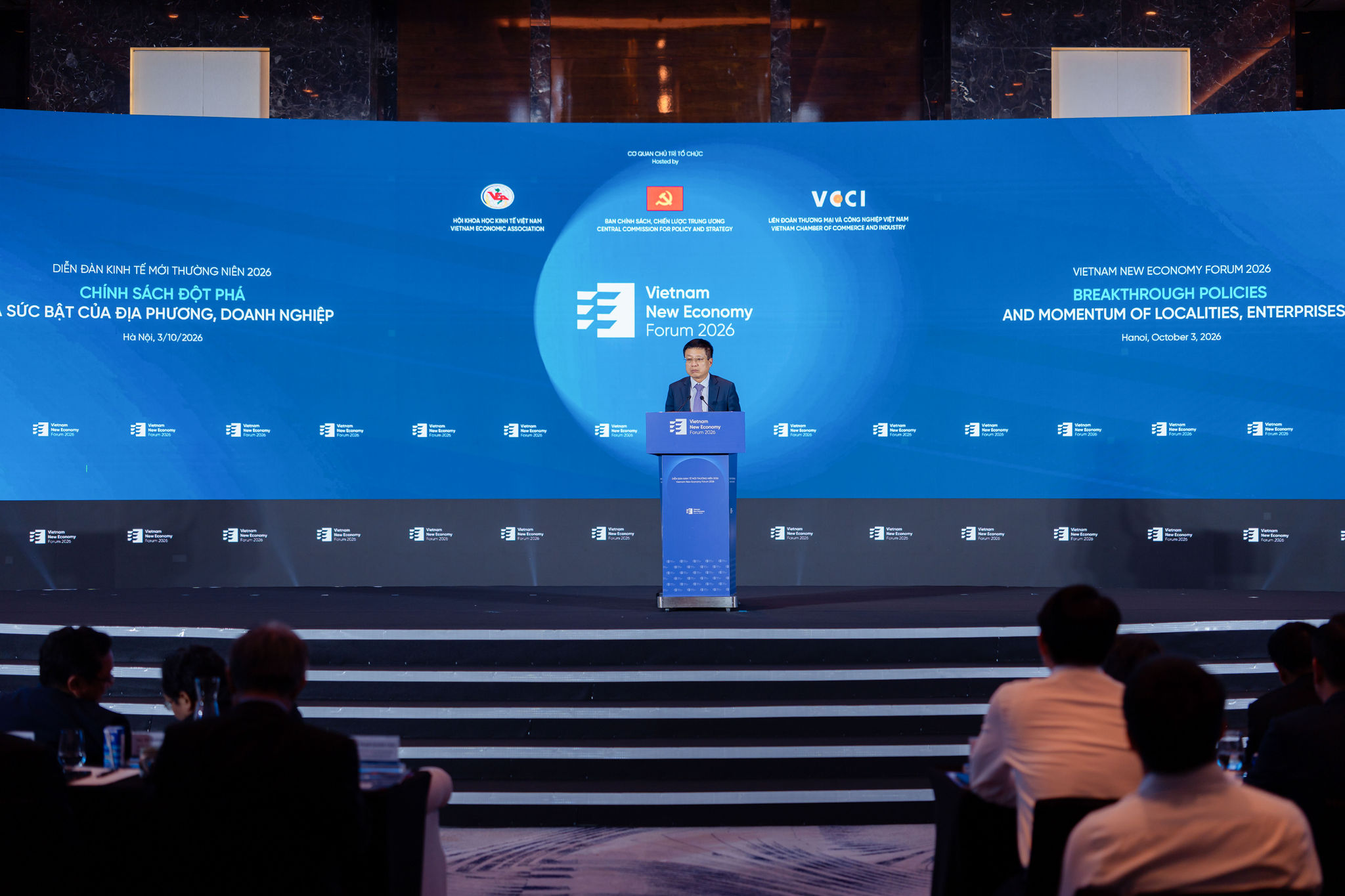
VCCI President Associate Professor Dr. Ho Sy Hung delivers remarks at the 4th Vietnam New Economy Forum 2026, themed “Breakthrough Policies and the Growth Momentum of Localities and Businesses”.
Policy Breakthroughs Create Leverage for Business Development
Speaking at the Forum, VCCI President Associate Professor Dr. Ho Sy Hung affirmed that the past two years had witnessed unprecedented institutional breakthroughs. The Politburo issued a series of key resolutions, which the National Assembly and the Government promptly translated into legislation and regulations to address numerous practical bottlenecks. The restructuring of the administrative apparatus into 34 provinces and centrally governed cities, alongside the introduction of the two-tier local government model, has helped simplify administrative procedures and business conditions, making compliance easier for businesses and significantly shortening processing times.
Associate Professor Dr. Ho Sy Hung cited the 2025 Law on Investment as an example of far-reaching reforms, including the transfer of decision-making authority from provincial People's Committees collectively to their respective Chairpersons; the formal recognition and expansion of special investment procedures under a “green lane” mechanism; and the replacement of many pre-inspection steps with investor commitments and subsequent state inspections. These changes have significantly shortened project preparation times.

VCCI President Associate Professor Dr. Ho Sy Hung emphasizes that the policy framework is undergoing highly favourable changes, creating substantial room and momentum for business growth.
The results of these reforms are evident in many provinces and cities, including Phu Tho Province. As of the end of September 2026, the province had attracted USD 2.4 billion in FDI, equivalent to 151.3% of its annual target and 2.1 times the figure recorded in the same period last year. In Tay Ninh, a single investment promotion conference covering the first eight months of 2026 resulted in the approval of 93 projects with total registered capital of approximately VND 900 trillion (around USD 33 billion), including projects with a combined investment of VND 116 trillion that commenced construction immediately.
The VCCI President also highlighted the example of Lang Son Province, where the implementation of “smart border gates” and customs procedure reforms has fundamentally transformed cross-border goods flows. The number of vehicles passing through the border gates increased from 650–750 per day in 2024 to more than 1,000 per day at present, while customs clearance times fell from 4–5 days to less than 24 hours, helping businesses save 30–40% in operating costs. As a result, Lang Son's total import-export turnover in the first nine months of 2026 exceeded USD 91 billion, up 37% compared with 2025.
Associate Professor Dr. Ho Sy Hung emphasized: “Shortening administrative procedure processing times directly enhances business competitiveness. These two examples convey one clear message: the policy framework is undergoing highly favourable changes, creating substantial room and momentum for business growth.”
Four Gaps in Policy Implementation
According to the VCCI President, businesses still have considerable development potential and expect existing difficulties and obstacles to be addressed more effectively. Registered FDI in the first nine months of 2026 reached an impressive USD 50.36 billion, up 76.4%, while investment from the domestic private sector amounted to only approximately VND 1.65 quadrillion – lower than the overall investment level across the economy and below the Government's expectations.
This situation stems from various causes, including differences in implementation and problem-solving among local authorities. The varying results across localities reflect differences in their commitment and approaches to implementation. In the coming period, outcomes will no longer depend primarily on where policies are formulated, but rather on how they are implemented.
Under the two-tier local government model, most procedures directly related to businesses have been transferred to provincial and commune-level authorities. The target of achieving double-digit growth requires all resources to be mobilized and obstacles removed swiftly. Investors must not only study policies but also be able to put them into practice. In this context, local implementation capacity has become a source of national competitiveness, although not all localities have achieved satisfactory results.
Based on the findings of a 2026 field survey, the VCCI President identified four major gaps in implementation:
First, the gap between rights granted under written regulations and actual practices due to unclear provisions. Implementing agencies tend to choose the safest approach for themselves, potentially exposing businesses to considerable risks. For example, in the inspection of imported animal feed, regulations allow businesses either to conduct their own conformity assessments (at a cost of approximately VND 700,000) or to hire a certification body (at a cost of approximately VND 5 million). However, businesses still have to choose the option that is seven times more expensive to ensure legal certainty.
Second, the gap between central-level policies and their interpretation by local authorities. Inconsistent law enforcement creates significant risks. The fisheries sector is a typical example. For the same products, such as shrimp, fish and squid, tax authorities in different localities provide different guidance on applicable tax rates: some apply 0%, while others impose rates of 5%, 8% or 10%. In some cases, the seller has already declared and paid the tax, but the buyer in another locality is not allowed to claim the corresponding tax deduction. The same issue arises with corporate income tax: even for the same production line, the classification of activities as seafood processing varies between inspection periods and among different authorities.
Third, the gap between decentralization and implementation capacity. Although the administrative apparatus has been streamlined, the professional capacity of commune-level personnel has not kept pace with their new responsibilities. In some areas, authorities are still waiting for further guidance. According to businesses, one company spent more than seven months without being able to determine which agency was responsible for issuing an import licence for reference standards used in pharmaceutical testing. The lack of interprovincial data connectivity also forces businesses to seek information confirmations from multiple authorities themselves.

Domestic and international delegates attend the Forum.
Fourth, the gap between reducing administrative burdens and enabling development. Although many localities have accelerated administrative procedures, their role in facilitating and enabling development remains limited, particularly for household businesses. According to VCCI's 2026 survey of more than 1,000 household businesses, as many as 73.3% reported facing major or serious legal difficulties, while only 15.6% intended to convert into enterprises within the next two years.
According to the VCCI President, these four gaps demonstrate that implementation breakthroughs cannot be achieved simply by issuing more legal documents. They require changes in implementation methods, the allocation of responsibilities and the measurement of results.
VCCI Proposes Four Key Groups of Solutions
Based on the above findings, the VCCI President proposed four key groups of solutions:
First, establish safeguards for policy implementation by codifying the following principles: where regulations are open to multiple interpretations, the interpretation most favourable to citizens and businesses should be prioritized; applications should not be refused solely due to the absence of implementing guidance; officials who act in accordance with written instructions should be exempt from liability; and regulations should not be applied retroactively in ways that disadvantage businesses. These principles would give businesses confidence in exercising their legally granted rights while providing local officials with clear legal grounds to take action and make decisions.
Second, ensure consistent interpretation and application of regulations nationwide. Various approaches are possible, including requiring ministries and sectors to issue detailed guidance accompanied by reference appendices and specific examples. Professional clarifications provided to one locality should be made public so that they can be applied consistently to similar cases elsewhere.
Third, align decentralization with implementation capacity and interconnected data systems. A comprehensive review is needed to address inconsistencies in authority, data and procedures following administrative restructuring. Each administrative procedure should have a clearly designated focal point. Commune-level personnel should be allocated based on actual application volumes, with increased support from provincial authorities during the initial phase. Interprovincial verification should be replaced by data lookups, and businesses should only be required to submit information once to the designated focal agency.
Fourth, measure implementation quality based on actual results and replicate effective models through an independent set of indicators covering processing times, actual costs and consistency in regulatory application. The rate of overdue applications handled by each agency should be published periodically to provide a basis for monitoring and oversight.
VCCI's analysis indicates that the impact of provincial governance quality on the private sector is subject to a lag of approximately three years. Therefore, for major tasks, the performance of heads of agencies and local authorities should be assessed over cycles of at least three years to ensure a long-term perspective in developing reform initiatives at the local and ministerial levels. This is essential to ensuring that difficult reforms can be sustained.
The VCCI President called for the early review and replication of successful models, such as the green lane mechanism for investment and smart border gates. Localities should compete on the basis of implementation quality rather than incentives.
The VCCI President affirmed that VCCI would continue to refine the provincial-level implementation assessment index to align with the two-tier local government model, with greater emphasis on the quality of implementation at the grassroots level. VCCI would independently monitor the implementation of major resolutions and promptly convey businesses' recommendations and difficulties to the competent authorities. When sound policies are implemented effectively, results can be achieved very quickly. Our task is to turn these bright spots into the norm nationwide.
“Policy breakthroughs open up opportunities, but implementation breakthroughs at the local level turn those opportunities into growth. That is the outcome we all strive for,” concluded VCCI President Associate Professor Dr. Ho Sy Hung.