VIETNAM CHAMBER OF COMMERCE AND INDUSTRY
Liên Đoàn Thương Mại Và Công Nghiệp Việt Nam
Fri, May 22, 2026, 16:06:00
To clarify existing challenges, propose solutions that help businesses identify opportunities and access more diversified capital sources, strengthen the effectiveness of resource connectivity, and enhance coordination among government agencies, local authorities, and enterprises, thereby creating momentum for businesses to accelerate investment expansion and contribute to high growth objectives in the coming period, under the direction of VCCI, Business Forum Magazine organized the “Finance Forum 2026: Unlocking Capital Flows, Connecting Multiple Channels”.
 Overview of Finance Forum 2026: “Unlocking Capital Flows, Connecting Multiple Channels”.
Speaking at the Forum, Mr. Hoàng Quang Phòng, Vice President of VCCI, stated that Vietnam is entering an important milestone year - the first year following the economic recovery cycle implementing the strategic objective of achieving average annual double-digit GDP growth during the 2026–2030 period and preparing to become a developed, high-income country by 2045 as outlined at the 14th National Party Congress.
Realizing growth aspirations
According to the socio-economic development plan for 2026–2030, Vietnam must accelerate strongly to overcome the middle-income trap and transform its growth model based on the digital economy, green economy and circular economy. This is not merely a growth aspiration for one year or five years, but rather a development imperative for the nation in the coming decade.
To realize this major aspiration, Mr. Hoàng Quang Phòng noted that the Vietnamese business community, especially the private sector, has continued to affirm its substantial contributions from an increasingly strong position. Private enterprises not only contribute a significant share to GDP and create millions of jobs, but have also emerged as pioneers in innovation, leading supply chains and shaping the nation’s competitiveness in the international arena.
Throughout the development journey and contributions of Vietnamese enterprises in general, the Party and the State have consistently pursued policies aimed at creating favorable conditions and accompanying businesses. Resolution No. 68-NQ/TW on the private economy identifies the private sector as the most important driving force for growth, while Resolution No. 79-NQ/TW on the state economy highlights its role in facilitating, guiding and paving the way for high-quality growth.
These policies have been translated into action through Decree No. 20/2026/NĐ-CP on private sector development, Decision No. 626/QĐ-TTg on supporting enterprises in expanding into international markets, programs for developing leading enterprises in the 2026–2030 period, and Decree No. 141/2026/NĐ-CP (supplementing Decree No. 68/2026/NĐ-CP and Decree No. 320/2025/NĐ-CP), which officially raises the revenue threshold exempting business households and individual businesses from Value Added Tax (VAT) and Personal Income Tax (PIT). These initiatives continue to strengthen and promote the role of entrepreneurs and enterprises in Vietnam.
“Government agencies are making efforts to remove institutional bottlenecks and improve the investment and business environment, with the ultimate goal of protecting the legitimate rights and interests of enterprises and creating the broadest possible development space, particularly for the private sector,” Mr. Hoàng Quang Phòng stated.
 Mr. Hoàng Quang Phòng, Vice President of VCCI, delivers remarks at the Forum.
Mr. Hoàng Quang Phòng also noted that the 2025 Private Sector Economic Report, recently released at the PCI 2.0 event, showed that by the end of 2025 Vietnam had more than one million active enterprises, an increase of 6.6% compared to 2024. Together with approximately 6.1 million business households, the private sector currently creates jobs for around 26 million workers, equivalent to 50.2% of total employment nationwide.
He also stated that in 2025, the number of enterprises entering the market reached a record high of 297,500, up 27.4% compared to the previous year. Up to 85.7% of enterprises reported maintaining or expanding their scale of operations, reflecting a cautious but positive outlook among the business community after the difficult period of 2023–2024.
“The Vietnamese private sector has moved beyond the defensive phase, is accumulating internal strength, and stands ready for breakthroughs if bottlenecks relating to markets, capital access and policy transparency are decisively addressed within the next 12 to 18 months,” Mr. Hoàng Quang Phòng emphasized.
Returning to the PCI 2.0 report, businesses continue to acknowledge improvements in information transparency, online administrative reforms and the quality of legal institutions. However, the report also revealed concerning bottlenecks: increasing difficulties in finding customers, continued dependence on collateral-based lending for access to financing, persistent unofficial costs in many interactions with the public sector, and still modest levels of innovation among private enterprises compared to regional and global standards. Notably, business households continue to operate with thin profit margins and a predominantly defensive mindset.
Furthermore, for private enterprises and SMEs to scale up, invest in core technologies and pursue green transformation to meet increasingly demanding standards such as ESG requirements from international markets, demand for medium- and long-term capital remains substantial.
On the other hand, the current landscape of capital access reveals major constraints, as businesses continue to rely heavily on bank credit while the banking system itself has limited capacity and strict collateral requirements.
He noted that market-based financing channels such as corporate bonds and stock markets, despite undergoing restructuring and enhanced transparency, still require greater depth to become stronger support mechanisms for enterprises. Meanwhile, new sources of funding from private investment funds, green finance and international climate finance remain abundant, yet technical barriers preventing private enterprises, particularly SMEs from accessing these resources remain excessively high.
Businesses need sustainable long-term capital
Mr. Hoàng Quang Phòng also stressed that the 2026–2030 period would be a phase of accelerating investment and building a stronger launchpad for the economy. To finance climate adaptation projects and sustainable infrastructure development in Vietnam, macroeconomic researchers from the World Bank and the Asian Development Bank (ADB) estimate annual investment needs at approximately USD 15–17 billion. Of this amount, the state budget can only meet around 30–35% of demand. Research from the World Bank also indicates that achieving this objective will require greater mobilization of private-sector participation.
In addition to infrastructure financing needs, he noted that SMEs and micro-enterprises in Vietnam continue to face significant financing gaps, with annual unmet financing demand amounting to billions of dollars and many businesses still unable to access the capital they need.
“Finding solutions to this challenging issue and removing capital bottlenecks is not only about creating momentum for individual enterprises but also about providing leverage for the entire economy during the 2026–2030 period. This is precisely why VCCI directed Business Forum Magazine to organize the Forum ‘Unlocking Capital Flows, Connecting Multiple Channels’,” Mr. Hoàng Quang Phòng said.
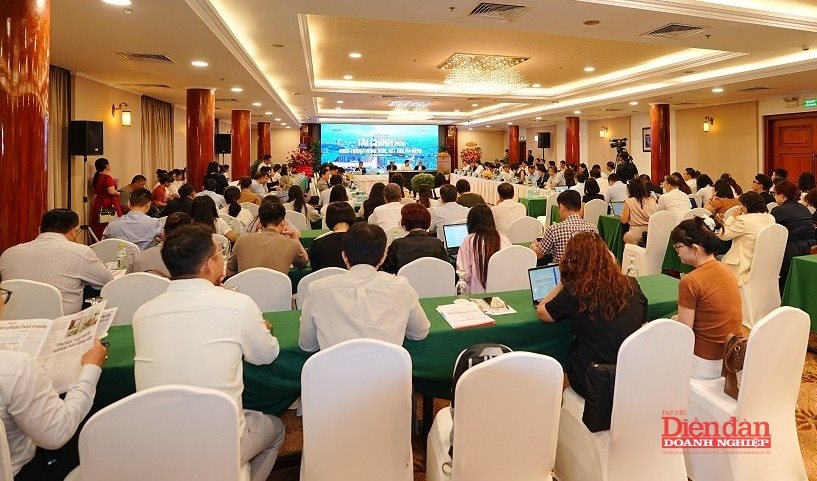 The Forum attracted a large number of participating enterprises.
He also expressed his expectation that the Forum would serve as a platform for candid discussions without avoidance among policymakers, financial institutions, investment organizations and the business community. Participants gathered not only to jointly design safer, more efficient and diversified financing channels, but also to help enterprises recognize the need to improve transparency and restructure governance systems to strengthen their ability to absorb capital.
“VCCI remains committed to standing alongside the business community and consolidating practical initiatives and recommendations from this Forum for submission to the Government and relevant ministries and sectors, thereby continuing to improve the legal framework, create a more favorable investment and business environment, and unlock every available resource for development,” Mr. Hoàng Quang Phòng further emphasized.
The Forum was attended by Mr. Hoàng Quang Phòng, Vice President of VCCI; Mr. Nguyễn Phi Lân, Director General of the Department of Forecasting, Statistics and Monetary-Financial Stability under the State Bank of Vietnam; Mr. Trịnh Sơn Hồng, Acting Chairman of the Ho Chi Minh City Stock Exchange; Associate Professor Dr. Nguyễn Hữu Huân, Vice President of the Executive Agency of the International Financial Center of Vietnam in Ho Chi Minh City; Mr. Nguyễn Thanh Toàn, Deputy Director of the Ho Chi Minh City Department of Finance; Mr. Trần Ngọc Liêm, Director of VCCI Ho Chi Minh City Branch; Ms. Nguyễn Thị Toại, Head of the Representative Office of the Ministry of Finance; Ms. Trần Thị Hải Yến, Director of the Southern Investment Promotion, Information and Support Center under the Foreign Investment Agency of the Ministry of Finance; Ms. Huỳnh Thị Hồng Nhung, Director of the Department of Science and Technology of Tây Ninh Province; Dr. Đỗ Thiên Anh Tuấn, Senior Lecturer at the Fulbright School of Public Policy and Management; Mr. Lê Hoàng Châu, Chairman of the Ho Chi Minh City Real Estate Association, among others.
Representing the organizers were journalist Phạm Hùng, Deputy Editor-in-Chief and Head of the Ho Chi Minh City Representative Office of Business Forum Magazine, and journalist Nguyễn Tiến Dũng, Deputy Editor-in-Chief, together with representatives from local departments and agencies, associations, enterprises, project developers, financial institutions, investment funds and investors from Ho Chi Minh City and the southern region.