VIETNAM CHAMBER OF COMMERCE AND INDUSTRY
Liên Đoàn Thương Mại Và Công Nghiệp Việt Nam
Wed, Jun 24, 2026, 15:50:00

National Conference for Business Associations organized by VCCI
Business associations under pressure to renew operations
At the 2026 National Conference for Business Associations organized recently in Hanoi by Vietnam Chamber of Commerce and Industry (VCCI), many participants agreed that Vietnam’s business association system is entering a new stage of development, with higher demands for operational quality and representative capacity.
According to Nguyen Duc Phong, Vice President of the Vietnam Fatherland Front Central Committee, during the 2024-2026 period, VCCI and business associations provided feedback on thousands of legal documents covering taxation, customs, and investment, making an important contribution to administrative reform and improvements in the business environment. However, he said that the current requirement goes beyond policy feedback to a higher level of substantive representation.
“An association is not only a place to bring members together but must become an effective bridge between enterprises and state management agencies,” Nguyen Duc Phong said, adding that Resolution 68-NQ/TW on private sector development is creating new opportunities while also increasing pressure to renew the way associations operate.
Sharing this view, VCCI President Ho Sy Hung said that amid deep integration and growing competition, business associations cannot stop at protecting member interests but must take a more active role in institutional reform, improving competitiveness, and strengthening business linkages.
He said policy advocacy should become a core capability of associations in the new phase. At the same time, associations need to shift from “policy reaction” to “policy creation,” participating earlier in the legislative process instead of providing feedback only when draft regulations are nearly finalized.
Vietnam currently has more than 700 business and entrepreneur associations operating at provincial level and above nationwide. However, their quality varies considerably. According to Hoang Van Anh, Director of the Membership Department at VCCI, a recent survey found that enterprises join associations mainly for practical needs (40.9%), followed by association reputation (28%) and value chain linkage needs (18.7%). This reflects growing expectations from enterprises for more practical and effective association activities.

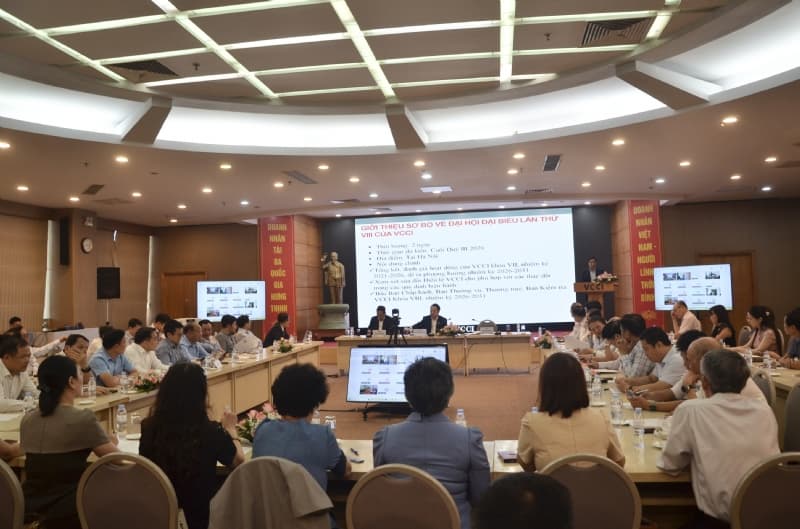
Overview of the event
From a “feedback forum” to a “development driver”
At the conference, many proposals emphasized the need to transform association operating models toward greater professionalism, autonomy, and leadership capacity.
Nguyen Thi Nga, Chairwoman of BRG Group and Acting Chairwoman of the Vietnam Private Entrepreneurs Association, said current associations still lack sufficient connectivity to create broader synergy. She recommended Vietnam study the “Keidanren Vietnam” model similar to Japan, forming a business federation with stronger influence in policy advocacy and long-term development support.
She also proposed establishing a “New Economic Thinking Center,” where associations would not only reflect business difficulties but also conduct research and forecast economic trends, particularly in areas such as digital transformation, artificial intelligence, and ESG standards.
Along with this, the proposal to establish a national digital dialogue mechanism between the Government, ministries, and business associations also attracted attention. The model is expected to shorten policy response time, increase transparency, and improve coordination efficiency between the state and enterprises.
Phan Duc Hieu from the National Assembly’s Economic and Financial Committee proposed that VCCI develop a “VCCI White Book” to annually compile business concerns and monitor policy implementation progress, thereby creating continuous and systematic pressure for reform.
He also stressed that associations should strengthen direct and practical support for enterprises instead of limiting themselves to policy dissemination. This includes support in financial standardization, governance, auditing, and compliance capacity building.
Meanwhile, many participants said the legal framework governing association operations remains incomplete. Currently, Decree 126/ND-CP serves as the main legal basis, but it does not fully cover increasingly diverse professional activities. VCCI recommended the early completion of a new legal framework and the development of criteria to assess association capacity, along with mechanisms allowing qualified associations to participate in public service delivery.
Another issue raised was autonomy. Many associations still rely on administrative or state financial support, reducing incentives for innovation and improving service quality for members. Therefore, VCCI recommended the early completion of a new legal framework to replace Decree 126/2024/ND-CP on the organization, operation, and management of associations, with clearer regulations on operating mechanisms, legal status, and performance evaluation criteria for business associations. It is necessary to develop capacity criteria so qualified associations can participate in public service delivery, policy research, and enterprise support programs.
VCCI President Ho Sy Hung said the development of business associations has always been closely linked with Vietnam’s economic reform process, private sector development, and international integration. In the new context, associations need to continue renewing their operating models, improving professionalism, and strengthening linkages to truly become a support foundation for the business community. This is also an important condition for the private sector to achieve stronger growth in the coming period.
Strengthening consultation and transparency in policy feedback
Ngo Khac Le, Deputy Secretary General of the Vietnam Logistics Business Association
 |
In reality, many legal documents directly affecting enterprise interests are sent to associations at a very late stage, with consultation deadlines sometimes limited to only 3 to 5 days. This leaves little time for members to conduct in-depth surveys or gather practical expert opinions.
Drawing from the experience of the logistics sector, which contributes significantly to the country’s record trade turnover of US$930 billion, we proposed establishing a transparent feedback and explanation mechanism after consultations. Policy criticism should not stop at commenting on draft documents but should serve as an early warning mechanism from the market. Accordingly, associations should participate in drafting committees from the initial stage to ensure policies reflect business realities, avoiding situations where drafting agencies maintain previous views despite repeated recommendations from associations.
 |
Policy feedback must reflect business reality
Tran Manh Bao, Chairman of the Vietnam Seed Trade Association (VSTA), Chairman of ThaiBinh Seed Group
Vietnam is entering a new development phase with the goal of becoming a developed, strong, and prosperous nation. In this process, the business community is an important driving force of the economy, while business associations serve as a bridge between enterprises and the State, and between policy and business practice.
In the seed sector, we define our key mission as connecting members, protecting the legitimate rights of enterprises, promoting a transparent business environment, and accompanying regulatory agencies in developing industry policies.
From practical operations, we believe an association is only truly strong when members receive practical benefits from participation. Therefore, VSTA currently focuses on three groups of activities: member support, policy criticism, and promoting business environment reform.
Among these, policy consultation is the most important task, but also an area where many associations remain hesitant to engage fully. Policy consultation is not about challenging regulators. It is about bringing practical perspectives from production and business into the policymaking process so that policies are more realistic and easier to implement.
Business associations should participate earlier and more deeply in policymaking, starting from the drafting stage. Enterprises must accelerate innovation, digital transformation, and green development to improve competitiveness in the coming period.
The greatest strength of business associations lies not in the size of their membership, but in their solidarity, social responsibility, and aspiration to contribute to the country.
VCCI must become a platform for the business community in new development phase
 |
Pham Dinh Doan, Chairman of Phu Thai Holdings Group
From 2026, Vietnamese enterprises will enter a completely new development phase, as the pace of change over the next five years may equal several previous decades combined. This creates major pressure and challenges for the business community in organizing production, integration, and long-term development strategies.
In this context, the role of VCCI becomes increasingly important. VCCI should not only represent the Vietnamese business and entrepreneur community but also become a platform that connects, supports, and leads enterprises in the new development phase.
VCCI needs to redefine its role and operations, clearly positioning itself as the central organization connecting business associations and entrepreneurs nationwide. In the current trend toward ecosystem and platform-based development, VCCI should serve as a platform that helps enterprises access resources related to policy, capital, technology, markets, and human resources.
In my view, VCCI should promote three major roles. First, becoming an “economic think tank” for the private sector and for the Government through research, policy criticism, and policy recommendations. Second, serving as a national resource connection platform to create more effective industry linkages. Third, acting as a leader in improving enterprise capacity, especially in training CEO teams and supporting small and young enterprises.
To achieve double-digit growth, Vietnam needs not only strong enterprises but also a strong ecosystem of business associations, effectively connected and led by VCCI.