VIETNAM CHAMBER OF COMMERCE AND INDUSTRY
Liên Đoàn Thương Mại Và Công Nghiệp Việt Nam
Wed, Sep 30, 2026, 15:48:00
 |
Global supply chains are changing rapidly, with growing demands for digitalization, resilience and green development. In your view, what opportunities do these changes create for Vietnam’s logistics industry?
I believe the biggest change in global supply chains today is that cost optimization is now accompanied by greater requirements for resilience, transparency, speed and sustainable development. Businesses are concerned not only about transportation costs, but also about whether supply chains can continue operating amid disruptions and effectively manage the flow of goods, emissions and data for trade, finance and compliance.
This presents a major opportunity for Vietnam. In 2025, total import-export turnover reached US$930.05 billion, up 18.2%; in the first seven months of 2026 alone, it reached US$659.58 billion, up 28.1% year on year. With its high degree of economic openness, favorable position along Asian trade flows, and network of seaports, airports, border gates and connectivity corridors linking ASEAN and China, Vietnam has an opportunity to move from a production base toward organizing, distributing and coordinating regional supply chains.
However, in the first seven months of 2026, the foreign direct investment (FDI) sector accounted for 80.1% of export turnover, while manufactured and processed industrial goods accounted for more than 90%. Therefore, the issue is not simply whether cargo volumes are rising, but how much value Vietnamese logistics businesses can capture within supply chains. If they only handle domestic transportation, customs declarations or low-margin freight forwarding, rising trade volumes do not necessarily mean that Vietnam’s logistics capabilities will increase accordingly.
The greater opportunities lie in high-value-added services such as third-party logistics (3PL), fourth-party logistics (4PL) and supply chain management; logistics for electronics, high-tech products and semiconductors; cold-chain and agricultural logistics; e-commerce fulfillment; multimodal transportation; inventory management; regional distribution; and data-driven services.
The second opportunity is trade digitalization. The world is moving from digitalizing individual processes to digitalizing end-to-end transactions, from booking and cargo tracking to bills of lading, documents of title, payment and trade finance. The United Nations Convention on Negotiable Cargo Documents (NCD Convention), adopted by the United Nations General Assembly on December 15, 2025, provides a unified legal framework for negotiable documents in both paper and electronic form for multimodal transportation. FIATA is also promoting the electronic FIATA Multimodal Bill of Lading (eFBL), a negotiable electronic multimodal bill of lading.
If Vietnam prepares early in terms of legal frameworks, data standards and system connectivity, it can reduce document-processing time and transaction costs, improve traceability, facilitate access to trade finance and establish direct connections with international supply chains.
The third opportunity is green logistics. As major export markets and multinational corporations increasingly demand better carbon footprint management, energy efficiency, traceability and ESG performance, green logistics capabilities will become a competitive “passport.” Businesses capable of measuring emissions, optimizing cargo loads and transport routes, using energy-efficient vehicles and warehouses, and increasing the use of low-emission modes of transportation will have an advantage when participating in international supply chains.
Therefore, Vietnam’s opportunity is to move from being a production and cargo-transshipment point to becoming a supply chain link capable of organizing, coordinating and creating value across global supply chains.

To capitalize on these opportunities, how should Vietnamese logistics businesses change their strategies, business models and approaches to cooperation? How can connectivity within the industry be strengthened?
In my view, Vietnamese logistics businesses need to make three major shifts: from standalone services to integrated services; from competing on price to competing on capabilities and data; and from “every business for itself” to supply chain-based cooperation.
Vietnam currently has about 50,000 businesses operating in logistics and related services, of which 15% have international operations, but most are small and medium-sized. Being small does not mean being weak; what matters is having specialized capabilities and the ability to connect with a larger network.
First, businesses need to change their business models. If they all focus on trucking, freight forwarding or customs brokerage and compete primarily on price, profit margins will become increasingly thin. Instead, they need to develop specialized areas such as cold-chain logistics, electronics and high-tech logistics, e-commerce fulfillment, agricultural logistics, cross-border logistics, rail, waterway and multimodal transportation. At a higher level, businesses with sufficient capabilities need to develop 3PL, 4PL and end-to-end supply chain management services, enabling them to participate in logistics tenders organized by major corporations.
Second, data must become a core capability. Digital transformation is not simply about purchasing software; businesses must use TMS, WMS, ERP, AI and data analytics to manage vehicle locations, delivery times, inventory, bottlenecks, costs and emissions. International customers increasingly require visibility, reliability and compliance, not simply transportation services.
Third, businesses must strengthen resilience against risks such as geopolitical conflicts, disruptions to shipping routes, fluctuations in fuel prices, insurance and trade policies. They need to shift from responding to individual incidents to designing supply chains capable of operating under uncertainty, with alternative routes, multiple carriers, combined transportation modes and early-warning systems to support timely decision-making.
Finally, businesses need to strengthen cooperation. A single business may not yet be large enough to provide an entire chain of services to a multinational corporation, but 5-10 businesses with complementary capabilities can form a sufficiently strong service chain. Cooperation can take the form of joint bidding, shared operation of warehouses and distribution centers, shared transportation capacity, technology platforms and data standards, and even joint investment in overseas networks.
From VLA’s perspective, the association needs to help establish common standards, shared data, cooperation platforms and trust among businesses. Through FIATA, Vietnamese businesses also have an advantage in connecting with a broad international logistics network. What matters is having strong enough service standards, reputation and partner networks to provide cross-border services.
In logistics, scale comes not only from the assets a business owns but also from its ability to connect and mobilize resources.

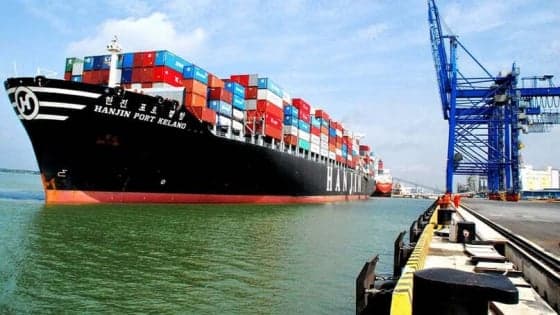
Tan Cang-Cai Mep International Terminal, a key logistics gateway connecting Vietnam with regional and global supply chains
Over the next 5-10 years, what direction should Vietnam’s logistics industry take to better serve the economy and participate more deeply in global supply chains? Which policies and conditions should be prioritized to help businesses strengthen their capabilities?
In my view, this is a particularly important period because, for the first time, Vietnam has a comprehensive, long-term and coordinated strategy for logistics services.
On October 9, 2025, the Prime Minister issued Decision 2229/QD-TTg approving the Strategy for Development of Vietnam’s Logistics Services for 2025-2035, with a vision to 2050. This is a “master blueprint” for the logistics industry, positioning logistics for the first time as an important economic sector with high added value and a driver of trade, investment, production and import-export activities.
By 2035, the strategy targets logistics value added at 5-7% of GDP, average annual growth of 12-15%, logistics outsourcing by businesses at 70-80%, and logistics costs reduced to 12-15% of GDP. It also aims to place Vietnam’s Logistics Performance Index (LPI) ranking in the top 40, have 80% of businesses apply digital transformation, develop at least five modern logistics centers meeting international standards, and provide technical and professional training to 70% of workers. By 2050, the targets are to raise logistics’ share to 7-9% of GDP, reduce costs to 10-12% of GDP, place the LPI in the top 30, have 100% of businesses use digital transformation solutions, and develop at least 10 modern logistics centers, while reducing emissions and contributing to the national Net Zero target.
However, what matters is turning these targets into actual operational capabilities.
The first priority is to connect infrastructure based on corridors and cargo flows rather than developing it in a fragmented manner. Logistics centers must connect effectively with seaports, airports, roads, waterways, railways, ICDs, industrial parks and consumer markets. Planning needs to shift from the mindset of one logistics center per locality toward a national logistics network, clearly defining gateways, hubs, corridors and the role of each region. At the same time, multimodal transportation needs to be expanded, making greater use of inland waterways, railways and coastal shipping to reduce costs, congestion and emissions.
The second priority is institutions and data. Data needs to be connected among customs authorities, ports, shipping lines, logistics businesses, cargo owners, banks and regulatory agencies. Electronic documents, eBL/eFBL, digital signatures and data exchange based on international standards should be promoted. Vietnam should also seriously study the NCD Convention recently adopted by the United Nations to create a legal foundation for electronic negotiable cargo documents and cross-border multimodal transportation.
The third priority is strengthening the capabilities of Vietnamese businesses. The goal is not simply to have more ports, warehouses or larger cargo volumes, but to develop businesses capable of managing regional networks, providing integrated services and gradually investing overseas. At the same time, support should be provided to help small and medium-sized businesses access technology, green financing, training and shared platforms so they can participate more deeply in supply chains.
The fourth priority is quantifying the green transition. The industry needs to move from the slogan of “green logistics” to specific indicators covering emissions per unit of cargo, clean energy use, vehicle efficiency, empty-run rates, low-emission transportation modes and green standards for warehouses, ports and logistics centers. Only when carbon emissions are measured can they be managed, reduced and turned into a commercial advantage.
The fifth priority is to develop human resources and strengthen the adoption of international standards. Future logistics will require professionals with expertise in supply chain management, data, AI, international trade, law, trade finance, ESG and risk management.
A point that deserves a fresh perspective is the LPI target. The strategy aims to place Vietnam in the top 40 by 2035 and top 30 by 2050, while Vietnam ranked 43rd out of 139 in the 2023 LPI. In 2025, the World Bank introduced LPI 2.0, shifting strongly from perception-based surveys toward actual operational data, with a focus on connectivity, speed and service reliability.
Rather than simply pursuing rankings, the industry needs to measure substantive indicators such as cargo dwell time at ports, border-crossing time, schedule reliability, on-time delivery rates, cost per unit of cargo and connection time between transportation modes. When these indicators improve, logistics can truly shift from a support service sector to a national competitive capability, helping Vietnam move from an important supply chain link to a high-value connectivity hub in regional and global supply chains.