VIETNAM CHAMBER OF COMMERCE AND INDUSTRY
Liên Đoàn Thương Mại Và Công Nghiệp Việt Nam
Tue, Aug 25, 2026, 00:26:00
When private infrastructure becomes a barrier to clean energy, conflicts of interest among infrastructure developers, renewable power generators, and large consumers are making it difficult for hundreds of thousands of enterprises to access the energy source they should have the right to choose.
Since Decree No. 80/2024/ND-CP dated July 30, 2024, paved the way for the direct power purchase agreement mechanism (now adjusted by Decree 243/2026/ND-CP dated June 26, 2026), many manufacturing enterprises expected to soon take control of their renewable energy supply—reducing costs while obtaining a "green pass" to retain export orders. In reality, when power transactions go through the internal power grid of an industrial zone (IZ), the bottleneck lies in an unexpected place: a conflict of interest among three parties sharing the same "distribution grid infrastructure."
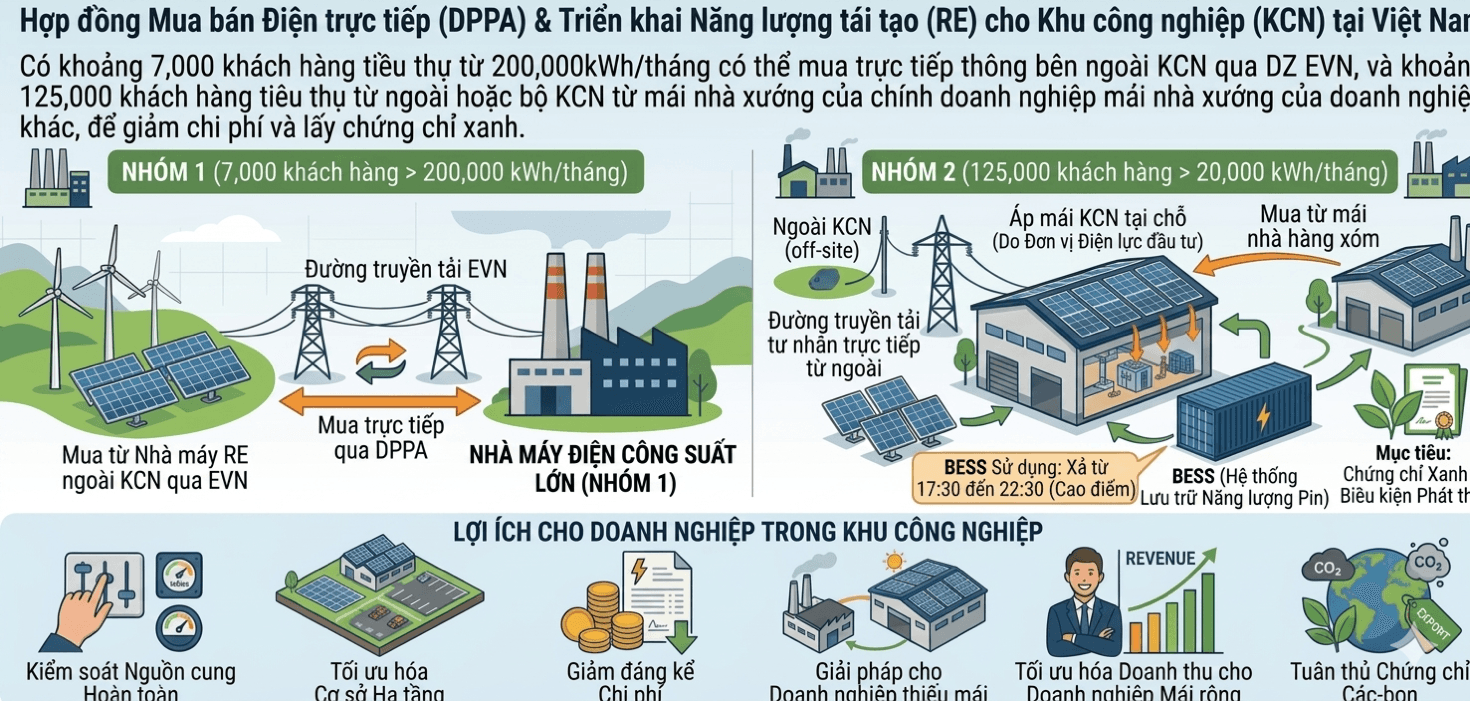
Simulation of customer groups participating in the DPPA mechanism
Three entities sharing a single power grid system
The demand for direct clean power purchase is currently divided into two groups. Large customers consuming 200,000 kWh/month or more can purchase through DPPA via national grid lines. The other group, consuming from 20,000 kWh/month, buys via private lines—either from external sources or within the IZ itself, utilizing factory roofs owned by themselves or neighboring enterprises. This is the shortest path for businesses without sufficient roof area to access cheap, on-site solar power, while roof owners optimize revenue from existing infrastructure. When integrated with Battery Energy Storage Systems (BESS)—charging during off-peak hours and discharging during peak hours (17:30–22:30)—the operational and low-carbon export equation becomes even more feasible.
Behind these benefits, however, IZ infrastructure developers bear significant costs. Building substations and internal distribution lines requires huge upfront capital: 110 kV stations often cost 150–200 billion VND, while 220 kV stations can reach 300–500 billion VND, excluding operation, periodic testing, and internal transmission losses. This investment is recovered through electricity price markups (around 3% at medium voltage and 8% at low voltage). When businesses switch to buying directly from renewable energy generators, infrastructure developers risk losing stable revenue while their grid is still utilized without clear compensatory mechanisms.
The bottleneck stems from ownership: IZ distribution grids are private assets outside EVN’s direct management, so the State cannot compel developers to rent out infrastructure unconditionally. Without a unified framework for internal grid rental fees, developers may inflate rates or deny connection, rendering DPPA financially unappealing. Furthermore, liability frameworks for grid incidents among generators, buyers, and infrastructure owners remain unprecedented, making all sides hesitant to negotiate.
International experience
International experience shows that regulatory bodies play a decisive role in arbitrating between infrastructure owners and market participants.
In India, state electricity regulatory commissions explicitly unbundled distribution tariffs by voltage level, capped fees at low levels, and mandated a 50–75% reduction in internal transmission fees for solar and wind energy. Grid owners cannot refuse connection if safety standards are met; commercial reasons cannot block access to clean power.
In the European Union, the non-discriminatory access principle treats grids—including private internal and IZ grids—as essential national infrastructure subject to competition law. Developers must grant third-party access for clean energy transmission or face penalties for monopoly abuse. Grid rental fees are regulated based on actual costs plus a reasonable profit margin.
South Africa uses unified transmission tariffs regardless of whether power is purchased from the national utility or independent renewable developers, eliminating grid owners' ability to leverage pricing pressure.
Across all three models, regulators act as neutral arbitrators, separating infrastructure service fees from power prices to ensure transparent competition.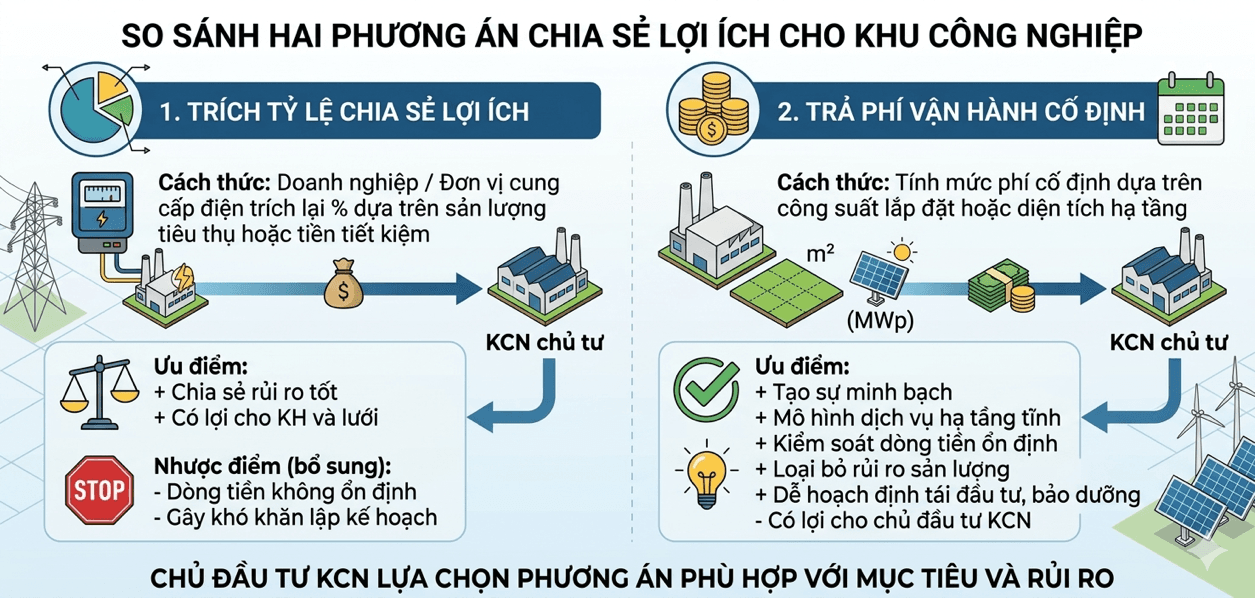
DPPA in industrial zones cannot run smoothly without a clear mechanism for grid rental fees, technical responsibilities, and party rights built on transparency and fairness.
Tight coordination among three parties
Domestically, Vietnamese authorities are removing price frame restrictions on private or internal grid DPPA transactions, allowing parties to negotiate power and infrastructure fees commercially. Expanding retail license eligibility in IZs is also expected to curb developer monopolies over grid connections.
However, policies are merely a necessary condition. The sufficient condition lies in establishing genuine cooperation models. Experts suggest prioritizing on-site rooftop solar: generators lease factory roofs to supply power directly to occupiers, minimizing reliance on main transmission lines. Combining storage systems further enhances operational flexibility.
Additionally, tripartite models offer a practical compromise where buyers and generators share benefits with infrastructure developers. Options include: First, percentage-based benefit sharing tied to consumption or savings (sharing risks, though developer cash flow fluctuates seasonally); Second, fixed monthly or annual operation fees per MWp of installed capacity or square meter of infrastructure, providing predictable cash flow for grid maintenance and reinvestment.
Ultimately, DPPA in industrial zones requires clear rules on rental pricing, technical obligations, and party rights overseen by regulatory bodies rather than unguided negotiations. Unlocking infrastructure bottlenecks is essential to making clean power accessible and helping enterprises achieve genuine decarbonization.