VIETNAM CHAMBER OF COMMERCE AND INDUSTRY
Liên Đoàn Thương Mại Và Công Nghiệp Việt Nam
Wed, Aug 19, 2026, 16:14:00
According to the H1/2026 Vietnam Real Estate Market Research Report by the Dat Xanh Services Economic - Financial - Real Estate Research Institute (DXS-FERI), real estate M&A activity was quite vibrant in the first half of the year. Notably, transactions went beyond project transfers to include capital contributions, subdivision acquisitions, and joint land bank developments.
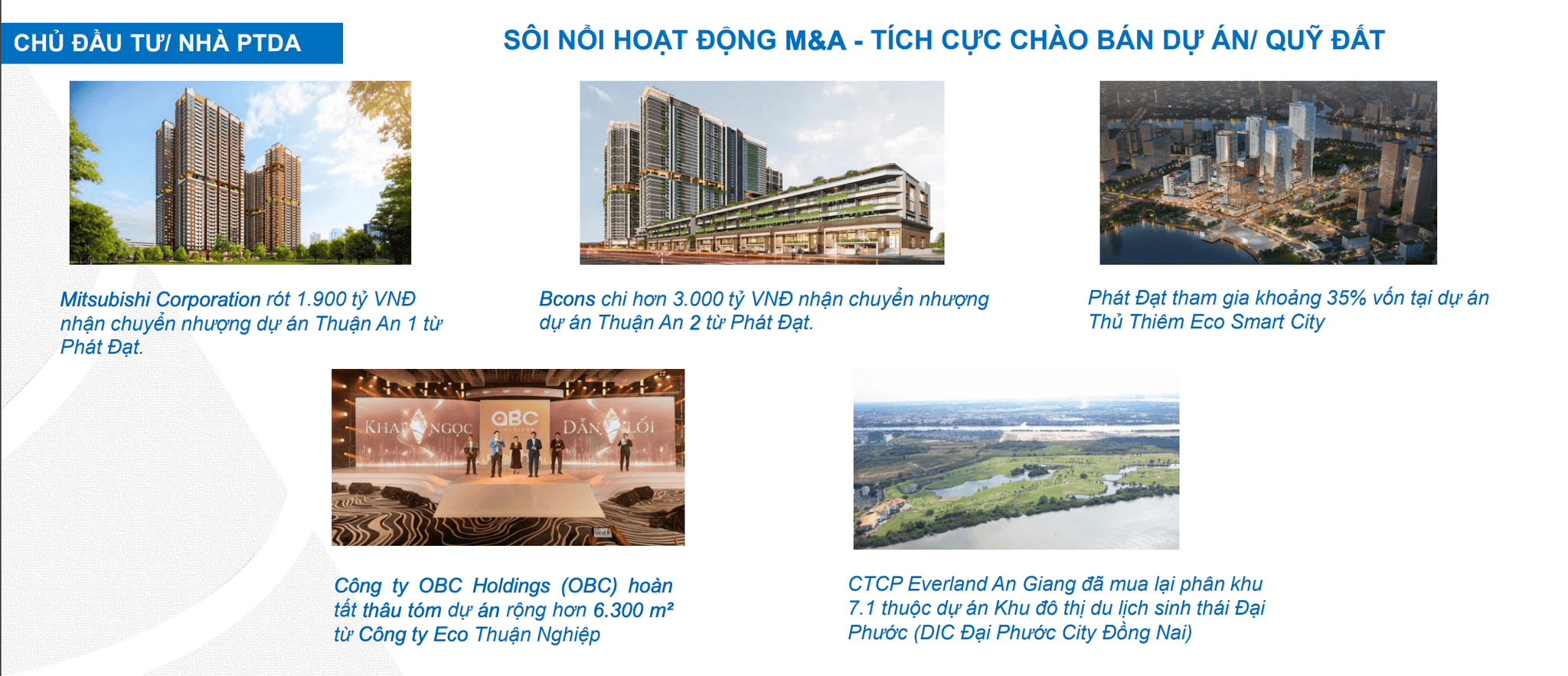
Real estate M&A activity heats up again with numerous project transfers, land bank acquisitions, and joint ventures. Source: DXS-FERI.
Land Banks Take Center Stage
Some notable transactions highlighted in the report include Mitsubishi Corporation investing 1,900 billion VND to acquire the Thuan An 1 project from Phat Dat and Bcons spending over 3,000 billion VND to acquire the Thuan An 2 project from Phat Dat.
In terms of joint investment, Phat Dat contributed approximately 35% of the capital to the Thu Thiem Eco Smart City project. Meanwhile, OBC Holdings completed the acquisition of a project exceeding 6,300 m² from Eco Thuan Nghiep Company, and Everland An Giang JSC acquired subdivision 7.1 of the Dai Phuoc Eco-Tourism Urban Area (also known as DIC Dai Phuoc City) in Dong Nai.
These deals demonstrate that M&A is becoming an important channel for enterprises to restructure investment portfolios, supplement land banks, and access projects with prior preparation.
According to DXS-FERI, a key driver behind the current M&A wave stems from the pilot mechanism under Resolution 171/2024/QH15. This mechanism permits pilot commercial housing projects through agreements to acquire land use rights or existing land use rights across various land types.
Against this backdrop, several developers are actively searching for suitable land banks to purchase or co-develop. Conversely, the market sees many developers offering land banks and projects for sale, particularly non-specialised real estate developers.
This creates a meeting point between two market needs: one side requiring additional land banks to maintain their project development cycle, and the other seeking asset transfers or capable development partners.
Thus, M&A is viewed not merely as a financial transaction but increasingly aligned with land bank development strategies and corporate restructuring for real estate firms.
From Project Transactions to Strategic Restructuring
M&A developments should also be viewed within the context of strong market polarization. DXS-FERI noted that new supply in H1/2026 reached approximately 37,300 units, a 16% increase year-over-year but a 44% decline compared to H2/2025. Total absorption was estimated at around 26,100 units, down 12% year-over-year and down 62% compared to the second half of 2025.
.jpg)
Land banks with suitable legal status are becoming priority targets for many real estate enterprises in their expansion and project development strategies. Photo: DH
In an environment of uneven liquidity, project execution capability, legal quality, and alignment with market demand have become increasingly decisive factors in investment decisions.
In practice, buyers in the first half of the year remained cautious, prioritizing legally sound projects serving real housing needs, positioning to capitalize on infrastructure, and placing heavy emphasis on developer reputation.
These factors directly influence how companies select M&A targets. Instead of expanding land banks purely in quantity, enterprises are focusing more on asset quality, execution viability, and commercial potential.
DXS-FERI forecasts that new real estate supply in H2/2026 could increase by approximately 33,000 units, bringing total primary supply to over 100,000 units. The apartment segment will continue to play a dominant role, with transactions driven mainly by end-user demand and mid-to-long-term investment.
In this context, the need for portfolio restructuring, land bank expansion, and strategic partnerships will likely sustain momentum for M&A activity.
However, this trend will come with greater selectivity. As the market transitions from a broad-based recovery to polarisation, not all projects will hold equal appeal. Assets with clear legal status, strategic locations, execution readiness, and market relevance will hold a distinct advantage when seeking partners.
Echoing this view, Mr Ta My Bach, Capital Markets Director at JLL Vietnam, noted a clear shift from growth-expectation strategies toward investment focused on asset quality and real operational efficiency. Amid elevated capital costs, investors increasingly favour projects capable of generating stable cash flows, possessing long-term competitive edges, and meeting sustainable development standards. These will be the key factors determining the market's capital attraction in the upcoming period.
Foreign investors are expected to maintain strong interest and commitment to the Vietnamese real estate market. Both existing and new investors are actively seeking projects with clear legal status, high quality, and strong alignment with return and risk management criteria.