VIETNAM CHAMBER OF COMMERCE AND INDUSTRY
Liên Đoàn Thương Mại Và Công Nghiệp Việt Nam
Wed, Jun 17, 2026, 15:27:00
The survey, Country-of-Origin Image among Vietnamese consumers, found that perceptions of product quality remain strongly tied to country of origin, with Japan maintaining a clear lead over both European and Asian competitors.
Nearly 60% of respondents said they held a “very positive” view of products made in Japan, far ahead of other countries included in the survey – the U.S., South Korea, and China.
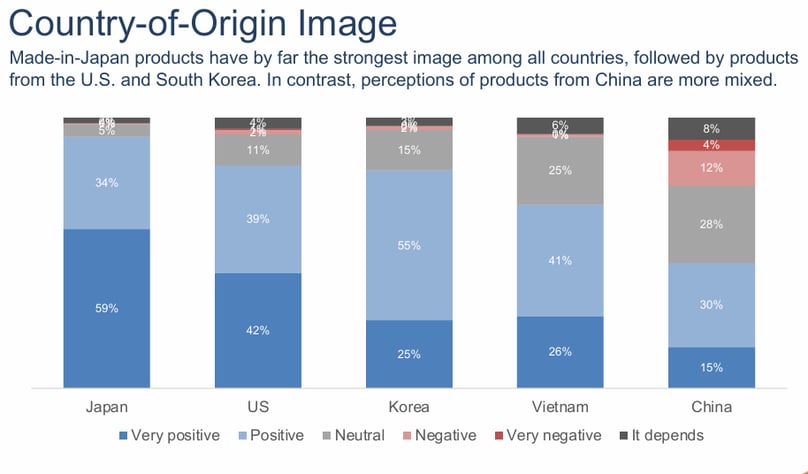
Japan’s dominance extends across the attributes consumers value most. More than 80% of respondents associated Japanese products with high quality, while 78% cited trustworthiness and 57% linked them to efficiency. Notably, Japanese products recorded virtually no significant negative associations in the survey.
The U.S. ranked second in overall perception, with 42% of consumers expressing a very positive view of American products.
While Japan dominates on trust and quality, U.S. brands have carved out a premium positioning. Respondents most frequently associated American products with international prestige and premium quality, reflecting the influence of globally recognized technology and consumer brands.
The survey shows that South Korea and Vietnam occupy a distinct middle tier in the consumer hierarchy. South Korean products received strong recognition for design, with nearly half of respondents identifying the country as a leader in aesthetics and product innovation. The country's influence is driven largely by electronics brands, particularly Samsung, which emerged as the most recalled foreign brand in Vietnam with an awareness rate of 74%.
Vietnamese products, meanwhile, benefit from familiarity rather than premium positioning. Three-quarters of respondents associated domestic products with familiarity and accessibility. However, the survey suggests local brands still face challenges in convincing consumers that they can consistently match the quality standards associated with Japanese, American or South Korean products.
Among domestic brands, dairy producer Vinamilk (HoSE: VNM) ranked as the most recognized name (38%), followed by EV maker VinFast (33%) and its parent company Vingroup (28%).
A significant finding from the survey is the widening generational divide in attitudes toward both Chinese and Vietnamese products.
Overall, China remains the least favored country of origin in the survey. Only 15% of respondents expressed positive sentiment toward Chinese products, while many continued to associate them with lower quality and weaker reliability.
Yet younger consumers appear to hold markedly different views. Among respondents in their 20s, positive perceptions of Chinese products reached 23%, compared with just 5% among those in their 40s. A similar pattern emerged for Vietnamese products, with younger consumers expressing significantly stronger confidence in domestic brands than older generations.
The findings suggest that younger shoppers are increasingly evaluating products based on functionality and price rather than historical perceptions tied to country of origin.
The survey also highlights the extent to which a handful of leading companies influence perceptions of entire countries. In Japan’s case, automotive giants Toyota and Honda remain the strongest symbols of quality and reliability among Vietnamese consumers. For the U.S., Apple emerged as the most recognized brand by a wide margin, followed by Ford and Google.
China’s image is increasingly being shaped by technology companies rather than traditional low-cost manufacturing. Xiaomi has overtaken Huawei as the most recognized Chinese brand in Vietnam, reflecting the growing popularity of competitively priced consumer electronics among younger buyers.
While Japan’s reputation for quality remains deeply entrenched across all age groups, the survey suggests Vietnam’s consumer landscape may be entering a gradual transition.
The broad-based trust enjoyed by Japanese brands continues to provide a formidable competitive advantage. However, the rising acceptance of Chinese and Vietnamese brands among younger consumers indicates that perceptions built over decades may slowly evolve as a new generation of shoppers gains purchasing power.