VIETNAM CHAMBER OF COMMERCE AND INDUSTRY
Liên Đoàn Thương Mại Và Công Nghiệp Việt Nam
Mon, Dec 29, 2025, 12:09:00
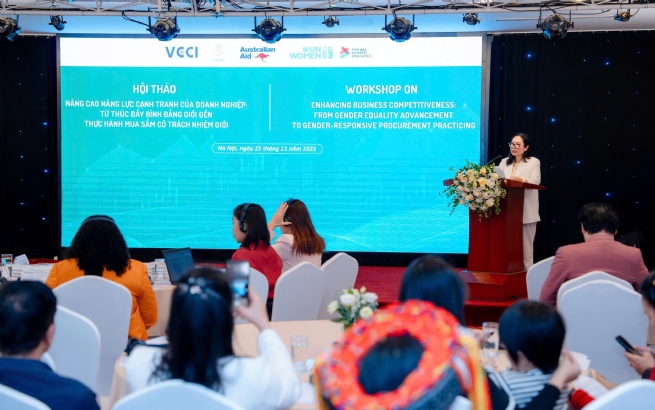
Overview of the workshop
At a workshop focused on improving the competitiveness of female-led businesses, organized by the Vietnam Women Entrepreneurs Council (VWEC) under the Vietnam Chamber of Commerce and Industry (VCCI) and the United Nations Entity for Gender Equality and the Empowerment of Women, Mai Thi Dieu Huyen, Vice Chairwoman in charge of VWEC, said that most women-owned enterprises still face barriers related to scale, capital, market connections, and access to high value supply chains.
According to Nguyen Thi Bich Thuy, Deputy Director of the Division of Enterprise and Household Business Support (Department of Private Enterprise and Collective Economy Development, Ministry of Finance), as of October 2025 Vietnam had more than 1 million active enterprises, including more than 20% owned by women and more than 50% with female participation in ownership structures.
The number of women owned enterprises has continued to rise in recent years, growing at least 2% a year, a rate higher than the overall business sector. Vietnam is also among the markets with one of the most dynamic groups of women entrepreneurs and one of the most effective networks of women led enterprises in ASEAN.
However, women owned enterprises face several key obstacles: small scale and limited networks; difficulty accessing finance; constraints in management skills and innovation; and the burden of social roles and gender bias.
According to Huyen, in this context the project “Enhancing women’s economic empowerment in Asia Pacific through advancing gender responsive procurement” implemented by UN Women with support from the Government of Australia is creating new opportunities for enterprises to strengthen competitiveness and participate more deeply in sustainable value chains.
In particular, the Women’s Empowerment Principles (WEPs) and gender responsive procurement, an initiative of UN Women, are becoming global trends. They help enterprises enhance sustainable competitiveness, expand markets, attract responsible investors, and generate positive social impact.
As of November 16, 2025, a total of 11,655 enterprises and organizations in more than 160 countries had signed on to the WEPs. In Vietnam, the number of participating enterprises rose from 67 in 2020 to about 239 in November 2025, reflecting growing momentum within the business community.
Huyen noted that in the current phase of development, enterprises, especially women-owned enterprises, need a transparent and inclusive ecosystem that enables women to participate equally in economic activity. Promoting the WEPs and GRP is one of the strategic solutions to build diverse and sustainable supply chains, strengthen market resilience, foster innovation, and expand opportunities for women to access, participate in, and benefit fairly from economic growth.
“Advancing gender equality is essential for enterprises to raise competitiveness standards in the new era. When enterprises respect differences, ensure equal opportunity, and practice gender responsive procurement, they also open the door to larger, more professional, and more sustainable supply chains. As the national organization representing women entrepreneurs and a strategic partner of UN Women, VWEC -VCCI is committed to continuing to work with UN Women and partners to implement the WEPs and GRP. We will support capacity building for women owned enterprises through training, advisory services, and knowledge sharing; strengthen market connections; and help women owned enterprises expand cooperation opportunities domestically and internationally,” Huyen emphasized.
According to Caroline T. Nyamayemombe, UN Women Country Representative in Vietnam, when government agencies, the private sector, and development partners work together, they advance gender equality and create momentum for broader economic and social development. “UN Women remains ready to support and help create more success stories of gender responsible enterprises in Vietnam,” Caroline T. Nyamayemombe said.