VIETNAM CHAMBER OF COMMERCE AND INDUSTRY
Liên Đoàn Thương Mại Và Công Nghiệp Việt Nam
Thu, Aug 13, 2026, 16:10:00
The Vietnam-Australia Science, Technology, Innovation, and Education - Training Cooperation Forum (Tech Connect) recently took place in Sydney within the framework of the State visit to Australia by General Secretary and President To Lam.
The event took place more than two years after Vietnam and Australia upgraded their relations to a Comprehensive Strategic Partnership in March 2024. While trade, investment, and education have built a solid foundation for the economic relationship between the two countries over many years, science, technology, and innovation are expected to become a new driving force.
At Tech Connect, fields such as artificial intelligence, semiconductors, digital technology, quantum technology, clean energy, strategic minerals, research, and workforce training were placed on the cooperation agenda among universities, research institutes, businesses, and investors from both nations.
These are also sectors capable of complementing the strengths of each economy. Australia possesses an advanced research and higher education system, strong capital resources, and high-tech capabilities. Meanwhile, Vietnam offers a market of nearly 100 million people, a rapidly growing digital economy, and a high demand for technology, infrastructure, and high-quality human resources.
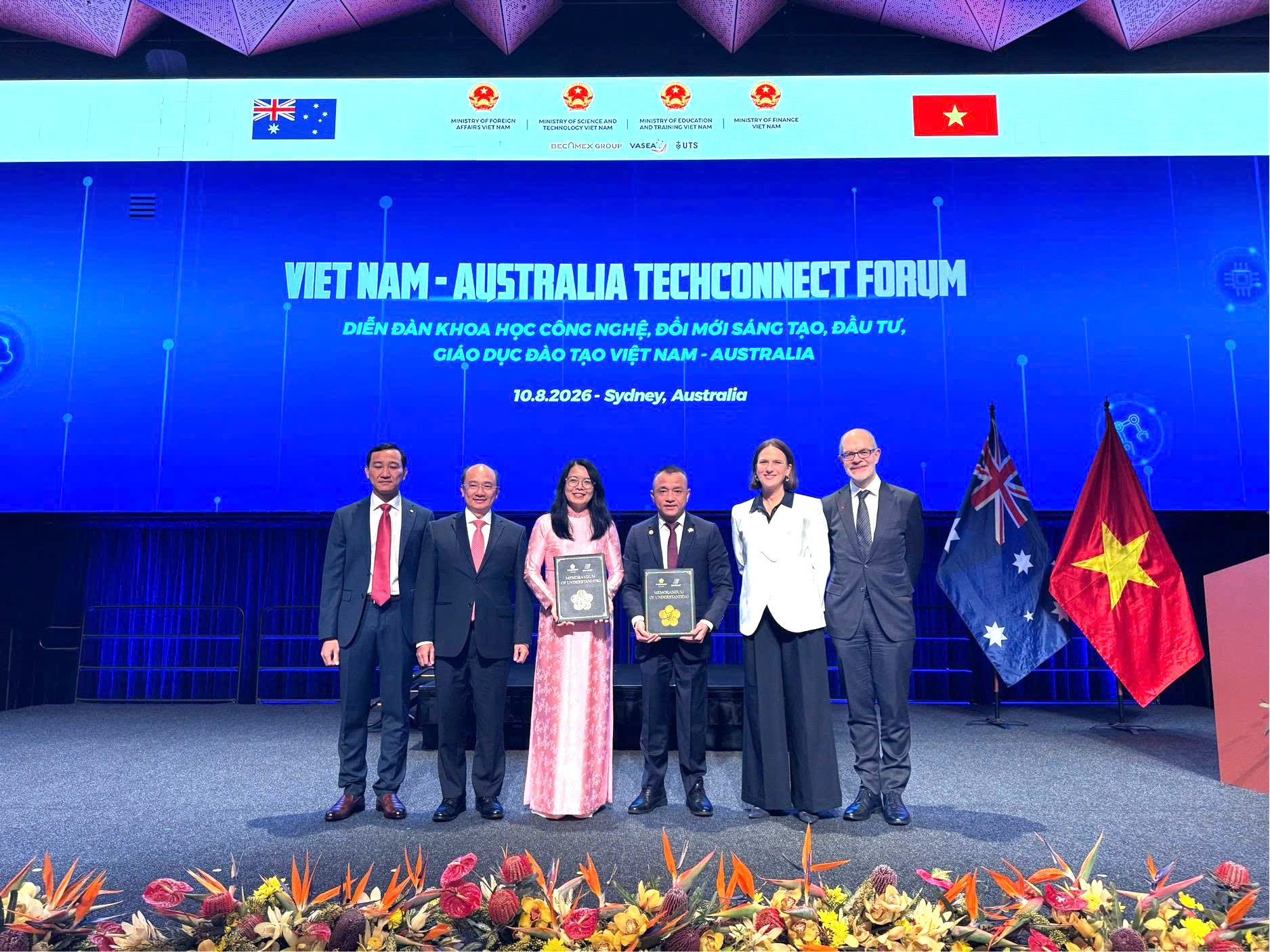
MoU exchange ceremony at the Vietnam - Australia Science, Technology, Innovation, and Education - Training Cooperation Forum (Tech Connect) held on August 10 in Sydney (Photo: Provided by character)
From a Trade Foundation to New Impetuses
According to Australia's Department of Foreign Affairs and Trade (DFAT), total two-way trade in goods and services reached approximately AUD 30 billion in 2025. In the first six months of 2026, figures from Vietnam indicate that two-way turnover reached around USD 8.1 billion, an increase of nearly 22% compared to the same period last year. Vietnam's exports to Australia reached about USD 3.8 USD billion, up by over 25%.
Both countries are targeting two-way trade of USD 20 billion while doubling bilateral investment.
The trade structure has long relied heavily on traditional complementary sectors such as energy, raw materials, agriculture, processed goods, and educational services. Expanding cooperation into science, technology, and the digital economy could help the economic ties between the two countries develop higher value-added trade and investment flows.
Australia and Vietnam are promoting cooperation in strategic technology, innovation, digital transformation, and workforce training. The Australia - Vietnam Strategic Technology Centre was launched in 2025, covering programs related to artificial intelligence, cybersecurity, satellites, and quantum technology. The Aus4Innovation program also continues to support the innovation ecosystem in Vietnam.
This edition of Tech Connect introduced more businesses and private capital into that process by linking research activities with technology commercialisation needs and market demand.
Flow of People Drives Demand for Digital Connectivity
An advantage of the Vietnam-Australia relationship is the growing level of connectivity between the peoples of both nations.
Australia's 2021 Census recorded approximately 335,000 people identifying with Vietnamese ancestry, including nearly 258,000 born in Vietnam. This community creates frequent links in family, education, tourism, investment, and business between the two countries.
Two-way tourism is also expanding rapidly. Australia is currently one of the key markets for Vietnamese tourism. Along with the number of Vietnamese living, studying, and working in Australia, the rise in travel between the two countries generates growing demand for cross-border digital services.
This foundation opens up opportunities for new markets, with payments being one of the most visible examples.
Vietnam has become a fast-growing digital payment market in the region, driven by the popularity of instant transfers, banking apps, and QR codes. Alongside this is the demand for international remittances, travel payments, tuition fees, and cross-border commercial transactions.
The scale of these money flows is substantial. The World Bank previously projected remittance inflows into Vietnam to reach around USD 15 billion in 2025, with Ho Chi Minh City alone receiving over USD 10.3 billion in remittances that year.
Transaction costs remain a major hurdle in the international money transfer market. World Bank data shows that the global average remittance cost remains above 6% of the transaction value. This leaves room for banks, payment companies, and fintech firms to develop more direct connectivity models between markets with large flows of people and money.
When Fintech Meets Tourism
One of the agreements signed at Tech Connect on August 10 highlights the growing intersection between digital finance and service industries.
EzyRemit and its platform EzyWallet signed a Memorandum of Understanding (MoU) with Saigontourist Group to research integration models between digital payments and the tourism ecosystem.
Under the agreement, the two sides will explore integrating EzyWallet's digital payment solutions into Saigontourist's service ecosystem, connecting customer networks in Australia and international markets with tourism products, and researching payment programs, customer loyalty schemes, and value-added services for users.
This cooperative direction reflects a broader shift in the tourism industry. Payments are increasingly becoming an integral part of the entire customer journey, from booking services, transportation, and accommodation to spending at the destination. For international travel routes experiencing rapid growth in visitor numbers, seamless payment connectivity benefits both travel enterprises and consumers.
A notable point lies in the human mobility between the two countries. Tourists, students, the Vietnamese community in Australia, and businesses operating across both markets all require financial services capable of functioning cross-border. As these groups expand, the market for accompanying payment products and digital services expands alongside them.
Digital payments represent just one component of the broadening Vietnam - Australia tech cooperation landscape.
Behind financial transactions lies a broader ecosystem encompassing data, cybersecurity, artificial intelligence, e-commerce, digital tourism, financial technology, and workforce training. These are all sectors where the private sector can play an increasingly prominent role alongside government-to-government cooperation programmes.
This connectivity can add depth to bilateral economic ties. A research outcome can transform into a commercial product, a training programme can supply talent for tech companies, and a payment platform can support tourism, trade, and money flows between the two nations.
With two-way trade already reaching tens of billions of AUD, the next challenge is to maximise the value generated across every economic connection.
Strengthening cooperation in science, technology, innovation, and education demonstrates that both countries are actively seeking a new wave of momentum for their Comprehensive Strategic Partnership. Agreements reached between enterprises at Tech Connect—starting from specific sectors like payments and tourism—could serve as essential building blocks in that ongoing process.
If traditional trade established the scale of Vietnam-Australia relations over the past two decades, the digital economy can unlock additional growth space for the next phase.