VIETNAM CHAMBER OF COMMERCE AND INDUSTRY
Liên Đoàn Thương Mại Và Công Nghiệp Việt Nam
Thu, Aug 27, 2026, 16:17:00
In the context of Vietnam's economy aiming for double-digit growth, the small and medium enterprise sector (SME) is expected to be one of the core drivers. However, actual data reveals a multi-dimensional picture with numerous challenges regarding financial health, growth capacity, and room for credit access.
Credit Bottlenecks for SMEs
According to the periodic report following the 2025 study titled "Vietnamese SMEs: Maturity Level and Credit Access" by FiinGroup, while policies continue to support SMEs in capital, digital transformation, governance, and markets, financial institutions are also paying increasing attention to this segment. Assessing the maturity level, financial health, and risk profile of SMEs serves as the foundation for identifying growth potential and credit margin. The report notes that although SMEs account for approximately 94% of the total number of enterprises nationwide, their contribution to the economy is inversely proportional to their size. Specifically, this group generates less than 20% of total revenue and contributes about 8% to the national total import-export turnover.

Credit institutions expect the non-performing loan ratio to decrease in the fourth quarter of 2024. Illustrative photo: Quốc Tuấn
Part of the reason for this limitation lies in the credit bottleneck. The proportion of SMEs with access to loans is currently at a very low level of just 8.8% (down 0.5% compared to 2025). This figure is vastly overshadowed when compared to the 47.1% rate of large enterprises. This financial gap is directly impeding small and medium enterprises from maintaining operations and scaling up.
Addressing the closure and bankruptcy rates of SMEs, FiinGroup notes that the market is undergoing a harsh period of elimination. Micro-enterprises are the most vulnerable group, with a closure rate reaching 22.7%, followed closely by SMEs at 12.7%.
The maturity capacity of SMEs remains a difficult puzzle. Over the years, the proportion of micro, small, and medium enterprises transitioning into large enterprises has hovered around 0.7% to 0.9%. Although 2026 recorded nearly 43,000 businesses upgrading their scale (mainly from micro to small and medium), the rate of transformation into industry leaders remains overly modest.
Risk Differentiation by Sector
Data from FiinGroup's report indicates risk differentiation across sectors, requiring credit risk appetites to be fine-tuned and closely aligned with the degree of differentiation by industry.
The high-risk category includes real estate and accommodation & food services, which face the greatest danger with closure rates of 24% and 23.5%, respectively. Notably, the real estate sector has a median FiinScore below 500, demanding special caution from credit institutions, according to FiinGroup experts.
The defensive group comprises sectors containing the largest concentration of SMEs, such as commerce, processing industry, and construction. These sectors maintain a relatively positive stance with closure rates around 13% and median risk scores above 550.
During the 2022–2024 period, the proportion of SMEs in the high-risk category and above increased sharply to 62.2% by the end of 2024, before gradually declining by the end of 2025. In the latest 2026 update, the high-risk and above group fell to about 39%, while the low- and very-low-risk groups increased to 37.2%.
Credit Access: Grey Areas and Bright Potential
Credit institutions currently apply very stringent filters regarding operational tenure, as shown by nearly 85% of SMEs with outstanding debt having operated for 5 years or longer. However, data shows that around 45% of businesses operating for over 5 years with medium and low risk levels have not accessed any bank loans.
Notably, within the group without debt, up to 67,000 enterprises simultaneously record positive cash flow from operating activities (CFO) and positive revenue growth. This group possesses superior financial metrics compared to the debt-bearing group: median revenue growth reached 15.6% (compared to 9.8% for the borrowing group); median net profit margin reached 1.2% (compared to 0.8%); and median current ratio reached 2.65 times (compared to 1.54 times for the borrowing group). This is clearly a high-potential customer segment with strong self-financing capabilities, serving as a target group that banks are advised to proactively approach to unlock capital demand.
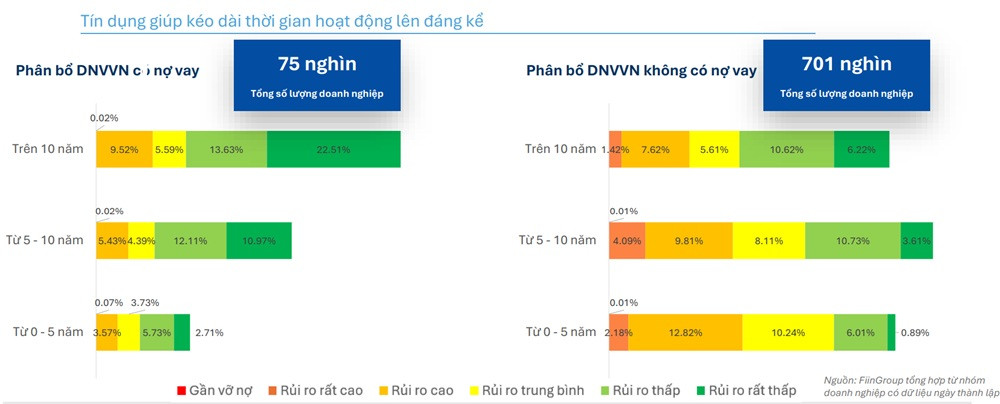
Taking the commerce sector as a primary example, FiinGroup records 275,000 currently operating enterprises with relatively positive profitability (median gross profit margin reaching 11.6%). Although only 23.4% of businesses in this industry achieve positive operating cash flow (requiring careful screening), less than 10% having access to loans indicates a vast room for credit supply.
Research findings and data show that the financial picture of Vietnamese SMEs in 2026 still presents grey areas of survival risk alongside bright spots of untapped credit potential.
Accordingly, to drive growth, credit institutions need to move beyond traditional filters and refine risk measurement models (benchmarked against Basel) to "sift gold from sand", particularly targeting long-established businesses with healthy cash flows that have yet to access financial leverage.
Market observations indicate that recent policies from the State Bank of Vietnam requiring credit institutions to implement preferential credit programmes for SMEs and economic growth drivers have been embraced by numerous commercial banks, with expected package sizes exceeding 220,000 billion VND. Combining insights and data from FiinGroup's approach with actual assessments of SME capital access from lender perspectives is expected to create new momentum for disbursements, providing practical capital support for enterprises.