VIETNAM CHAMBER OF COMMERCE AND INDUSTRY
Liên Đoàn Thương Mại Và Công Nghiệp Việt Nam
Thu, Sep 03, 2026, 14:07:00
On the morning of August 26, 2026, in Hanoi, the Institute for Business Technology and Innovation under the Vietnam Chamber of Commerce and Industry (VCCI), in cooperation with Hai Bon Bay Joint Stock Company (247Express), organized the seminar “CBAM, ESG and Global Green Standards: Solutions to Enhance Competitiveness for Industrial Park Enterprises.”
The event was part of The Green IZ Tour series of discussions, with 247Express serving as a partner throughout 2026, aimed at supporting enterprises in industrial parks in northern Vietnam in adapting to international green standards.
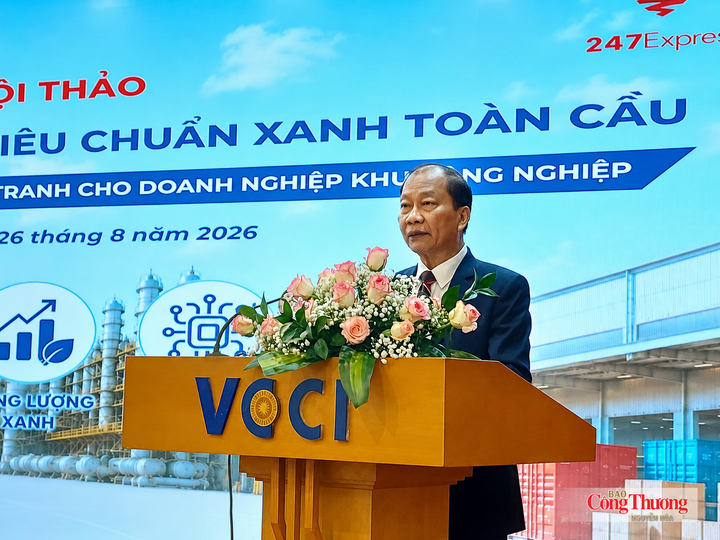
Mr. Hoang Quang Phong, VCCI Vice President, speaks at the seminar.
Speaking at the seminar, VCCI Vice President Hoang Quang Phong emphasized that the green transition is taking place rapidly and increasingly having a direct impact on enterprises’ production, investment and trade activities.
Requirements concerning carbon emissions, energy use, data traceability, environmental and social responsibility, and corporate governance are no longer merely guiding commitments. They are gradually becoming conditions for enterprises to participate in supply chains, access markets and financing, and engage with international partners.
For enterprises operating in industrial parks – where a large share of manufacturing, energy consumption and export activities is concentrated – the pressure from CBAM, ESG and green standards is becoming increasingly evident. In particular, CBAM and increasingly stringent green standards in many markets are creating an urgent need for enterprises to conduct emissions inventories, manage carbon data, improve energy efficiency, and develop measurable and verifiable emissions reduction roadmaps.
Sharing this view, Dr. Nguyen Minh Thao, Head of the Business Environment and Competitiveness Research Department at the Institute for Policy and Strategy (Ministry of Finance), highlighted the challenges facing enterprises in meeting CBAM, ESG and global green standards.
According to Dr. Nguyen Minh Thao, global green policies today are not only increasing in number but are also becoming more complex and continuously evolving. Meanwhile, there is no single common set of green standards, nor is there a uniform green transition roadmap applicable to all types of goods exported to the European Union (EU)...
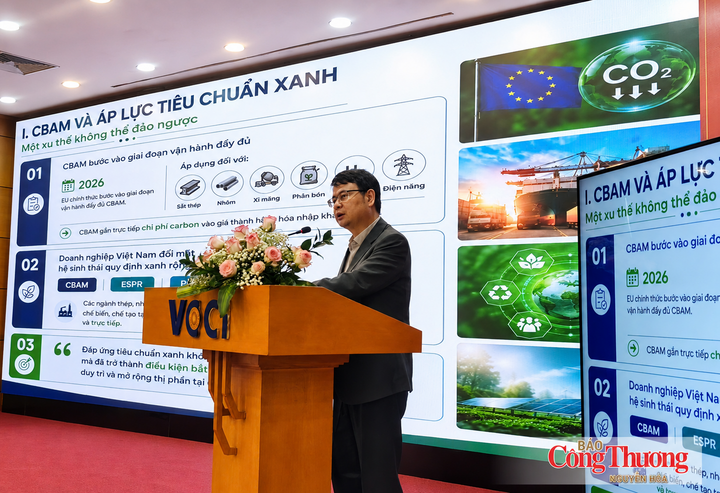
Mr. Nguyen Ba Hai, Deputy Director of the Trade and Investment Promotion Support Center under the Trade Promotion Agency (Ministry of Industry and Trade), speaks at the seminar.
Mr. Nguyen Ba Hai, Deputy Director of the Trade and Investment Promotion Support Center under the Trade Promotion Agency (Ministry of Industry and Trade), also noted that, from 2026, the EU officially entered the full implementation phase of the Carbon Border Adjustment Mechanism (CBAM), which applies to emissions-intensive goods such as iron and steel, aluminum, cement, fertilizers, hydrogen and electricity.
“Accordingly, this is no longer a recommendation, but has become a genuine ‘non-tariff barrier’ that directly incorporates carbon costs into the prices of goods imported into the EU market,” Mr. Nguyen Ba Hai said.
To support enterprises in meeting green criteria and create opportunities for them to participate in global supply chains, the Party and State have in recent years introduced strategic orientations. Notably, Politburo Resolution No. 68-NQ/TW on private-sector development calls for support to enterprises in promoting innovation and the application of technology toward sustainable development.
According to Mr. Nguyen Ba Hai, the Government has recently approved the GoGlobal Program for international market expansion for the 2026–2035 period. For high-value and highly demanding markets such as the EU, the United States and Japan, the program prioritizes raising quality standards and environmental and social responsibility, digitalizing traceability, while encouraging enterprises to invest in bonded warehouses, distribution centers and networks of retail partners in export markets.
The program also sets out measures to support small and medium-sized enterprises in meeting ESG requirements in international trade, including regulations and standards on environmental protection, low-carbon emissions and the circular economy. These measures are particularly relevant to the majority of enterprises operating in industrial parks. At the same time, the program aims to develop an integrated ecosystem to support private enterprises in expanding into international markets, including services for export promotion, digital transformation, green finance and credit, as well as international standards and certifications, with the Ministry of Industry and Trade serving as the coordinating focal point.
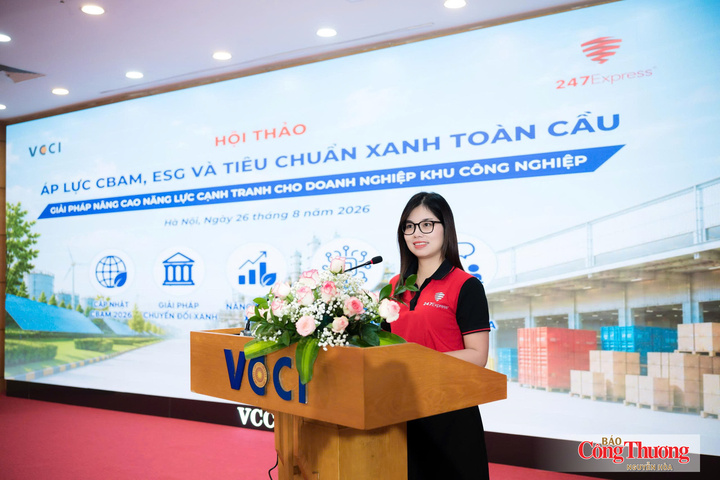
Ms. Pham Thi Van Anh, Northern Region Sales Director at Hai Bon Bay Joint Stock Company (247Express), speaks at the event.
From the perspective of a logistics enterprise, Ms. Pham Thi Van Anh, Northern Region Sales Director at Hai Bon Bay Joint Stock Company (247Express), said that with more than 200 post offices covering nearly 34 provinces and cities nationwide and over 20,000 customers having chosen the company as their transportation partner, 247Express recognizes that the green transition is not merely an internal matter for manufacturers but needs to be implemented throughout the entire supply chain.
For the logistics sector, Ms. Pham Thi Van Anh said key priorities include improving vehicle efficiency, optimizing transport routes, and digitalizing data to measure and enhance transparency in emissions. These are also the directions that 247Express is gradually incorporating into its implementation roadmap, working alongside industrial parks in northern Vietnam toward greener and more sustainable supply chains.
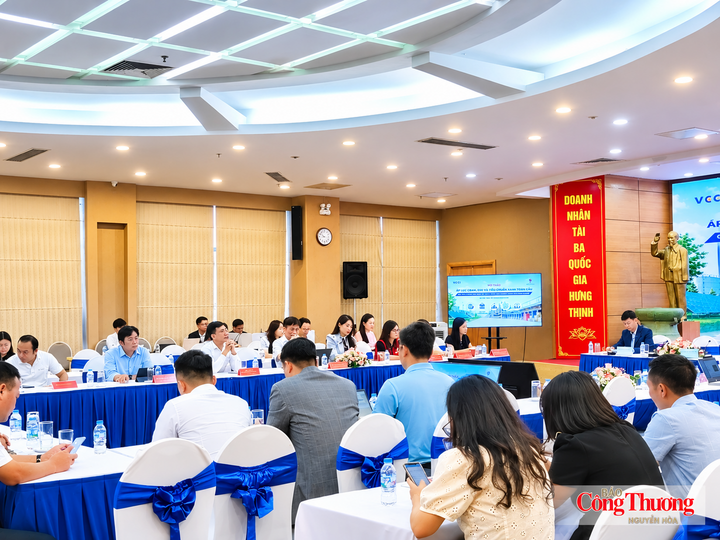
Delegates attend the event.
To meet global green standards, Mr. Vu Van Hai, Chairman of the Board of Directors of Hung Viet Green Technology Joint Stock Company, said that investment trends in rooftop solar power, energy storage systems and smart energy management are becoming increasingly important for industrial enterprises. These solutions help improve power supply stability, optimize investment efficiency, reduce operational emissions and meet the market’s green requirements.
Sharing experience from Du Long Industrial Park, Dr. Tran Hong Hai, Director of Sustainable Development, said that industrial parks and enterprises need to comprehensively assess their capacity to transition toward the eco-industrial park model; develop industrial symbiosis networks; strengthen monitoring of resource efficiency and cleaner production; and link green finance with social objectives to enhance their advantages in international supply chains.
According to Dr. Dao Dinh Kha, an independent consultant specializing in digital transformation and information technology, when evaluating an order, the issue is not simply how much emissions are generated. It is also necessary to determine what production lines, raw materials and energy sources are used to manufacture the product in order to meet CBAM requirements, as well as assess the associated costs and the level of CO2 reduction achieved.
In this context, digital transformation will enable enterprises to measure, manage and demonstrate their green performance, thereby moving toward smart factory models, optimizing costs and meeting market requirements.
CBAM, ESG and green standards are gradually becoming conditions for enterprises to participate in supply chains and gain access to international markets and partners. For industrial park enterprises, this requires them to conduct emissions inventories, manage carbon data, use energy efficiently, digitalize processes and develop measurable and verifiable emissions reduction roadmaps. Early and well-oriented transformation will help enterprises optimize operations, reduce costs and enhance their competitiveness.