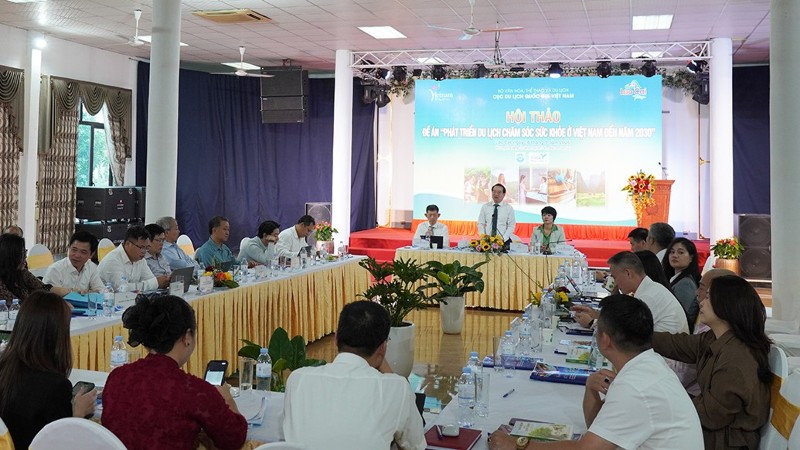
Bringing together healthcare experts, tourism officials, and local representatives, a workshop held by the Vietnam National Authority of Tourism (VNAT) in northern mountainous Lao Cai province on September 16 focused on establishing technical standards, inter-industry mechanisms, and unique regional products for the draft scheme “Developing Wellness Tourism in Vietnam through 2030.”
Speaking at the event, Dr. Ha Van Sieu, VNAT Deputy Director General, noted that wellness tourism is becoming a high value-added segment that drives growth across related industries.
According to him, Vietnam possesses vast natural and cultural assets-such as diverse landscapes, around 400 mineral springs, 3,850 medicinal plant species, and traditional ethnic healthcare knowledge - yet its potential remains underutilized. Existing offerings mostly stop at basic spas, hot springs, or traditional resorts due to a lack of standardization and inter-industry linkages.
According to the Global Wellness Institute, the global wellness tourism market reached over $894 billion in 2024 and is projected to hit $1,383.3 billion by 2029. Average spending per wellness trip stands at $721, more than double that of general tourism.
Addressing regulatory boundaries, Dr. Duong Huy Luong, Deputy Director of the Department of Medical Service Administration under the Ministry of Health, stressed distinguishing wellness tourism (focused on physical and mental well-being) from medical tourism (focused on diagnosis and treatment). This distinction ensures appropriate risk management, safety, and regulatory compliance.
“Health authorities proposed joint standard-setting, credentialing, specialized workforce training, and shared data systems to safeguard tourist health information,” he said.
Lao Cai was highlighted as a key hub for high-altitude wellness products, leveraging Sa Pa’s climate, Hoang Lien forests, mineral springs, and herbal knowledge from local Dao, Hmong, and Thai communities.
The province plans to build a “Northwest Wellness Tourism Belt” connecting Sa Pa, Y Ty, Thac Ba, and Bac Ha with mountain retreats, forest bathing, herbal baths, and outdoor sports.
Dr. Nguyen Anh Tuan, Director of the Institute for Tourism Development Research and Lecturer at Nguyen Tat Thanh University, proposed a development framework comprising “one ecosystem - three product tiers - six policy pillars.” He recommended introducing a voluntary “Vietnam Wellness” quality label and shifting enterprise support policies from single facilities to the entire value chain.
For the 2027-2030 period, experts recommended piloting five to seven destination clusters, including Lao Cai - Sa Pa - Ta Phin, Quang Ninh, Hue - Da Nang, Khanh Hoa, and Lam Dong, with standardized safety and service protocols to boost tourist spending and lengthen stays.