VIETNAM CHAMBER OF COMMERCE AND INDUSTRY
Liên Đoàn Thương Mại Và Công Nghiệp Việt Nam
Tue, Jul 01, 2025, 03:32:00
The press is a part of the overall business environment
How do you view the relationship between the press and businesses?
Practice has proven that the relationship between the press and businesses is a "symbiotic" relationship, developing together. The need to strengthen friendly and healthy relationships between businesses and press agencies is extremely necessary. The role of the press and media in the development of businesses is identified as a support to bring business brands to consumers; an important factor contributing to building a healthy competitive environment, protecting justice, supporting honest businesses to survive and develop.
Through press coverage, outstanding businesses and entrepreneurs are honored, contributing to promoting the spirit of entrepreneurship and startups in society. At the same time, negative events are brought to light, creating a healthy business environment for businesses as well as the entire economy to develop sustainably.

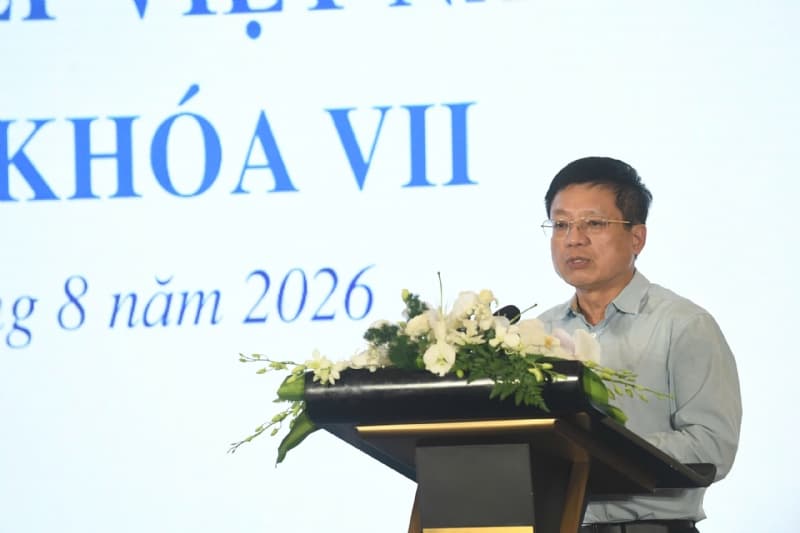
Mr. Pham Thai Lai, Director of the VCCI Center for Economic Information and Communications.
The role of the press and media in inspiring and promoting business spirit is extremely important. The spiritual factor has always been a special strength of the Vietnamese revolution and the Vietnamese people, helping our country gain great achievements in the history of revolutionary struggle as well as building and defending the Fatherland. In particular, the vibrant entrepreneurial spirit and momentum in the renovation period has contributed significantly to creating a transformation and outstanding economic development in Vietnam.
In order to successfully achieve the country's development goals by 2030, with a vision to 2045, it is necessary to strongly arouse the entrepreneurial spirit and momentum in society and in the business community, igniting the aspiration to contribute to bringing our country into a "new era - the era of the Vietnamese people's rise", seizing the historical opportunities that are opening up to develop a prosperous and happy country.
How do you evaluate the quality and effectiveness of communication about the economy, businesses and entrepreneurs today?
Information and propaganda about the economy, businesses and entrepreneurs, ensuring objectivity and honesty, encouraging the entrepreneurial spirit in society, limiting negative phenomena and false and inaccurate information affecting businesses is important for both businesses and the press. Thereby, it contributes significantly to creating a business environment that is open, transparent, stable, safe, easy to implement, low cost, meets international standards, ensures regional and global competitiveness and builds a modern, professional and humane press.
The media and press environment is also part of the overall business environment in Vietnam. This environment is healthy, both disseminating information and knowledge about economics and business activities, and encouraging and motivating the entrepreneurial spirit in society, which is the foundation for promoting the development of businesses, inspiring business in society, contributing to the country's economic growth.
In reality, there are still challenges and some violations in a part of the press agencies, causing outrage in society, including businesses, affecting the reputation of seriously operating press agencies. Providing unbiased and dishonest information about an incident related to a business not only has a direct impact on the existence and development of the business itself, but also damages the trust of the public and society in the business community in general.
I believe that in 2025, the 100th anniversary of Vietnam Revolutionary Press Day, with the responsible, courageous and creative support from both the press and the business community in general, and private enterprises in particular, our country will enter a new era - an era of growth, development, prosperity, civilization and prosperity.
The human factor still plays a decisive role
Resolution 68 is considered a policy turning point for the development of the private economic sector. In your opinion, how should the press play its role to effectively convey the spirit of this Resolution and promote changes from policy to business practice?
Resolution 68-NQ/TW not only sets out major orientations for private economic development, but also opens up an opportunity for other forces in society, including the press, to participate proactively, positively and creatively. On this journey, the press needs to make adjustments in thinking, approach and expression methods, in order to play a more effective role as a companion to the business community.
In the current information environment, the purely descriptive and event-reporting journalism style is gradually losing its appeal. Enterprises, especially the private sector, are operating in a volatile context, requiring the press to not only reflect phenomena but also explain, analyze and provide well-founded criticism. Criticism here is not confrontational, but a way to illuminate and supplement missing perspectives, thereby helping policies to be closer to reality.
For Resolution 68 to truly come into life, especially in promoting reform, perfecting and improving the quality of institutions and policies, creating breakthroughs as expected, the press needs to promote this role as a two-way information bridge between business practices and policy-making agencies.
The press can also diversify content, reach out more deeply to the community of medium, small and micro enterprises, innovative models, green transformation and digital transformation in the private sector - groups that often do not have many opportunities to access modern and advanced governance models. Recognizing and spreading innovative efforts and effective practices from this sector will contribute to stimulating the entrepreneurial spirit, creating positive effects in society and supporting the sustainable development goals stated in the Resolution.
At the same time, the application of technology, data and new media platforms also needs to be promoted. The ability to exploit and process in-depth information, analyze trends, and personalize content for each audience group will help the press increase the effectiveness of transmission and maintain its guiding role in the modern information flow.
Ultimately, the human factor still plays a decisive role. The team of journalists needs to be strengthened not only in terms of professional skills, but also in economic knowledge, policies and in-depth analysis. This will help the press truly become a connecting force between the State - enterprises - society, accompanying the process of private economic development in a practical and effective manner.
In the process of digital transformation and media modernization, how do you assess the new requirements placed on the press to fulfill its role as a partner accompanying private enterprises in an effective and responsible manner?
In terms of operating methods, I highly appreciate the efforts of our country's press in keeping up with the wave of digital transformation by strongly applying technology, artificial intelligence (AI) and big data (Big Data) to the content production process. These technologies not only help improve the processing speed and accuracy of information, but also support the press to reflect multi-dimensionally and more deeply on emerging socio-economic issues, while expanding the ability to forecast fluctuations, thereby becoming a useful tool in supporting businesses in orienting their development strategies.
In addition to content, the form of transmission is also undergoing many positive changes. Diversification through new platforms such as videos, podcasts or interactive infographics shows that the press is gradually breaking away from traditional stereotypes, moving towards a modern communication model that is closer to the public. When information is transmitted vividly, intuitively and easily accessible, not only readers benefit but businesses also have more opportunities to spread messages more effectively in the digital environment.
In parallel with building a technological platform, we cannot ignore the core factor of journalism ethics and culture. Building a professional, humane and modern press, in line with the spirit of the 13th Party Congress, is a prerequisite for strengthening social trust and creating a healthy media environment, thereby contributing to promoting sustainable socio-economic reform.
Journalists today need to not only be good at their jobs and quick-witted, but also uphold the principles of honesty, respect for the truth and especially have empathy for the business community, important partners in the development of the economy. The press strictly verifies information, accurately reflects the difficulties of businesses, and creates a forum for them to seek solutions, which will not only protect their own reputation but also help businesses avoid damage to their image or economic losses due to false news, thereby promoting transparency in business activities and social management.
Counter-argument – A Special Capability of Journalism
Currently, there are conflicting opinions about press counter-argument of businesses. In your opinion, what are the principles to ensure that press criticism is not misunderstood as an attack or "suppression"?
In the coming time, VCCI will coordinate with Vietnam Television to deploy a specialized communication program on Resolution 68 and activities to support businesses in the period of 2025-2028; at the same time, coordinate with the Vietnam Journalists Association to deploy a Program to evaluate the quality of economic and business information in the press...
We expect that this program will not only stop at policy propaganda, but will become a forum for substantive and constructive dialogue between businesses, policy-making agencies and the public. Through this, businesses can share practical issues and reflect reform desires, while management agencies have more channels to receive, respond to, and interact with policies more effectively and transparently. At the same time, the program is also an opportunity to honor press agencies that promote business development and contribute to the country's socio-economic development," said Mr. Pham Thai Lai.
First of all, I would like to emphasize that: counter-argument is for building, not for destroying. The problem is how to clearly distinguish between constructive criticism and "destructive" and extreme counter-argument - something fragile but very important to preserve the reputation and role of the press in society.
The boundary between constructive counter-argument and extreme counter-argument actually lies in the attitude, purpose and method of expression. It is necessary to clearly define that criticism is to contribute to correcting mistakes, improving, and promoting progress. Critical journalism is not to destroy individuals or businesses, but to point out what is wrong, what is not effective, thereby opening up directions for adjustment for the common good.
Constructive Criticism: When Journalists Uphold Objectivity and Aim for Improvement
Constructive criticism occurs when journalists maintain an objective and impartial attitude while prioritizing improvement above all. A truly critical journalistic work must be based on multi-dimensional, thoroughly verified information, include responses from relevant parties, and be presented in a measured tone that respects the subjects being reported on. On the contrary, if an article is heavily influenced by personal emotions, one-sided, lacks dialogue, or employs accusatory language, it easily falls into the trap of extreme criticism — which not only fails to solve the problem but also undermines public trust in the press.
What conditions must be met for journalism to effectively fulfill its role in constructive criticism?
To fulfill the role of constructive criticism effectively, journalism must meet both the necessary and sufficient conditions.
The necessary condition lies in the professional courage and competence of the journalist — the one who engages in criticism. They must have deep knowledge of the subject matter, the ability to analyze issues from multiple perspectives, and the skills to verify and utilize reliable sources. Equally important is ensuring the right of reply for the parties being reported on, as this is not only a professional standard but also a clear demonstration of fairness and transparency in journalistic practice.
The sufficient condition is the existence of a clear legal framework that protects critical journalism — guaranteeing freedom of expression and freedom of the press, while coupling these freedoms with social responsibility and compliance with the law. Journalists can only boldly critique sensitive issues when they are protected from undue pressure, retaliation, or unjust legal action.

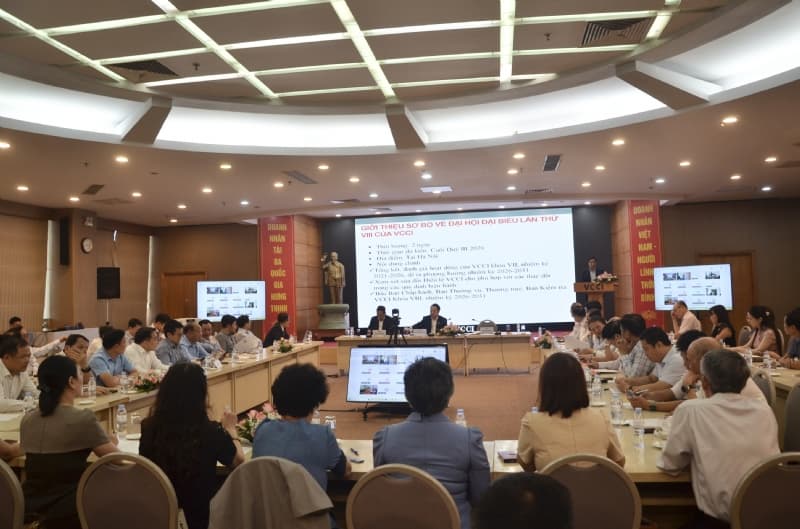
Forum: “Journalism and Business Accompany Each Other for a Prosperous and Happy Vietnam.” Archival Photo
Ultimately, it is important to emphasize that critical thinking is a unique capability of journalism. Without caution, the media may inadvertently harm a business’s reputation unnecessarily. But when done properly and responsibly, constructive criticism becomes a driving force for improvement — for society, businesses, and even journalism itself — fostering more sustainable development.
From the perspective of a unit specializing in media support for businesses, could you share some initiatives between VCCI and press agencies to help implement Resolution 68 in the business community?
As the national organization representing the business community, VCCI clearly recognizes that journalism and media play a crucial role in spreading the spirit of reform, igniting aspirations for development, and promoting the sustainable growth of the private sector — fully aligned with the vision outlined in Resolution 68 issued by the Politburo. We hope the press will continue to uphold its role as a channel for objective information and act as a voice for constructive criticism, becoming a trusted companion of the business community.
In terms of collaboration mechanisms, in 2023, VCCI took the initiative to establish a four-party cooperation model involving VCCI, the Vietnam Journalists Association, the Ministry of Information and Communications (now the Ministry of Culture, Sports and Tourism), and the Central Propaganda Department (now the Central Commission for Propaganda and Mass Mobilization). This agreement — between Party bodies responsible for political and ideological direction, guidance, supervision, and inspection of journalistic and publishing activities, state agencies managing media and communications, and two national organizations representing entrepreneurs, enterprises, and journalists — can be seen as a strong commitment by the Party and the State to accompany the business community and the media workforce in pursuit of the common goal of national development.
This will continue to be an essential foundation for fostering dialogue, information sharing, and strategic communication aligned with key reform priorities in the business environment and enterprise development — including those outlined in Resolution 68.
Thank you very much!