VIETNAM CHAMBER OF COMMERCE AND INDUSTRY
Liên Đoàn Thương Mại Và Công Nghiệp Việt Nam
Wed, Jul 15, 2026, 10:27:00

The seminar “Cash Flow Management and Unlocking Capital for Enterprises in the New Context” was held in Da Nang on July 3
On July 3, the Vietnam Chamber of Commerce and Industry – Central and Central Highlands Branch (VCCI Central and Central Highlands), in collaboration with the Vietnam Thuong Tin Commercial Joint Stock Bank (Vietbank), organized the seminar titled “Cash Flow Management and Unlocking Capital for Enterprises in the New Context.” The seminar focused on issues of concern to businesses, including cash flow management, access to financing, strengthening financial capacity, and enhancing resilience to market fluctuations.
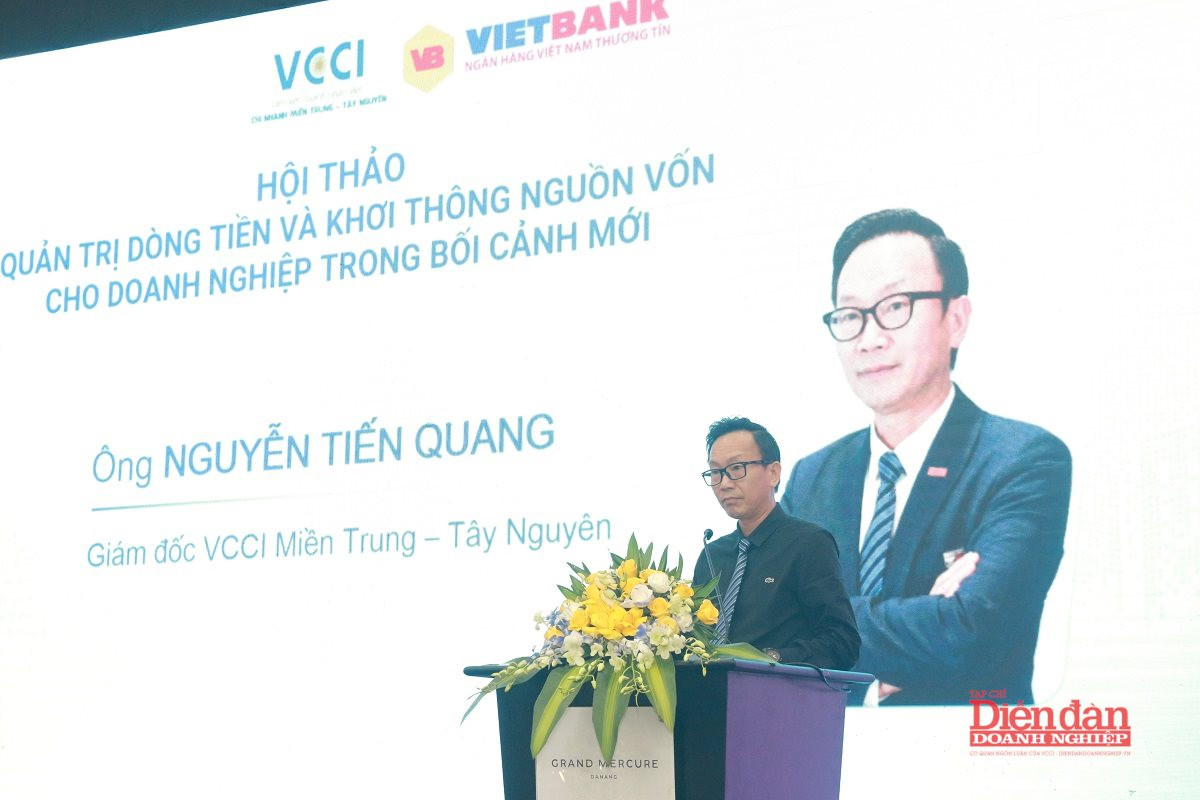
Mr. Nguyen Tien Quang noted that many enterprises have orders, production capacity, and markets, yet still face difficulties in accessing capital.
In his opening remarks, Mr. Nguyen Tien Quang, Director of VCCI Central and Central Highlands, said that during the first six months of 2026, many enterprises had seen orders recover and markets gradually improve. However, the financial health of businesses remained relatively fragile. According to Mr. Quang, the greatest challenge at present lies not only in finding customers or expanding markets, but also in maintaining stable cash flow to ensure uninterrupted production and business operations.
"In reality, many enterprises have orders, production capacity, and established markets, yet they continue to face difficulties in accessing capital. At the same time, many credit institutions are under pressure to manage risks and ensure the safety of the financial system, making the connection between enterprises’ financing needs and banks’ capital sources less seamless than expected," Mr. Quang said.
From the business perspective, the Director of VCCI Central and Central Highlands identified three major challenges. First, the cash flow management capacity of many enterprises, particularly small and medium-sized enterprises (SMEs), remains limited. The management of receivables, inventories, financial planning, and cash flow forecasting has not kept pace with rapidly changing market conditions.
Second, enterprises continue to face difficulties in meeting traditional lending requirements, particularly collateral requirements. Finally, trust and cooperation between enterprises and the financial system need to be further strengthened through greater transparency, partnership, and shared responsibility.
"Against the backdrop of an increasingly volatile and unpredictable global economy, sustainable business growth cannot rely solely on borrowed capital. More importantly, enterprises need to strengthen their financial management capacity, improve cash flow management, enhance the transparency of their business operations, and proactively build creditworthiness," Mr. Quang added.
The latest Provincial Competitiveness Index (PCI) and Business Performance Index (BPI) survey results released by VCCI show that the proportion of profitable enterprises in the Central and Central Highlands region stood at 58.8%, lower than the national median of 60.4%. Meanwhile, only 29.9% of enterprises planned to expand their businesses over the next two years, compared to the national median of 31.57%. In addition, only 23.7% of SMEs in the region were able to obtain loans from credit institutions, below the national median of 25.9%.
During the seminar, participants reviewed the macroeconomic outlook, assessed the operational situation of enterprises in Da Nang and the Central and Central Highlands region, and discussed the challenges they face in accessing credit and managing cash flow. They also exchanged solutions aimed at strengthening connections between enterprises and banks, thereby unlocking financial resources to support production and business activities.
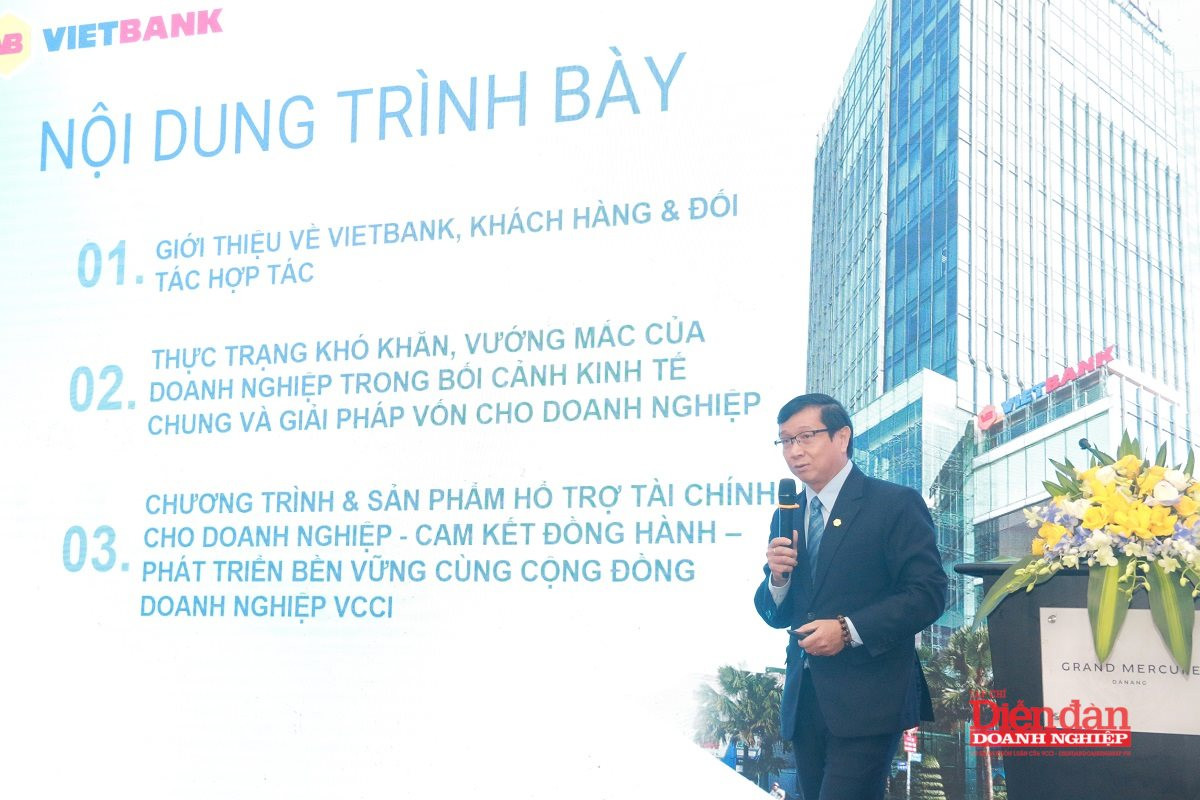
Mr. Pham Linh, Deputy Chief Executive Officer of Vietbank, noted that many enterprises still lack sufficient collateral, while high lending rates have significantly increased financial costs.
Mr. Pham Linh, Deputy Chief Executive Officer of Vietbank, said that enterprises are currently facing multiple pressures affecting their production and business activities. These include challenges related to suppliers, customers and market share, investors, inventories, and access to financing.
Regarding SMEs, Mr. Linh noted that many continue to lack adequate collateral, while high lending rates have increased financial costs. In addition, stringent lending requirements, complicated loan procedures, unfeasible business plans or investment projects, and an inability to demonstrate repayment capacity have all made it more difficult for businesses to obtain financing.
"Therefore, enterprises should consider using alternative forms of collateral instead of relying solely on real estate, such as cash flows generated from business operations, inventories, and revolving accounts receivable," Mr. Linh suggested.
To better manage financing, Mr. Linh recommended that enterprises select orders aligned with their operational capacity and complete them as quickly as possible to reduce borrowing costs. He also encouraged businesses to strengthen cooperation with one another, proactively seek preferential financing from international partners through loans, bond or share issuances, and diversify funding sources by working with banks.
According to Dr. Nguyen Duc Kien, former Vice Chairman of the National Assembly’s Economic Committee, Vietnam has set a target of achieving double-digit GDP growth in 2026. By 2030, the country aims to become an upper-middle-income industrialized nation and, after 2030, a developed country.
To achieve these goals, Dr. Kien emphasized the need for comprehensive institutional reforms, raising the public debt ceiling to between 40% and 60% of GDP, and prioritizing human resource development. He particularly highlighted the importance of promoting the private sector, which currently contributes approximately 50% of GDP, 30% of state budget revenue, accounts for 82% of total employment, and represents 60% of total social investment.
Similarly, Dr. Truong Van Phuoc, former Acting Chairman of the National Financial Supervisory Commission, forecast that interest rates in 2026 would likely have peaked but remain at relatively high levels. Meanwhile, consumer demand is recovering slowly, with growth of 6.1%, while exports are showing signs of improvement but continue to face intense competition from businesses worldwide.
Looking ahead, Dr. Phuoc advised enterprises to closely monitor macroeconomic trends when formulating their business plans. He noted that the U.S. dollar is expected to remain relatively strong, meaning the USD/VND exchange rate could continue to face upward pressure. At the same time, VND interest rates are unlikely to rise significantly but are also not expected to decline sharply, making capital cost management an ongoing priority.
"Enterprises should focus on improving efficiency rather than merely expanding scale, while implementing plans to control financial costs. They should consider restructuring high-interest loans to reduce financing expenses, converting part of their short-term debt into medium- and long-term loans where cash flows permit, and strengthening cash flow management to reduce reliance on short-term borrowing," Dr. Phuoc recommended.
Through the seminar, VCCI Central and Central Highlands and Vietbank reaffirmed their commitment to supporting the business community by promoting stronger connections, facilitating information sharing, enhancing financial management capabilities, and expanding access to financing. The event also represented a practical initiative to improve the business environment, strengthen enterprise resilience, and create momentum for sustainable economic growth in the Central and Central Highlands region and across Vietnam.