VIETNAM CHAMBER OF COMMERCE AND INDUSTRY
Liên Đoàn Thương Mại Và Công Nghiệp Việt Nam
Wed, Sep 30, 2026, 16:18:00
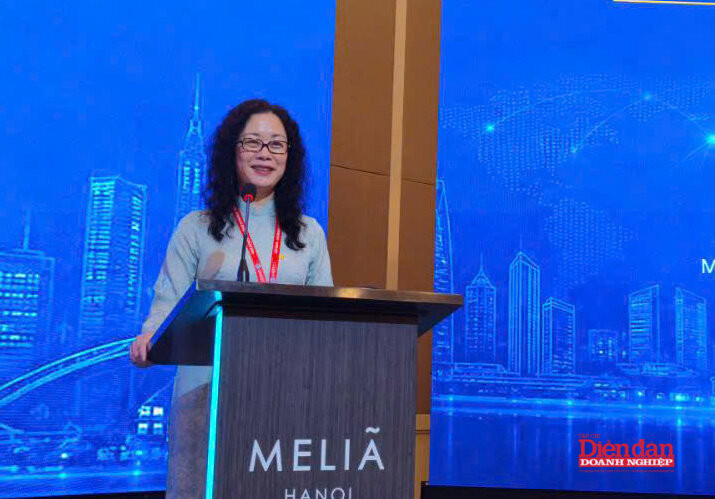
Ms. Tran Thi Lan Anh, Secretary General of the Vietnam Chamber of Commerce and Industry (VCCI), speaking at the Vietnam - Myanmar Business Forum 2026
Speaking at the Vietnam - Myanmar Business Forum 2026, Ms. Tran Thi Lan Anh, Secretary General of the Vietnam Chamber of Commerce and Industry (VCCI), assessed that the large participation of the Myanmar business delegation was a positive signal for economic relations between the two nations.
Vietnam and Myanmar enjoy a long-standing traditional friendship. In 2025, the two countries celebrated the 50th anniversary of the establishment of diplomatic relations. Since 2017, bilateral relations have been elevated to a Comprehensive Cooperative Partnership framework.
Upon that foundation, Vietnam - Myanmar economic cooperation has achieved noteworthy results. Numerous Vietnamese enterprises have invested and conducted business in Myanmar across sectors such as telecommunications, banking, real estate, agriculture, and services.
Alongside traditional cooperation areas, economic relations between the two countries are opening up new avenues, including agriculture, food processing, logistics, digital transformation, science and technology, as well as education and training.
According to the VCCI Secretary General, the achievements to date serve only as an initial foundation, while the potential for cooperation between the two business communities remains vast. In 2025, two-way trade turnover reached nearly USD 592 million. Vietnam and Myanmar are currently targeting to raise bilateral trade turnover to USD 1 billion.
To realize this goal, a crucial factor is for businesses of both countries to step up meetings, gain a deeper understanding of market needs, and build trust for long-term cooperation.
In particular, the VCCI Secretary General emphasized that the presence of over 200 Myanmar enterprises at the Vietnam - Myanmar Business Forum 2026 reflected the growing interest of the Myanmar business community in the Vietnamese market, while simultaneously unlocking further opportunities for enterprises from both countries to seek partners, expand cooperation, and move toward concrete projects.
One noteworthy room for growth lies in the potential to complement each other's economic strengths. Myanmar possesses rich resources, advantages in agriculture, and a wide array of raw materials such as rice, beans, corn, fruits and vegetables, seafood, and rubber. Additionally, Myanmar boasts a market of over 50 million people and a strategic geographical position connecting Southeast Asia with South Asia.
Meanwhile, Vietnam holds strong advantages in industrial manufacturing, food processing, machinery, materials, textiles, consumer goods, technology, telecommunications, and distribution network development.
According to Ms. Lan Anh, if these advantages are effectively linked, cooperation between enterprises of both countries can extend beyond simple trading activities, striving toward building Vietnam - Myanmar value chains.
Agriculture is viewed as a vivid example of this direction of cooperation. Myanmar holds advantages in land, raw materials, and production; whereas Vietnamese enterprises possess expertise in mechanization, processing, preservation, logistics, branding, and market access.
This combination can open up collaborative opportunities spanning from production and processing to distribution, serving not only the Vietnamese and Myanmar markets but also targeting the ASEAN market and broader markets via RCEP.
Similar cooperation opportunities have also been identified in logistics, telecommunications, digital transformation, energy, food processing, textiles, tourism, and services.
Promoting bilateral trade is not viewed solely in terms of bringing Vietnamese goods and enterprises into Myanmar. The VCCI Secretary General expressed the desire to see an increasing presence of Myanmar products in the Vietnamese market.
In the first seven months of 2026, Vietnam's imports of fruits and vegetables from Myanmar reached USD 107 million in turnover, representing a 31.5% increase year-on-year. This product category alone accounted for approximately 61% of Vietnam's total import turnover from Myanmar.

Within the framework of the Forum, the business communities of the two countries signed and exchanged memoranda of understanding (MOUs) across various fields.
This shows that Myanmar is increasingly becoming an important supply source for the Vietnamese market in the fruit and vegetable product group.
The VCCI Secretary General expressed hope that Vietnamese consumers will become more familiar with Myanmar's quality products, while an increasing number of Myanmar enterprises will invest, conduct business, establish offices, seek distributors, and build networks in Vietnam; conversely, more and more Vietnamese enterprises will find reliable partners in Myanmar, thereby expanding the space for cooperation between the two business communities.
According to the VCCI Secretary General, to transform potential cooperation into concrete contracts, projects, and investment activities, the business communities and business representation organizations of both countries need to focus on three key areas.
First, strengthen regular and substantive business connectivity. VCCI desires to collaborate with the Republic of the Union of Myanmar Federation of Chambers of Commerce and Industry (UMFCCI) to organize more trade delegations, B2B matchmaking programs, and sector-specific networking activities. The VCCI Secretary General emphasized that VCCI stands ready to assist Myanmar enterprises in exploring the Vietnamese market, finding clients, distributors, and investment partners, as well as connecting with local authorities and industry associations in Vietnam.
Second, shift from simple trade to value chain collaboration. Enterprises from both nations can jointly invest, manufacture, process, and tap into markets together. This is expected to serve as the foundation for Vietnam – Myanmar economic relations to develop in a more sustainable direction.
Third, jointly address practical difficulties facing enterprises. Pressing needs include accurate market information, reliable partners, convenient payment mechanisms, efficient logistics, and clear regulations.
In this process, VCCI and UMFCCI expect to continue acting as a bridge between businesses, as well as between the business community and the government agencies of both countries.
From a business perspective, direct exchanges at the Forum are expected to help both sides clarify needs, opportunities, and issues requiring resolution when entering each other's markets. This also serves as a basis to determine subsequent cooperation steps in a more concrete manner.
The VCCI Secretary General committed that VCCI will remain a partner to UMFCCI and the Myanmar business community, working toward promoting the flow of businesses, investors, products, and tourists between the two countries.
Within the framework of the Forum, the business communities of the two countries signed and exchanged memoranda of understanding across various fields.