

Prime Minister Le Minh Hung has called for the development of an integrated resolution and a unified action program featuring key tasks, measurable targets, and specific evaluation mechanisms to successfully deliver Vietnam's socio-economic development goals for 2027.
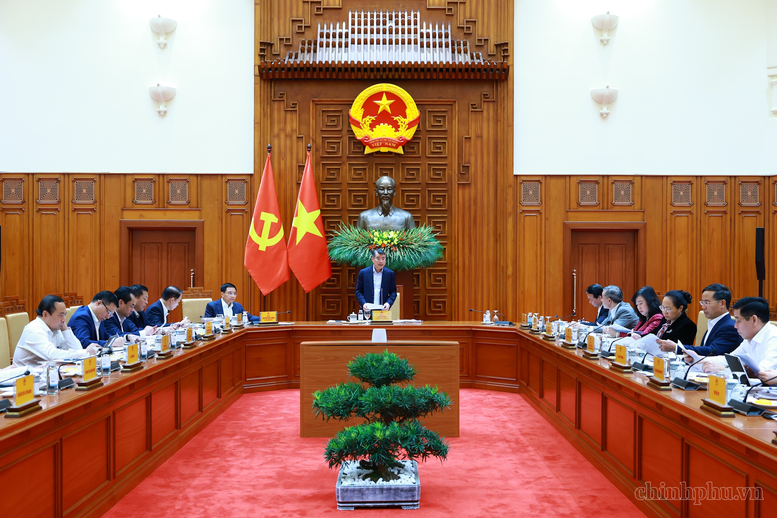
Chairing a meeting on November 25 to prepare a draft Government Action Program for implementing resolutions and conclusions issued by the Party Central Committee and the National Assembly on the 2027 socio-economic development plan, PM Hung emphasized the need to align the program with action plans implementing directives from the Party Central Committee and the Politburo.
Addressing the meeting, the Government leader said that based on Conclusion No. 106-KL/TW of the 4th plenum of the 14th Party Central Cimmittee and resolutions of the National Assembly on socio-economic development and the 2027 state budget, 2027 has been identified as a year for acceleration and breakthrough, laying the foundation for the successful implementation of the Resolution of the 14th National Party Congress.
The Party Central Committee, the Politburo, General Secretary and President To Lam have all underscored the importance of 2027, calling for determined efforts to achieve socio-economic development objectives, particularly economic growth of 10% or higher, while maintaining macroeconomic stability, controlling inflation, and ensuring major economic balances.
The PM stressed that the ambitious targets require significant innovation in drafting resolutions and action programs, as well as in leadership, governance, and implementation methods.
A key reform, he said, is the integration of tasks into a single resolution, accompanied by a unified action program, a list of priority tasks, and clear mechanisms for monitoring, supervision, and performance evaluation.
He instructed ministries and agencies to focus on priorities and breakthroughs that can generate tangible socio-economic impacts, particularly those aimed at boosting growth, maintaining macroeconomic stability, improving institutions, unlocking resources, advancing science and technology, fostering innovation, and accelerating digital transformation.
The Prime Minister also called for greater proactiveness and flexibility in governance based on data and performance outcomes, especially in the allocation of public investment capital. He urged authorities to identify and address bottlenecks early, promote decentralization alongside stronger accountability and implementation effectiveness, and closely monitor domestic and international developments to make timely policy adjustments.
Specifying growth scenarios and mobilizing resources
Regarding priority tasks, the PM requested calculations of the total social investment capital required to achieve double-digit growth, including funding from the state budget, private investment, foreign direct and indirect investment, and bank credit.
On science, technology, innovation, and digital transformation, he said that 2027 must deliver concrete and commercially viable products in several critical sectors, helping improve productivity and competitiveness across industry, construction, agriculture, and services, while supporting the development of new industries and growth models.
The Prime Minister reaffirmed that maintaining macroeconomic stability, controlling inflation, and safeguarding key economic balances remain top priorities.
At the same time, he called for stronger efforts to develop and improve the legal framework, advance administrative reform, reduce and simplify administrative procedures and business conditions, improve governance quality and execution capacity, build and complete national databases, ensure social welfare, and promote the development of education, culture, healthcare, and national target programs.