VIETNAM CHAMBER OF COMMERCE AND INDUSTRY
Liên Đoàn Thương Mại Và Công Nghiệp Việt Nam
Mon, Oct 26, 2026, 14:22:00

Politburo member and Permanent Deputy Prime Minister Pham Gia Tuc (center), VCCI leaders and other delegates tour exhibition booths at the ceremony honoring outstanding Vietnamese entrepreneurs 2026
VCCI President Ho Sy Hung made these remarks at the “Pioneering Entrepreneurs - Enabling Government for the New Era” Forum, part of a series of events recently organized by the Vietnam Chamber of Commerce and Industry (VCCI) in Hanoi to celebrate Vietnam Entrepreneurs’ Day (October 13).
Policy Breakthroughs Open Opportunities; Effective Implementation Delivers Growth
In his opening remarks, VCCI President Ho Sy Hung said that “enabling government” and “pioneering entrepreneurs” were not merely forum themes, but two essential conditions for ushering in a new period of growth.
According to VCCI President Ho Sy Hung, the Government can create room for development through better institutions, but businesses must turn that room into investment, production, products, jobs and new value. Businesses may have ideas, capital and ambition, but an unstable business environment, lengthy procedures and resource bottlenecks can make it difficult to turn them into projects. Therefore, government support and business leadership must work toward one common outcome: tangible development results.
Over the past two years, Vietnam has accelerated policy reform. The Politburo has issued many important resolutions, while the National Assembly and the Government have worked urgently to develop and implement new laws, mechanisms and other measures. Many localities have significantly shortened investment procedures, effectively introduced “green channel” mechanisms and sped up customs clearance at border gates through digitalization and process reform. These changes have directly reduced costs, accelerated capital turnover and strengthened business competitiveness.
However, the gap between policy direction and implementation remains a challenge. “If the previous phase focused heavily on institutional breakthroughs, the next phase must focus more on breakthroughs in implementation,” VCCI President Ho Sy Hung stressed.
Referring to nearly 900 business submissions identifying 53 categories of obstacles for the July 2026 meeting between the Government Standing Committee and the business community, VCCI President Ho Sy Hung said businesses need more than simplified procedures. They also need stable, consistent and predictable policies. Reform in the new phase is not just about reducing the number of procedures, but, more importantly, improving the quality of implementation.
VCCI President Ho Sy Hung said policy development and review are among VCCI’s core responsibilities. However, VCCI must go beyond forwarding recommendations and strengthen its role as a policy bridge through data, analysis and follow-up. Its policy contributions will continue to follow three principles: reflecting business realities, relying on data and evidence, and considering long-term impacts.
“We will also strengthen independent monitoring of the implementation of major resolutions and policies related to the business environment. Policy breakthroughs create opportunities, but breakthroughs in implementation turn those opportunities into growth. Most importantly, the question is not how many bright spots we have, but how to make them the norm across Vietnam’s business environment,” VCCI President Ho Sy Hung affirmed.
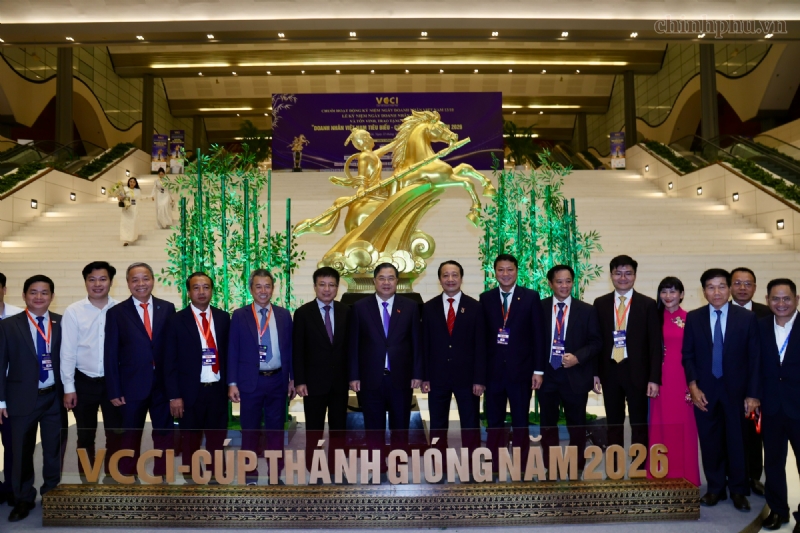
Permanent Deputy Prime Minister Pham Gia Tuc poses for a group photo with delegates at the ceremony marking Vietnam Entrepreneurs’ Day and honoring the 100 Outstanding Entrepreneurs of 2026
Revitalizing Traditional Growth Drivers, Advancing Sci-Tech for Double-Digit Growth
According to Dr. Nguyen Duc Hien, Vice Chairman of the Central Policy and Strategy Commission, over more than four decades of Doi Moi (Renovation), Vietnamese businesses and entrepreneurs have made significant contributions to the revolutionary cause and to national construction and defense. In response to the country’s development needs in the new era, the Party has issued major policy directions and decisions in recent years.
Strategic resolutions have identified the requirements for creating new drivers of double-digit growth. The first is to renew traditional growth drivers. Vietnam needs to shift its export strategy toward higher value added rather than volume, while promoting key sectors with strong growth potential, such as research and development (R&D), logistics, energy, banking and finance, and upgrading value chains in core industries.
Another requirement is to develop new growth drivers through breakthroughs in science and technology, innovation and digital transformation, which are central to improving labor productivity. These will form new productive forces that help restructure the economy and strengthen Vietnam’s position in global value chains.
Within this ecosystem, state-owned enterprises play a leading role in economic restructuring, while the private sector remains a key growth driver. This requires building strong private conglomerates that can compete globally. Developing new models, such as green and circular economies, and modernizing governance through data-driven approaches and decentralization will help mobilize social resources.
Dr. Nguyen Duc Hien stressed that to realize the country’s development aspirations through 2030, with a vision to 2045, businesses and entrepreneurs must nurture their ambitions, strengthen competitiveness and take the initiative in contributing to national growth and development goals. They must also lead the transformation of growth models, improve productivity, and advance science and technology, innovation and digital transformation.