VIETNAM CHAMBER OF COMMERCE AND INDUSTRY
Liên Đoàn Thương Mại Và Công Nghiệp Việt Nam
Wed, Apr 15, 2026, 15:43:00
This message was emphasized by business and association representatives at the event “Connecting Global Supply Chains: Opportunities and Action Roadmaps for Vietnam’s Supporting Industry Enterprises,” organized by the VCCI SME Support Center in coordination with VINEXAD.
Urgent requirements
Ms. Trần Thị Thanh Tâm, Director of the SME Support Center, noted that in 2025, Vietnam’s total import-export turnover reached USD 930.05 billion, with the FDI sector accounting for 77.3%.
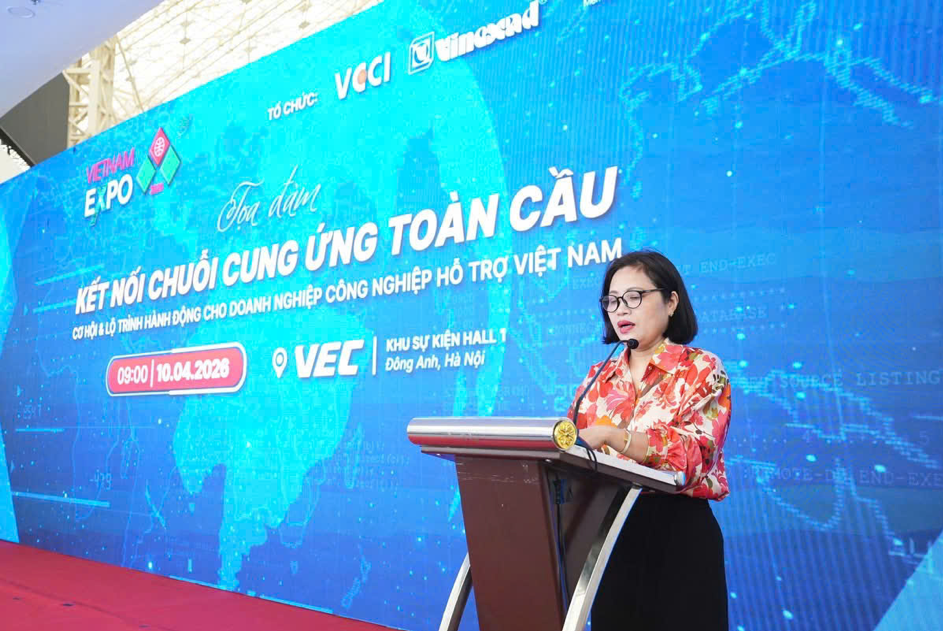 Ms. Trần Thị Thanh Tâm, Director of the SME Support Center, speaks at the event
Vietnamese enterprises are facing opportunities to integrate more deeply into global value chains. However, with localization rates still modest at 10–30%, domestic value retention remains limited. This creates an urgent need for supporting industry enterprises to upgrade their capabilities to fully capitalize on export opportunities.
She highlighted two major challenges: increasingly stringent international standards and limited market access. Many enterprises produce quality products but lack internationally standardized capability profiles, making it difficult to connect with major buyers.
At the event, Mr. Phạm Hải Phong, Vice Chairman and Chief of Office of the Vietnam Association for Supporting Industries (VASI), stated that domestic enterprises are mainly concentrated in the “middle segment” of the value chain—manufacturing components and parts.
This is an area where Vietnamese firms have accumulated significant capabilities over the past two decades, especially in mechanics, plastics-rubber, and parts of electronics. However, most products remain simple components or basic assemblies such as stamped parts, basic electronic components, and wire harnesses.
To join supply chains of major corporations, Vietnamese enterprises must undergo rigorous evaluation processes, including process improvement, governance enhancement, and consistent quality assurance. This transition is challenging and requires investments in technology, knowledge, and especially supply chain management—areas where many SMEs still face gaps.
Strengthening internal capacity
According to Mr. Kiều Công Thành, representative of Smart Factory Vietnam Solutions Co., Ltd. (SFV), the core issue lies not in opportunities but in internal capabilities.
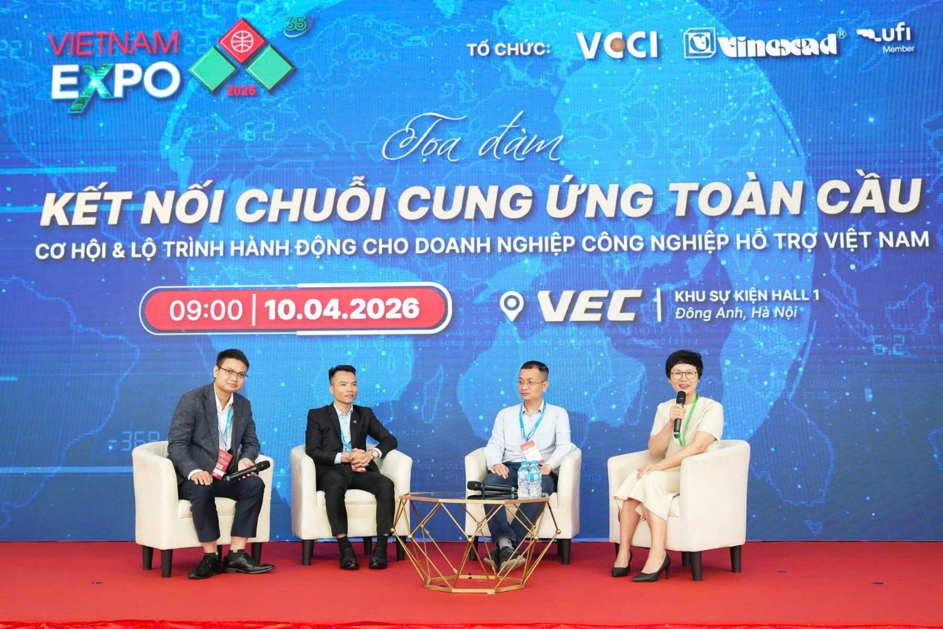 Representatives from VASI and enterprises share insights on opportunities, challenges, and action roadmaps at the event
He emphasized that while the FDI shift opens major opportunities, only a limited number of Vietnamese enterprises currently meet supply chain requirements.
FDI corporations typically evaluate suppliers based on four pillars: compliance, execution capability (QCD), technology, and sustainability. Among these, QCD is a prerequisite, while digitalization and data traceability are increasingly critical.
In reality, many Vietnamese enterprises still operate manually, with fragmented data and heavy reliance on individual experience. Common issues include weak quality control, delayed defect detection, low equipment efficiency, lack of traceability, and suboptimal production planning.
To address these challenges, he stressed the need for digital transformation with the principle of “start small but think big,” focusing first on high-impact problems. Enterprises should also integrate IT and OT systems to international standards, build production operation centers, and enhance fast, data-driven decision-making.
From a business perspective, Mr. Trần Đức Tùng, Deputy CEO of Hanel PT, suggested that enterprises should follow a three-tier value development roadmap:
First, a foundation of core values, including corporate culture, business ethics, and commitment to sustainable development.
Second, an operational system, emphasizing digital transformation, transparent governance, and smart manufacturing solutions.
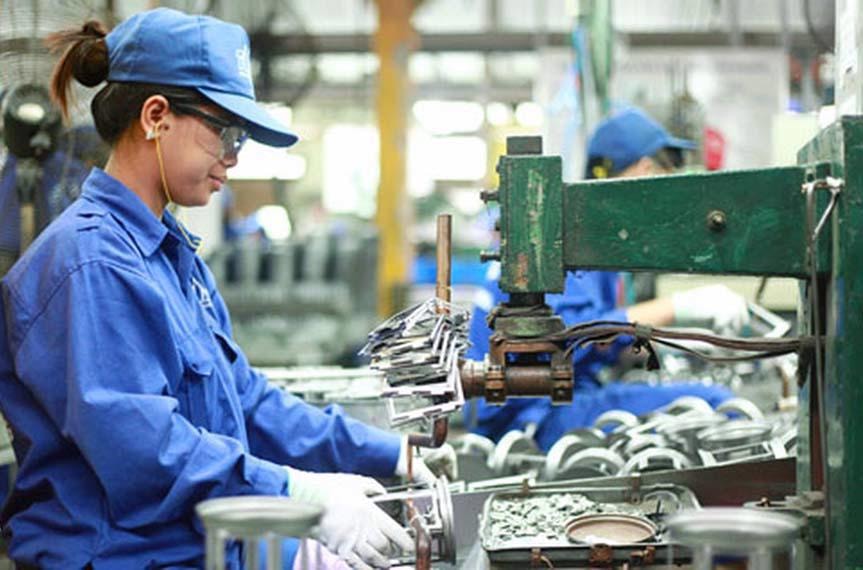 Third, production capability, including product quality, competitive cost, on-time delivery, and continuous improvement—key criteria in supplier selection by FDI enterprises.
Enhancing long-term competitiveness
Hanel PT’s leadership emphasized that international buyers assess enterprises through multiple criteria and evaluation rounds, with supplier selection processes typically lasting from 6 months to 3 years. Vietnamese enterprises must be well-prepared, persistent, and focused on long-term strategies rather than short-term gains.
At the panel discussion, participants noted that new requirements are placing pressure on enterprises to transform—but also creating opportunities for comprehensive upgrades. Investments in technology, production process improvement, emissions control, and product quality not only meet international standards but also strengthen long-term competitiveness.
With a solid foundation in culture, governance, and technology, enterprises can better integrate into supply chains, expand export markets, and gradually establish their position in the global industrial landscape.
In the context of deeper global integration, and with support from organizations such as VCCI and industry associations, Vietnam’s supporting industry enterprises are well-positioned to seize opportunities, “open the door” to global supply chains, enhance domestic value creation, and drive sustainable economic growth.