VIETNAM CHAMBER OF COMMERCE AND INDUSTRY
Liên Đoàn Thương Mại Và Công Nghiệp Việt Nam
Wed, Sep 10, 2025, 03:40:00
Enterprises are the driving force for sustainable development in the new era.
Editor's note: In the context of an increasingly uncertain world, from climate change, energy security risks, to geopolitical conflicts, the path to sustainable development is no longer an option, but a necessity if businesses want to survive and grow.

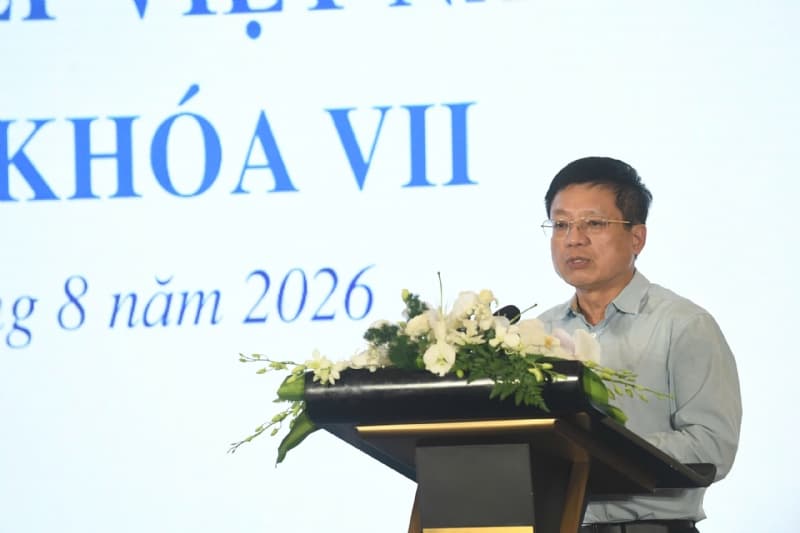
Mr. Nguyen Quang Vinh - Vice Chairman of the Vietnam Chamber of Commerce and Industry (VCCI)
Mr. Nguyen Quang Vinh said: With the theme "Sustainable development in the new era: Turning aspirations into actions", the main message that the Vietnam Business Forum for Sustainable Development 2025 (VCSF 2025) sends to the business community is to turn development aspirations into practical, oriented and responsible actions. VCSF 2025 will be a place to clearly demonstrate the determination of the business community to accompany the country on the journey to become a developed, modern, prosperous and inclusive economy.
- In your opinion, how can we optimize national resources and realize VSDGs in a volatile world?
According to the Sustainable Development Report 2025, only 35% of the global sustainable development goals (SDGs) are making progress. Vietnam needs to accelerate more strongly and more drastically, and needs to synchronously utilize three resources: institutions - finance - human resources to catch up with the progress.
By 2030, Vietnam will need about 45 billion USD per year for areas related to SDGs. In which, green finance and climate finance are key factors. The workforce needs to be trained in new skills to adapt to sustainable production models, digital transformation, and global standards such as ESG, GRI or TCFD.
We also need to continue to perfect the system of national standards on environment, carbon, corporate governance, etc. to synchronize with new generation trade agreements.

Representatives of typical business leaders shared at the VCSF 2024 Plenary Session
It can be said that in a volatile context like today, to complete the above requirements, Vietnam needs to carry out a strong transformation. And that transformation and reform is taking place right now. The rearrangement of ministries, branches, reorganization of administrative boundaries, and operation of a new two-tier local government model have created a new development premise for the country.
Along with that, the Politburo has issued a "four-pillar resolution" that has created many new driving forces for green transformation and SDGs
- What is the biggest challenge for businesses in the current context, sir?
The biggest challenge at present is not "lack of commitment", but "lack of implementation capacity". Vietnamese businesses, most of which are small and medium-sized enterprises, are facing the biggest difficulty in accessing green capital.
According to data from PwC, as of March 31, 2024, outstanding green credit in Vietnam reached nearly VND 640,000 billion, equivalent to about 4.5% of total credit in the whole system, and although the State Bank has issued a Green Credit Classification Framework since 2023, according to IFC's report, by 2024, only about 5% of outstanding credit in Vietnam is green credit.
In addition, the lack of information and tools to practice ESG, difficulties in converting technology or suitable human resources when the circular production process or energy-saving technology is still expensive also pose significant challenges.
- How will VCCI, in its role, support and accompany the business community in strengthening internal strength, improving competitiveness, and turning challenges into opportunities for sustainable development?
As a national organization representing the business community, VCCI always identifies sustainable development as not only an inevitable trend of the times but also a way to enhance competitiveness and create long-term value for businesses and the economy.
Over the past time, VCCI, through VBCSD, has proactively implemented many strategic initiatives to support businesses in sustainable development, including: Business Forum for Sustainable Development (VCSF); Building and implementing the Corporate Sustainability Index (CSI)...
In the coming time, based on the "four pillars of resolutions", with the role of "creating and accompanying", in addition to the activities that have been and are being implemented, VCCI and VBSCD will focus more on the following key points:
Firstly, further promoting the role of providing policy advice and bridging between businesses and the Government, in order to promptly reflect difficulties, obstacles and recommend policies suitable to reality, contributing to perfecting a favorable and transparent business environment to promote circular business models, green economy, and sustainable development in the spirit of Resolution 66-NQ/TW.
Second, promote the improvement of business capacity through training programs, provide tools and solutions for sustainable management, support businesses in applying digital technology, green technology, artificial intelligence to improve productivity and reduce emissions in the spirit of Resolution 57-NQ/TW and Resolution 68-NQ/TW. VCCI-VBCSD will continue to operate and upgrade the CSI Index - a tool to measure sustainable health and ESG in accordance with Vietnamese practices, helping businesses self-assess, improve and demonstrate their commitment to sustainable development. Third, create an ecosystem linking businesses - international partners - research organizations - financial institutions, helping businesses not only adapt but also turn challenges into opportunities, promote digital transformation, green transformation to proactively participate deeply in green global value chains in the spirit of Resolution 59-NQ/TW. We will strengthen the role of VBCSD as a platform connecting businesses with each other and with international organizations, green investment funds, and specialized ESG training programs.
I believe that, with the direction of the Government, the support of VCCI - VBCSD, the initiative of businesses and the cooperation of international partners, we can completely turn our aspirations into real actions, making Vietnam a bright spot in sustainable development in the region and the world.
- Thank you very much!
Mr. Binu Jacob - General Director of Nestlé Vietnam:

Over the past three decades, Nestlé Vietnam has been shifting from the role of “manufacturer” to “development partner”, not only in the economic field but also in the environmental, social and governance pillars. With the approach of “creating shared value”, we not only maintain the goal of business development, contributing to the socio-economic development of the country but also implement many initiatives and programs to promote the common prosperity of the community.
Nestlé’s Net Zero 2050 strategy is realized through each link in the value chain – from input materials, production technology to consumer behavior. We also invest in human resource training, multilateral cooperation and communication to change public awareness.
Nestlé is committed to continuing to accompany and support the Vietnamese business community in the green transformation journey, putting people at the center and leaving no one behind.
Mr. LESTER TAN - GENERAL DIRECTOR OF SABECO

Over the past year, we have made significant strides towards a more sustainable and efficient future. We have expanded the use of solar energy in our systems and improved our production processes, helping to improve our energy and water efficiency.
As one of the leading brewers in Vietnam, we recognise the importance of responsible waste management. We have made progress in ensuring that our primary packaging materials are recyclable, contributing to reducing greenhouse gas emissions and positively impacting the environment. At the same time, we have maintained a responsible approach to water conservation across our operations.
We are committed to developing SABECO in an innovative, sustainable and community-engaged manner.
Ms. Nguyen Thi Ngoc Lien - Director of External Affairs and Communications MONDELEZ KINH DO:

Green transformation in Mondelez Kinh Do's sustainable development strategy focuses on the following key areas: environmental responsibility, economic development and sustainable corporate governance.
First of all, regarding the environment, we are constantly innovating to minimize carbon emissions, optimize the use of renewable energy and pioneer in promoting the circular economy, from input materials, packaging to food waste treatment.
In addition, we always strive to build a strong supply chain, work closely with local suppliers to promote community economic development, support the local economy and ensure that our business activities create shared value.
We consider creating a diverse - equitable - inclusive working environment, ensuring physical and mental health for employees as the foundation of sustainable governance.
Mr. Le Hoang Minh - Executive Director of Production and Head of Net Zero Project, Vinamilk Company:

Vinamilk started implementing green production goals, aiming for sustainable development since 2010. Over the past 15 years, energy conversion, application of new technology solutions, data integration, and management according to international standards have helped us build a sustainable and unified production ecosystem.
Not standing outside the "AI era", Vinamilk has also gradually applied AI in management, accurately forecasting demand and optimizing production plans.
We are deploying ESG and greenhouse gas data management software throughout the entire system, helping to retrieve data in a timely manner, forecast trends and ensure integrity and security. 173 types of ESG data are built to ensure comprehensiveness and meet national and international standards such as GRI, CDP, CSI, VNSI... Not only does it help businesses themselves develop more "standard" sustainable development, but this will also create good practices and good practices for the entire industry.