


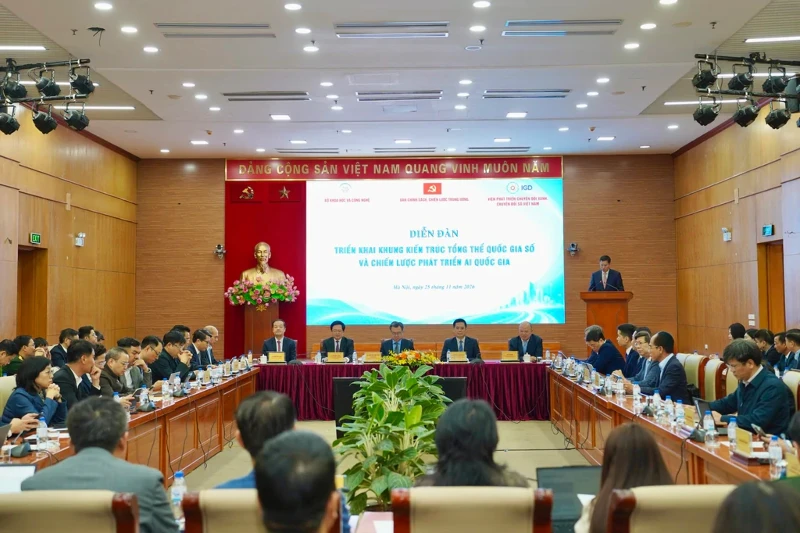
Speaking at a forum on implementing the National Digital Master Architecture Framework and the National AI Development Strategy, co-hosted on November 25 by the Central Commission for Policy and Strategy, the Ministry of Science and Technology (MST), and the Vietnam Institute for Green Transformation and Digital Transformation Development (IGD), Deputy Prime Minister Ho Quoc Dung noted that the two frameworks are inseparable.
While the digital master architecture serves as the country’s digital blueprint defining shared components and connectivity, the AI strategy acts as a breakthrough driver determining how intelligently the nation operates, the Deputy Prime Minister noted.
With Vietnam’s legal and institutional framework for digital transformation, data, and AI largely complete under an enabling approach that accepts controlled risks, the Deputy Prime Minister outlined six key tasks to ensure effective implementation.
First, agency heads must take direct responsibility for building digital architecture frameworks and AI action plans.
Second, authorities must conduct comprehensive reviews to inherit functioning systems and merge overlapping ones rather than starting from scratch, ensuring commune-level digital architecture is integrated within provincial frameworks.
Third, data must be central, meeting standards of accuracy, completeness, cleanliness, real-time updates, and unified sharing aligned with national data and cybersecurity architectures.
Fourth, AI deployment must be prioritized yet controlled, focusing on a national civil service AI platform targeting four core areas: civil servant assistants, public service delivery, institutional building, and executive governance.
Fifth, to promote “Make in Vietnam” AI products, ministries, sectors, and localities must publish priority AI problems, usable data, leasing or procurement demands, and projected budgets so domestic businesses can proactively develop solutions. Implementation should prioritize service leasing and public-private partnerships without vendor lock-in.
Sixth, public monitoring in the digital environment must be strengthened.
Deputy Prime Minister Dung instructed MST to finalize digital architecture guidelines, launch the national digital architecture management system, and issue AI transformation evaluation indexes similar to the Provincial Innovation Index (PII), alongside expanding AI training for civil servants, especially at the commune level.
At the forum, Deputy Minister of Science and Technology Pham Duc Long pointed out that fragmented information systems, underutilized data, and parallel paper processes continue to limit productivity gains.
He called for three mindset shifts: moving from building isolated systems to integrating shared digital capabilities; shifting from mere technology adoption to solving concrete development challenges; and transitioning from project completion to outcome accountability.
“Our goal is not to build a nation with numerous digital systems, but one that operates smarter, commands higher competitiveness, and creates greater value for the country and its people,” he stated.
Under the National AI Strategy, by 2030 Vietnam aims for 100 percent of civil servants and public employees to use the civil service AI platform weekly, 60 percent of executive decisions to be supported by data and AI, 100 percent of online public services to integrate AI assistance, and at least five national shared AI platforms to be developed.