VIETNAM CHAMBER OF COMMERCE AND INDUSTRY
Liên Đoàn Thương Mại Và Công Nghiệp Việt Nam
Wed, Sep 02, 2026, 08:37:00
These are the insights shared by Assoc. Prof. Dr. Ho Sy Hung – President of VCCI, regarding VCCI’s contributions to policy advisory work, promoting the business environment, and enhancing internal strength for the Vietnamese business community to build an independent and self-reliant economy.
- The 14th National Party Congress continues to emphasize institutional reform as one of the top strategic breakthroughs to unleash the entire productive capacity. From the perspective of the business community's representative organization, how do you assess the importance of institutions in the new phase and VCCI’s mission of policy critique?
The history of economic development has proven that institutions are not merely administrative management tools, but rather the strategic infrastructure of all infrastructures. An advanced, transparent, safe institution with low compliance costs will maximally unleash social resources, stimulate the spirit of innovation, and create momentum for long-term investment flows.
In the context of the country entering an era of rising up after the 14th National Party Congress, the requirement for economic institutions does not stop at "removing difficulties" but must advance to the level of "development-enabling." Institutions must be one step ahead to anticipate new trends such as the digital economy, green economy, artificial intelligence (AI), energy transition, and global supply chain shifts.
Identifying the participation in policy formulation and critique as its foremost core mission, VCCI is not just a place to merely reflect the thoughts and aspirations of businesses, but plays the role of a bridge, an independent and practical policy analysis center bringing the "breath" from the operational reality of hundreds of thousands of enterprises.
Every recomendation from VCCI is based on three principles: strict practicality; data-driven scientific rigor; and strategic forecasting capability. Thereby, this helps policy makers see legal "blind spots" and hidden costs borne by businesses, subsequently adjusting legal documents toward maximum facilitation and ensuring the principle that businesses are free to conduct business in whatever is not prohibited by law.

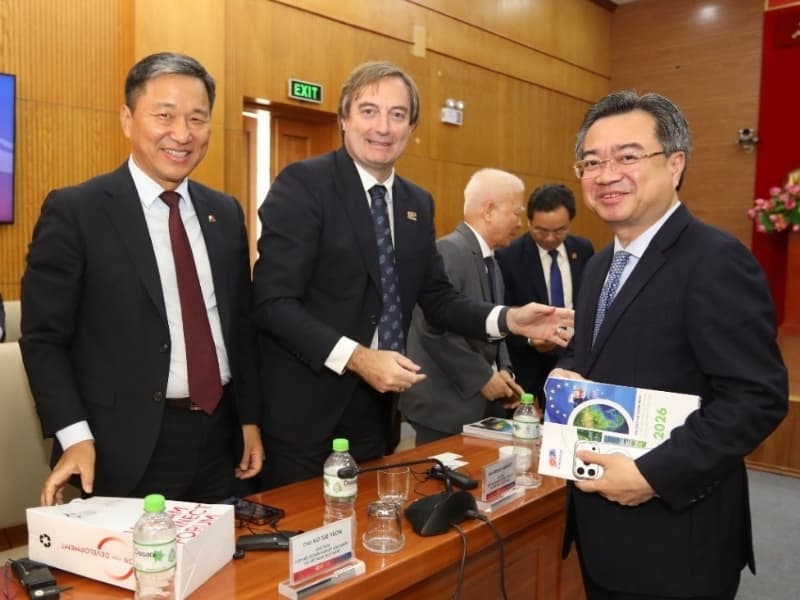
Deputy Prime Minister Nguyen Van Thang (middle), Assoc. Prof. Dr. Ho Sy Hung – President of VCCI (2nd from left), VCCI Vice President Nguyen Quang Vinh (far right) attend the World Energy and Environment - Vietnam Forum 2026 on July 8, 2026.
- Looking back at the outcomes of the 13th VCCI Executive Committee Conference, 7th Tenure recently, could you share specific contributions by VCCI in pointing out legal "overlaps," abolishing "sub-licenses," and removing bottlenecks for economic projects?
At the 13th Executive Committee Conference, 7th Tenure held recently, VCCI conducted a comprehensive evaluation of policy recomendation work. In the first 8 months of 2026 alone, VCCI directly chaired and participated in providing in-depth comments and recomendations for nearly 340 draft legal documents—ranging from strategic draft laws submitted to the National Assembly, decrees, to circulars.
Not only that, with its role as a representative and policy bridge for the business community, VCCI prepared for the Conference between the Standing Government and the Business Community on July 18. Accordingly, VCCI gathered nearly 900 proposals and recomendations from domestic and international businesses and business associations, synthesizing them into 53 groups of issues across 10 fields to report to the Government. At this Conference, VCCI also directly reflected major issues of concern to businesses regarding institutions, policy enforcement, access to resources, and the business environment.
Following the aforementioned event, in Document No. 8530/VPCP-KTTH dated August 21, 2026, the Prime Minister assigned the Ministry of Agriculture and Environment, Ministry of Finance, Ministry of Construction, Ministry of Industry and Trade, Ministry of Science and Technology, Ministry of Home Affairs, Ministry of Public Security, and the State Bank of Vietnam—in accordance with their assigned functions, tasks, and authority—to urgently consider and process 65 problems facing businesses and business associations, ensuring clear, substantive, and effective handling of recommendations; and to inform the handling results to the Ministry of Finance and VCCI prior to August 25, 2026, for synthesis and reporting to the Government at the regular Government Meeting in line with Resolution No. 216/NQ-CP dated August 6, 2026, as well as providing feedback to businesses and business associations.
In policy research and recomendation, VCCI published the Vietnam Private Sector Report 2025 - PCI 2025, continuing to promote its role as an independent, reliable channel reflecting the proposals of businesses, identifying bottlenecks in the business environment, and driving reform at both central and local levels.
Along with that, VCCI organized the National Conference of Business Associations and coordinated with the Central Strategy and Policy Commission to organize a conference on the role of private enterprises and entrepreneurs in innovating the country's development model. Through these activities, VCCI continues to leverage its role in uniting and connecting the business community while directly contributing to strategic issues regarding private sector development in the new period.
In addition to the above prominent activities, business support, trade and investment promotion, membership development, policy recomendation, digital transformation, and internal governance innovation continues to be implemented across the entire system.

In the first 8 months of 2026, VCCI directly chaired and participated in giving in-depth feedbacks and recomendations for nearly 340 draft legal documents. Photo: Quoc Tuan
- In the context of the economy witnessing many new models such as the digital economy and circular economy, alongside "green barriers" from international markets (such as CBAM, EUDR), what solutions has VCCI implemented to contribute to institutional reform and support enterprises in proactively integrating, sir?
The Fourth Industrial Revolution and green transition trends are reshaping the entire global economic structure. The biggest barrier today for Vietnamese enterprises is no longer tariffs, thanks to the system of new-generation FTAs (CPTPP, EVFTA, RCEP...), but rather domestic institutional barriers regarding new concepts and non-tariff barriers regarding green standards from abroad.
To solve this problem, VCCI has actively researched and recommended that the Government allow the widespread application of controlled testing mechanisms (Sandboxes). This mechanism allows enterprises to test new technologies and business models within a flexible legal framework, managing risks while encouraging innovation.
In addition, VCCI also established the Vietnam Business Council for Sustainable Development (VBCSD) and organized specialized consulting and training programs on ESG (environmental, social, and governance) practices. At the same time, it collaborated with ministries and agencies to recommend that the Government develop a National Green Taxonomy, creating a basis for enterprises to easily access international green credit and green bonds at preferential capital costs.
Not stopping at organizing simple trade promotion delegations, over the past period, VCCI has made comprehensive innovations, focusing on supporting enterprises to build trade defense capabilities and respond to anti-dumping and anti-circumvention lawsuits. At the same time, it serves as a bridge to enable qualified Vietnamese private enterprises with technological and managerial capabilities to enter directly into the global supply chains of multinational corporations operating in Vietnam.
- Towards the country's strategic development goals and building an independent, self-reliant economy, what message does VCCI wish to convey, and what commitments is it making to the business community in continuing to accompany the Government to promote institutional reform and improve the business environment in the coming time, sir?
Standing at a development turning point in the new context, with its role as the national representative organization of the business community and team of entrepreneurs nationwide, VCCI commits to maintaining its position as a leading, independent, objective, and steadfast institutional advisory organization.
In doing so, it will continuously improve the quality of policy research and recomendation; persistently recommend the removal of barriers, sub-licenses, and informal costs; and protect property ownership rights, freedom of business, and legal safety for enterprises and entrepreneurs.
Simultaneously, it will comprehensively innovate the VCCI system toward a modern, digitized, and professional direction by building Big Data on the business community and applying AI to receive and handle feedback and problems from businesses in real time. Concurrently, it will enhance the capacity of sector-specific and local business associations, creating a network linking the strength of Vietnamese enterprises seamlessly from the central to grassroots levels.
VCCI will continue to nurture a team of Vietnamese entrepreneurs with heart, talent, and a rich national spirit. Accordingly, VCCI will continue to promote the spread of the Code of Ethics for Vietnamese Entrepreneurs, honoring entrepreneurs and enterprises that build decent business cultures, comply with the law, and hold responsibility toward society and the environment. A team of entrepreneurs with fortitude, culture, and a desire to contribute will be the core force carrying the mission of national economic autonomy.
When the Government acts decisively to create momentum, institutions are cleared, combined with the dynamic and creative spirit of the business community, we fully have the right to firmly believe in a powerful, autonomous, resilient, and groundbreaking Vietnam in the new era.
- Thank you very much, sir!