VIETNAM CHAMBER OF COMMERCE AND INDUSTRY
Liên Đoàn Thương Mại Và Công Nghiệp Việt Nam
Tue, Oct 13, 2026, 09:12:00
To support the business community and relevant stakeholders in gaining an accurate, comprehensive and up-to-date understanding of EUDR requirements from an exporter’s perspective, while discussing preparations, outstanding challenges and solutions to help businesses comply with the EUDR, on the morning of September 22, the Vietnam Chamber of Commerce and Industry (VCCI) organized the workshop “European Union Deforestation Regulation (EUDR) – What Businesses Need to Know.”
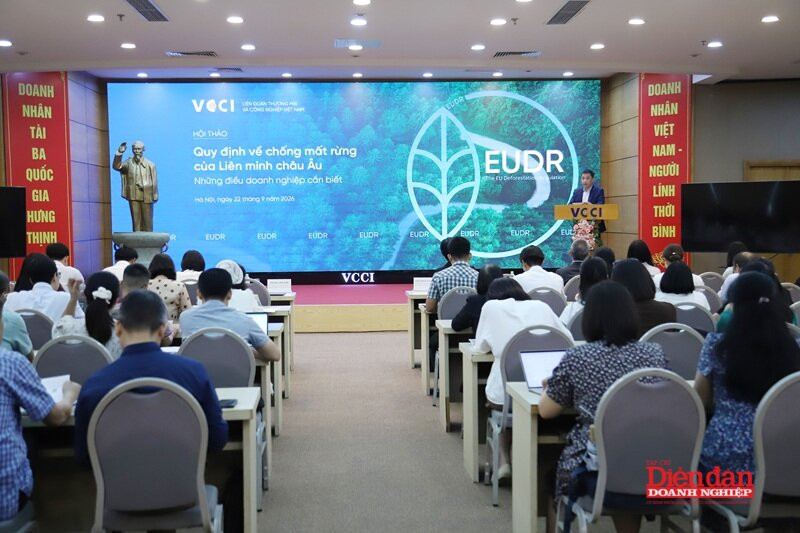
On the morning of September 22, VCCI organized the workshop “European Union Deforestation Regulation (EUDR) – What Businesses Need to Know.”
In his opening remarks, Mr. Dau Anh Tuan, VCCI Deputy Secretary General and Head of the Legal Department, said that international trade is entering a new phase in which the rules of the game are being reshaped around new criteria.
For decades, the competitiveness of an export-oriented economy was measured by cost, quality and delivery time. Today, in addition to these factors, markets are asking another question: how and where are these goods produced, and what impact do they have on the environment and communities where production takes place?
According to Mr. Tuan, the European Union Deforestation Regulation (EUDR) is a clear manifestation of this shift. It is neither an isolated nor a temporary measure, but rather part of the broader green policy framework that the EU is implementing in a coordinated manner, alongside the Carbon Border Adjustment Mechanism (CBAM) and regulations on supply chain due diligence, packaging and forced labour.
What these measures have in common is a shift in the focus of regulation from products to processes, and from national borders deeper into supply chains. Therefore, the right approach is not to respond to each regulation as it takes effect, but to build the foundational capacity needed to adapt to a broader trend that is already taking shape.
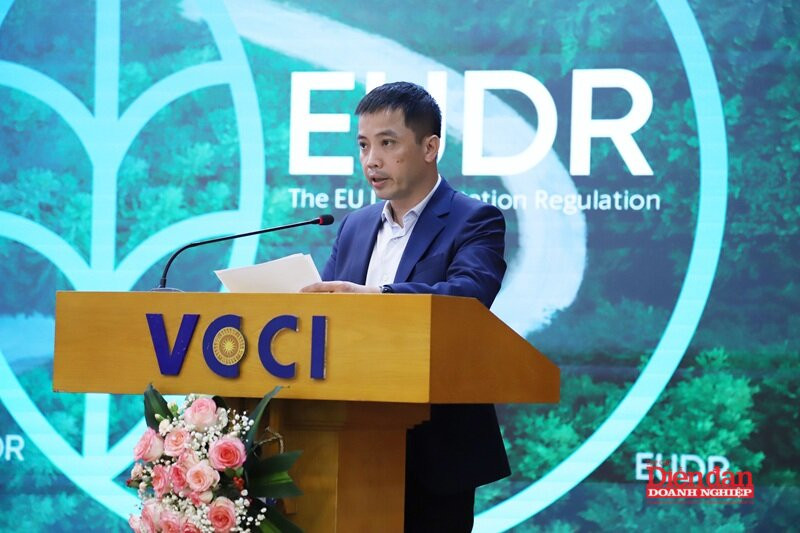
Mr. Dau Anh Tuan, VCCI Deputy Secretary General and Head of the Legal Department, delivers opening remarks at the workshop.
Mr. Tuan also noted that in just over three months, from December 30, 2026, the EUDR will officially apply to large and medium-sized enterprises, and from June 30, 2027, to small and micro enterprises. The Regulation covers more than 80 product lines across seven product groups: cattle, cocoa, coffee, palm oil, rubber, soy and wood. It sets out three mandatory conditions: being deforestation-free, complying with the laws of the country of production, and being declared in a Due Diligence Statement.
For Vietnam, this is not a matter concerning just a few shipments. Coffee, rubber, wood and wood products are among the country’s key export commodities, while the EU is one of the largest markets and also serves as a standards-setting market for many other markets. What Vietnam does today to meet EUDR requirements will affect the position of Vietnamese goods not only in the European market.
“From a legal perspective, the obligations fall on business operators in the EU. Vietnamese businesses are not directly subject to the Regulation. In practice, however, all the data needed to fulfill those obligations is generated at the Vietnamese end – at farmers’ plots of land, collection facilities, and processing and manufacturing plants. The obligation lies on one side, while the capacity to fulfill it lies on the other. That is why a European regulation has become a test of Vietnam’s supply chain management capacity,” Mr. Tuan said.
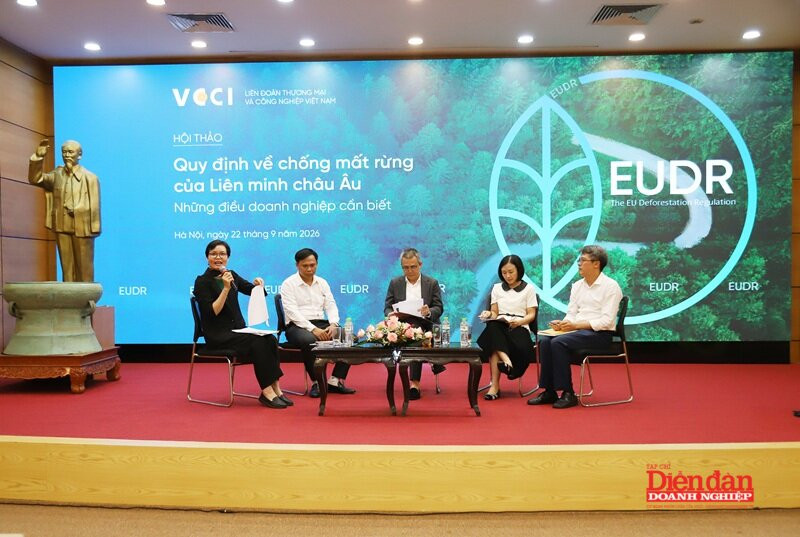
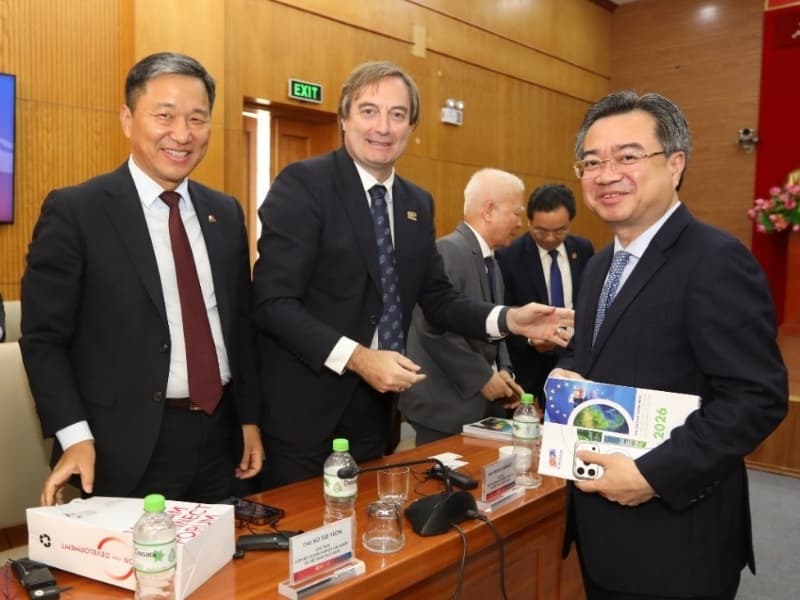
Delegates, experts and industry associations participate in the discussion at the workshop.
In addition, he highlighted three necessary shifts: from an export documentation mindset to a supply chain data mindset; from individual compliance to industry-wide cooperation; and from a passive approach to a proactive one.
According to Mr. Dau Anh Tuan, complying with the EUDR is not about preparing an additional set of documents at the final stage, but about maintaining continuous traceability from the plot of land to the container. In a supply chain with multiple layers of intermediaries, if information is not properly organized, businesses may be unable to demonstrate compliance even when their production is entirely legal and unrelated to deforestation.
Mr. Tuan noted that no business, regardless of its size, can digitalize hundreds of thousands of producers on its own. This is an industry-wide challenge that requires the leadership of industry associations, support from government agencies in providing land and forest data, and reasonable cost-sharing among different links in the supply chain.
“Vietnam has been classified by the EU as a low-risk country. This is a very favorable starting point, significantly reducing the burden of proof and the likelihood of post-clearance checks. However, it is important to note that a country-level risk classification does not replace the obligations applicable to individual shipments. A national-level advantage only becomes a genuine competitive advantage when it is translated into specific documentation and data for each business. Conversely, if we become complacent, we could easily lose the advantage we currently have,” Mr. Tuan said.
Alongside these issues, Mr. Tuan also pointed to two extreme perceptions observed in practice. On the one hand, some believe that the regulation is still far off or that, if they cannot export to the EU, they can simply redirect their products to other markets. On the other hand, some businesses prepare beyond the actual requirements, incurring unnecessary costs because they fail to distinguish between mandatory EUDR obligations and additional requirements imposed by customers or voluntary sustainability certifications. Mr. Tuan noted that both extremes are costly. Understanding the requirements correctly and taking proportionate action is always the most cost-effective approach.
Against this backdrop, Mr. Tuan expressed his expectation that the workshop would not only provide an understanding of a new regulation, but also clear answers to four highly practical questions: whether a company’s products fall within the scope of the Regulation; what data and evidence it needs to prepare; how it should coordinate with suppliers and EU customers; and what the limits are of what it is actually required to do.
“Every time the market raises its standards, Vietnamese businesses face a choice: either retreat to less demanding market segments or move up the value chain to remain in the most demanding markets. Experience over the years has shown that whenever we choose to move forward, the position of Vietnamese goods is elevated to a higher level. Therefore, the EUDR should be viewed not merely as a compliance obligation, but as an opportunity to increase transparency and standardize some of the most important supply chains in Vietnam’s agriculture and processing industries,” Mr. Tuan said.