VIETNAM CHAMBER OF COMMERCE AND INDUSTRY
Liên Đoàn Thương Mại Và Công Nghiệp Việt Nam
Tue, Oct 27, 2026, 09:45:00
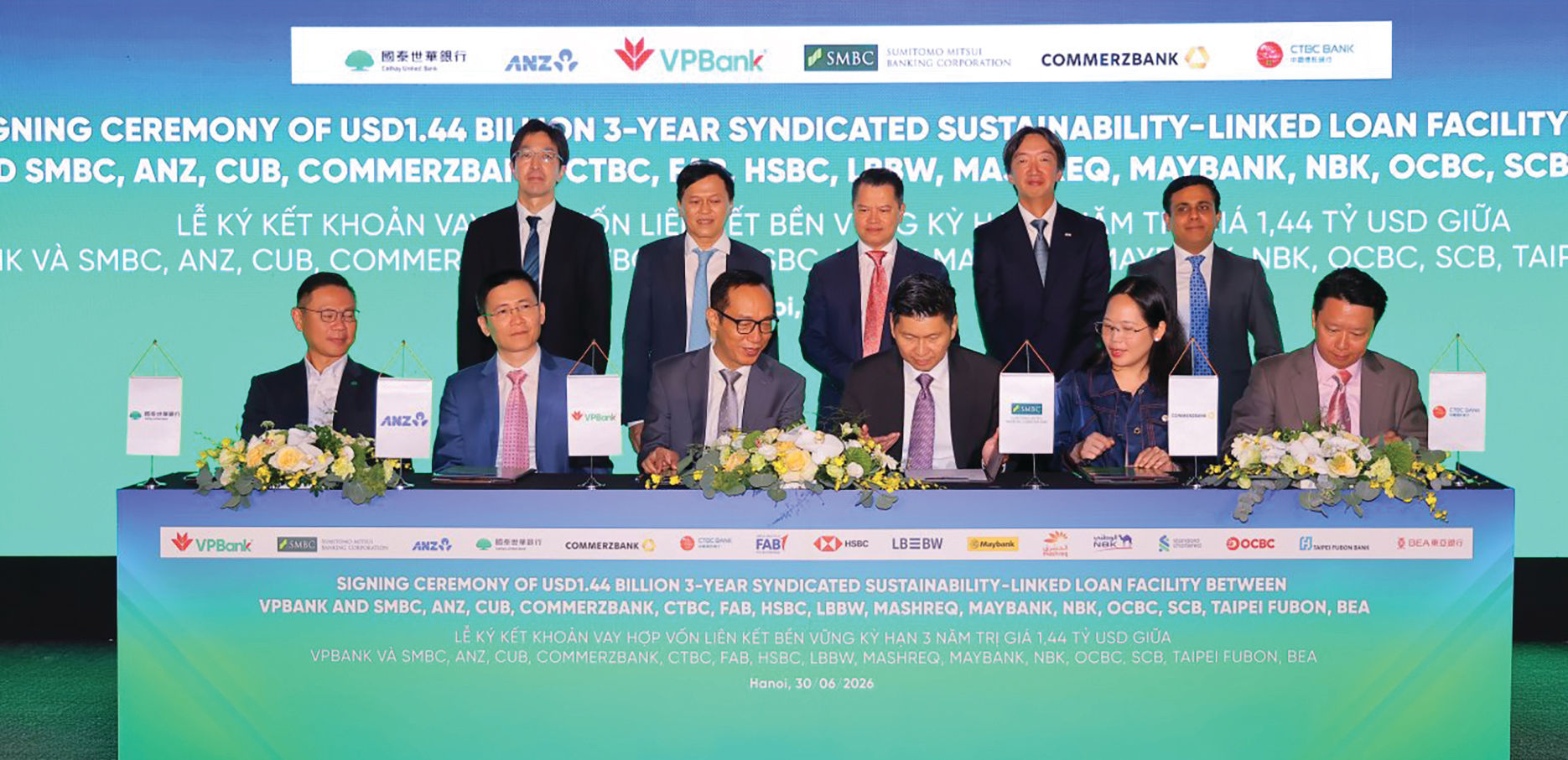
VPBank together with 15 international financial institutions signed a syndicated sustainability-linked loan facility worth $1.44 billion, marking a new step in the bank's international capital mobilization and sustainable development strategy. Photo: VPBank
For Vietnam's banking and financial market, the level or model of a capital-connecting bank is not a newly created function or a new type of functional license. Rather, it stems from the practical needs of the economy as well as the needs of banks themselves—moving from needing to be connected to mobilize capital (focused mainly on international sources) to expanding and enhancing capacity to become banks that connect capital sources.
This operational and development level intersects with the investment banking model, but its content does not completely overlap with investment banking. Ms. Nguyen Hoai Thu, CFA, Deputy General Director of VinaCapital Fund Management JSC, believes that this is a notable operational model in the financial and capital markets in the coming time. However, it is not a story for all banks; only those with sufficient capacity, scale, reputation, and deep, extensive connections that can "walk the talk" can pursue this path.
What Have Banks Been Doing?
Looking at reality, the concept of a capital-connecting bank was announced by HDBank when it established a strategic cooperation framework with the London Stock Exchange (LSE) and the Vietnam International Financial Center in Ho Chi Minh City (VIFC-HCMC), expanding cross-border capital mobilization channels for Vietnamese enterprises. At the time of the announcement in April 2026, HDBank and LSE implemented cooperation agreements with several leading Vietnamese enterprises to support access to the international capital market. The initial participating enterprises included corporations operating in industrial, manufacturing, and export sectors, such as Hoa Sen, THACO, and Phuc Sinh.
To date, the parties have not announced the specific progress of any transaction, but the enterprises participating in the memorandum of cooperation all have a need to expand their capital scale and have enhanced their governance standards to meet international practices. In early January 2026, Hoa Sen Home JSC—with 99% of its capital held by Hoa Sen Group—was established, expected to be the future of Hoa Sen Group with plans to increase its charter capital to 3,000 billion VND moving toward an IPO. Similarly, in 2024, when receiving a $25 million green capital investment from a Dutch fund, Mr. Phan Minh Thong, Chairman of Phuc Sinh Group, stated that the company planned to IPO within the next 4 years…
The role of capital-connecting banks in these blockbuster deals formed naturally as domestic banks grew large enough and capable enough to arrange and connect capital through international stock exchanges, international financial centers, and other major investment powerhouses—including global investment banks, commercial banks, and asset managers such as JP Morgan Chase, Morgan Stanley, Bank of America, UBS, BNP, SMBC, BII, and more.
In this model, banks do not replace the role of securities companies, including top players like SSI, VCI, HSC, which have their own competitive advantages. Connecting relationships have been driving effective investment banking operations for previous IPO deals of Techcombank, VPBank, HDBank themselves, before creating the launching pad to connect capital sources today.
Expectations for Long-Term Capital Efficiency
Where lies the difference and lack of overlap between banks and securities companies with investment banking operations? This can be seen from HDBank. The bank stated that the capital-connection axis will focus on arranging capital-raising structures, advising on listings, and connecting with global investors, thereby opening up new capital mobilization channels and diversifying funding sources for Vietnamese enterprises. Furthermore, this serves as an introduction and support system to help businesses meet international standards for accessing capital.
In addition to expanding and diversifying connections with external institutions and investment organizations, the most critical element for HDBank, Techcombank, or VPBank is owning an ecosystem with investment focus directed toward member securities companies—such as HDS, TCBS, and VPBankS—all of which are leveraging corporate bond and equity underwriting advisory services as revenue growth engines. Accordingly, the parent bank leads the way in opening connections while the subsidiary securities company follows to develop operations—a major advantage that allows the capital connection route to help all parties achieve their target efficiency.
Thus, in their business strategies and structures, ecosystem banks now do not merely mobilize funds to lend, but connect capital to re-lend. This is something almost all banks can implement. Next, banks connect and arrange capital. At a higher level, banks connect enterprises with multiple markets and financing tools in a package deal to become the "hub" of the financial ecosystem: credit, syndicated loans, international bonds, equities, fund capital, trade finance, and green finance.
Naturally, with this model and approach, Ms. Nguyen Hoai Thu notes that in the Vietnamese market, some banks are just starting out and gradually taking shape, so they cannot immediately record high business performance. However, this is and will remain an important direction for the competitive path of large banking ecosystems, while contributing another solution to the capital demand problem of enterprises and the broader economy.