
VIETNAM CHAMBER OF COMMERCE AND INDUSTRY
Liên Đoàn Thương Mại Và Công Nghiệp Việt Nam
Tue, Nov 10, 2026, 15:37:00
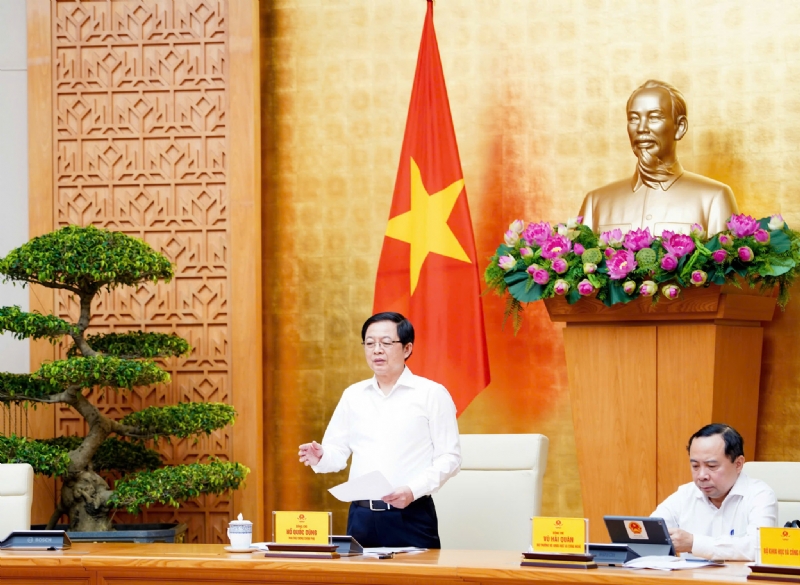
Deputy Prime Minister Ho Quoc Dung delivers the keynote address at the National Conference on Promoting Linkages between Research Institutes, Universities and the Business Community in Science and Technology Research and Development.
Shifting Research Focus to Business Needs
At the national conference on strengthening links among research institutes, universities and businesses in S&T research and development on October 23, 2026, Deputy Prime Minister Ho Quoc Dung pointed out a paradox: despite investment in research, links among research institutes, universities, businesses and the market remain weak. Many research tasks are not based on practical needs, and their results have not been effectively applied or commercialized.
According to the Deputy Prime Minister, during 2021-2025, businesses participated in only about 12% of national-level S&T tasks, compared with approximately 11% at the local level. Meanwhile, Vietnamese businesses invested just 0.3% of gross domestic product (GDP) in research and development (R&D), well below China's 2.1% and South Korea's 4.2%.
Research personnel are also concentrated mainly in research institutes and universities. Only 333 researchers with doctoral degrees work in businesses, compared with approximately 21,000 at research institutes and universities. These figures show that research capacity remains poorly connected with the demand for practical applications in production and business activities.
During 2021-2025, Vietnamese businesses were granted more than 700 patents, compared with approximately 24,000 granted to foreign businesses. More than 20 S&T trading platforms offered around 62,000 technologies for sale, but only 750 investors and businesses made inquiries, leading to just 72 transactions.
The problem, therefore, lies not only in the availability of technology and research resources, but also in the ability to turn research results into products that meet market demand.
In response, Deputy Prime Minister Ho Quoc Dung called on ministries, sectors, research institutes, universities and businesses to address bottlenecks in institutional frameworks, financial mechanisms, research organization, and the rights to use and commercialize research results. The Government is ready to consider recommendations on inappropriate regulations to remove obstacles and facilitate S&T research, development and application.
The key directive is that, from 2027, at least 30% of research tasks must be based on business needs, with the target gradually rising to 50%. This requires not only greater business participation in research but also changes in how S&T tasks are developed and organized. Businesses need to be involved from the problem-definition stage, rather than accessing research results only after the work is completed.
Linking Research Funding to Results
To achieve this target, Deputy Prime Minister Ho Quoc Dung assigned the Ministry of Science and Technology (MOST) to map S&T research facilities nationwide and assess and classify their capabilities by industry, field and region. This database will help businesses find suitable research partners, access specialized expertise and identify organizations that can address their technological needs.
MOST must also set research objectives for one-, three- and five-year periods and work with ministries and sectors to identify technology challenges based on practical needs. National S&T programs through 2030 must be restructured, shifting from assigning individual research projects to commissioning research tasks and allocating funding packages tied to deliverables. Implementing organizations will also be given greater autonomy alongside increased accountability.
According to a report presented at the conference by Le Xuan Dinh, Deputy Minister of Science and Technology, a major obstacle is that businesses often become involved too late, so requirements for functionality, cost and integration are not agreed upon from the outset. Research results may also lack operational data, standards, certification and funding for further technology development. The parties also face difficulties in determining valuations, usage rights, benefit-sharing arrangements and responsibilities during testing, while new products struggle to find their first customers.
MOST has proposed a coordinated set of measures, including using 10 indicators to measure collaboration outcomes; providing co-funding based on businesses' actual capital contributions; linking funding for research institutes and universities to collaboration and technology transfer outcomes; strengthening businesses' capacity to absorb technology; creating initial markets for new products; and enhancing the role of intermediary organizations.
Deputy Prime Minister Ho Quoc Dung also called for reviewing research results with commercialization potential and supporting technology refinement, testing, certification and market access. MOST has been tasked with developing shared research centers that allow businesses to access national key laboratories and establishing a national S&T trading platform linked to domestic and international markets.
He asked the Ministry of Education and Training to work with MOST to promote collaboration among the state, universities and businesses, develop innovation centers and support entrepreneurship at higher education institutions. The Ministry of Finance is to review mechanisms for commissioning and publicly procuring S&T products. Ministries, sectors and local authorities must compile lists of technology challenges based on practical needs, clearly defining objectives, expected products, receiving organizations and resource mobilization plans. They must also urgently establish S&T development funds in accordance with regulations.
The target of having at least 30% of research tasks based on business needs from 2027 will only be fully effective if supported by appropriate financial mechanisms, clear usage rights and markets ready to receive the resulting products. Businesses need to be involved from problem definition through testing, application and commercialization, while research institutes and universities must align their capabilities with practical needs. Regulatory authorities, meanwhile, need to shift their focus from controlling processes to evaluating outcomes.