VIETNAM CHAMBER OF COMMERCE AND INDUSTRY
Liên Đoàn Thương Mại Và Công Nghiệp Việt Nam
Tue, Oct 13, 2026, 08:52:00
A Significant Gap Between Financing Needs and Access to Capital
The gap between financing needs and access to capital among women-owned businesses highlights the need to change the way information is provided, financial products are designed, and business support is delivered, particularly in the process of the green transition.
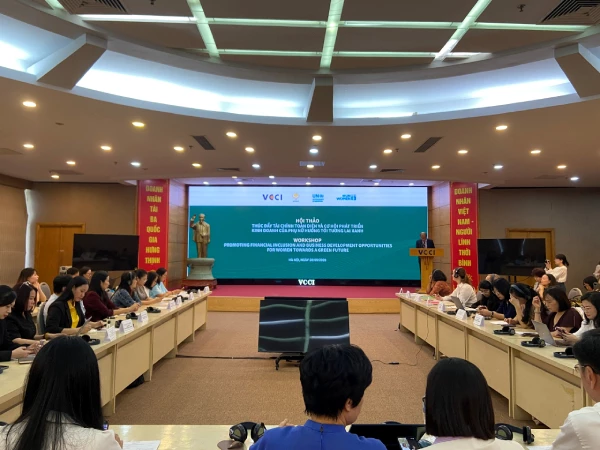
At the workshop “Promoting Inclusive Finance and Women’s Business Development Opportunities Towards a Green Future” held on September 28, Ms. Mai Thi Dieu Huyen, Vice Chairwoman in charge of the Vietnam Women Entrepreneurs Council (VWEC), said the survey covered 166 women-owned enterprises, household businesses and cooperatives across 20 provinces and cities. The survey was conducted in combination with consultations and in-depth interviews with local organizations and commercial banks from November 2025 to June 2026.
The findings showed that approximately 80% of respondents have a need for green investment and financing. Of this group, 31.3% reported a high level of need, while around 47% expressed a need but had yet to clearly define it. However, as many as 85.5% had never accessed any form of green financing.
According to Ms. Huyen, one of the underlying reasons is the information gap and limited understanding of specialized terminology. Businesses find more familiar concepts such as sustainable agriculture, renewable energy and the circular economy easier to understand and access. Meanwhile, for technical terms such as ESG, carbon credits, green finance and green credit, most respondents had only heard of them, had limited understanding, and showed relatively little interest.
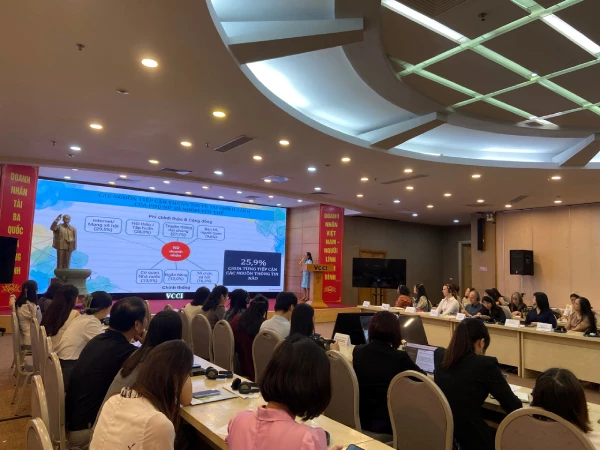
The event was jointly organized by VWEC under VCCI and UNEP.
This makes it more difficult for businesses to access green finance programs, as they may not know which criteria they need to meet, how to prepare the required documents, or how to demonstrate the “green” elements of their projects.
Three major barriers have been identified: a lack of information on green financial products and the requirements for demonstrating the green nature of projects; complicated procedures; and traditional collateral requirements.
Beyond the lack of capital, these businesses also lack the support resources needed to turn their green transition needs into finance-ready projects. Businesses need access to information alongside consultation and specific guidance, direct support in preparing loan applications, and training in finance and business management.
Meanwhile, 100% of the surveyed banks offer green financial products, but none has products specifically designed for women. Green financing is currently concentrated in green agriculture, renewable energy, green manufacturing and the circular economy, while sectors such as green tourism, green services and conservation forestry receive lower priority
Bringing Green Finance Closer to Businesses
From the business perspective, VCCI Vice President Hoang Quang Phong said that the green transition is becoming increasingly important to businesses’ competitiveness and long-term development. Changes in market standards, environmental requirements, supply chain responsibilities and sustainable finance trends are requiring businesses to proactively adapt, innovate their business models and improve resource efficiency.
According to VCCI Vice President Hoang Quang Phong, limited access to capital may create additional challenges for businesses in their green transition.
According to Mr. Phong, the green transition opens up opportunities to develop green products and services, access new markets, improve productivity and participate more deeply in value chains. However, these opportunities do not automatically translate into competitive capabilities. Businesses need knowledge, technology, human resources, market information and, in particular, appropriate financial resources.
For micro, small and medium-sized enterprises, particularly women-owned or women-led businesses, limitations in scale, capital, management capacity, access to credit and business linkages can create additional obstacles to the transition.
Ms. Parimita Mohanty, Programme Manager for Renewable Energy, Finance Division, Climate Change Unit, United Nations Environment Programme (UNEP) Regional Office for Asia and the Pacific, also emphasized the role of SMEs in the green transition. With SMEs accounting for approximately 95–97% of all businesses, Vietnam’s green transition cannot be separated from the ability of SMEs to access finance, technology and skills.
According to Ms. Parimita Mohanty, around 50% of SMEs are expanding their green transition activities, including many women-owned businesses, but financial constraints remain a major obstacle. Therefore, stronger connections are needed between businesses, financial institutions, technology solution providers and support resources to help businesses access more appropriate sources of finance.
Ms. Tran Thanh Huong, Deputy Head of the Policy, Business Environment and International Cooperation Division under the Agency for Private Sector and Collective Economy Development, Ministry of Finance, said that sustainable business practices have become a practical requirement for businesses.
During the 2022–2025 period, under the Program on Supporting Sustainable Business Practices in the Private Sector pursuant to Decision No. 167, 1,500 businesses received comprehensive green transition consultancy; 10,700 businesses received training, 65% of which were SMEs; and 320 businesses completed sustainability reports in accordance with GRI Standards. In addition, 58 pilot circular economy models were implemented, focusing on agricultural production and processing.
However, Ms. Huong noted that the transition from awareness to action remains slow. Businesses face difficulties in accessing sustainable business assessment criteria, a shortage of ESG experts and limited resources for consultancy. Access to finance for sustainable business practices also remains constrained.
To further address these bottlenecks, the Government issued Decision No. 926/QD-TTg dated May 25, 2026, approving the Program on Supporting Sustainable Business Development for the 2026–2030 period. The Program aims to support approximately 25,000 enterprises, household businesses and cooperatives in adopting sustainable business practices, while developing at least 20 exemplary models for wider replication.
Based on its research findings, VWEC proposed further improving policies by establishing criteria appropriate for small-scale projects and simplifying procedures. Gender considerations should also be integrated into support programs, with greater attention paid to women-owned businesses and cooperatives managed by women.
For intermediary organizations, simple tools should be developed, such as green production plan templates and business self-assessment forms. At the same time, relationships with banks should move beyond merely referring clients toward cooperation in screening, completing loan applications and monitoring projects.
For banks, one proposed approach is to develop microcredit products and design procedures and documentation better suited to household businesses and small-scale enterprises, while strengthening advisory support throughout the lending process. Credit assessment is also recommended to reduce reliance on traditional collateral and consider factors such as the reputation of group organizations, community activity records or guarantees provided by intermediary organizations.
According to Ms. Mai Thi Dieu Huyen, it is important to bring green finance information closer to businesses through simple and easy-to-understand language, rather than relying solely on technical terminology. When businesses understand what they need to do, what they need to prepare and which sources of finance they can access, the gap between green transition needs and access to finance can be narrowed.