VIETNAM CHAMBER OF COMMERCE AND INDUSTRY
Liên Đoàn Thương Mại Và Công Nghiệp Việt Nam
Wed, Aug 13, 2025, 08:20:00
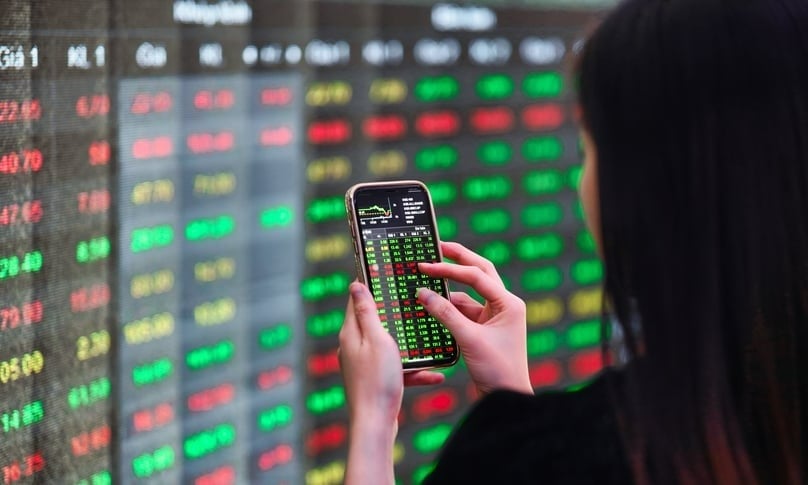 An investor tracks market developments. Photo by the Investor/Trong Hieu.
Discussing this issue at the recent Financial Street talk show on VTV8 channel, experts noted that the trend of restructuring global investors' portfolios will continue in the coming time. In particular, Vietnam is expected to be the next attractive destination in the eyes of foreign investors.
Phung Minh Hoang, director of strategy at Phu Hung Fund Management JSC (PHFM), assessed that foreign investors tend to net sell in developed markets like the U.S. and return to emerging markets, especially mainland China.
This cash flow also tends to spread to other emerging markets such as Taiwan, India, and Southeast Asian countries. This trend has become clearer in the past 1-2 months, after China and Vietnam reached preliminary trade agreements with the U.S.
Major financial institutions such as Goldman Sachs and JP Morgan have recommended to increase investment proportions and have a positive view on emerging markets, including Vietnam.
 Phung Minh Hoang, strategy director at Phu Hung Fund Management JSC. Photo courtesy of the talk show.
He said there are three reasons behind the structural change in equity flows.
First, emerging markets now trade at just over 12 times forward P/E, significantly lower than the roughly 19 times in developed markets.
Second, in developed markets and the U.S. in particular, the short-term economic outlook is not very positive due to concerns about risks from the tariff policy imposed by President Donald Trump, as well as a decline in profit expectations of listed companies in the AI and technology industry.
The market has realized that the U.S. is unlikely to have a monopoly in this field and is at risk of facing strong competition from China, especially after the launch of DeepSheek - a Chinese company developing AI.
The third factor that strongly promotes the shift in capital flows is the weakening of the U.S. dollar. The DXY index fell more than 10% in the first half of the year - the deepest decline in decades.
As the U.S. dollar depreciated sharply, investments and assets in the U.S. also lost value when converted into other currencies. Therefore, large global investment funds had to restructure their asset portfolios in the U.S., including selling U.S. stocks to reduce this risk. At the same time, investors increased their purchases of assets in other countries, including emerging stock markets, with more attractive valuations.
Nguyen Bao Tran, director of macro analysis and strategy at Mirae Asset Securities JSC (MAS), predicts that the trend of shifting to emerging markets will continue as the attractiveness of the U.S. market is gradually decreasing. The cash flow will not be widely dispersed, but will focus strongly on markets with clear growth prospects.
 Nguyen Bao Tran, director of macro analysis and strategy at Mirae Asset Securities JSC. Photo courtesy of the talk show.
The first decisive factor is the impact of U.S. trade policy. Next is the impact of growth support policies. Many countries are implementing loose monetary or fiscal policies, or both (depending on the policy space of each country) to promote economic growth. On that basis, cash flows will be differentiated, prioritizing specific industries with significant support from growth policies.
"In my opinion, the Eurozone, Asian markets such as South Korea, Japan, Taiwan, and Vietnam will be attractive destinations for foreign indirect investment capital flows," Tran commented.
For Vietnam alone, the Mirae Asset analyst believes that the net buying trend of foreign investors will continue thanks to the current P/E valuation of 15 times - significantly lower than the average of 16.6 times in the last 10 years. This valuation is also much lower than the average of 16.1 times in emerging markets.
The attractiveness of Vietnamese stocks also comes from the prospect of market status upgrade from "frontier" to "emerging". According to FTSE simulation, the upgrade can attract nearly $1 billion from passive funds and more than $5 billion from active funds.
After an upgrade by FTSE, the target will be an upgrade by MSCI. The roadmap of further reforms to achieve these goals will be the basis for continuing to attract international capital flows in the long term.
In parallel, the macro foundation is also a solid support for domestic and foreign capital flows.
Tran noted that Vietnam is showing determination to achieve the growth target of 8.3-8.5% this year and higher for the next 5 years, helping the country to escape from the middle-income trap through a series of changes from the system to policies.
Since July, Vietnam has merged provinces and cities, building a streamlined two-level local government model (the city/province level and ward/commune level only, with the removal of the district level). This is an important premise to help boost public investment disbursement and promote urbanization.
In addition, new laws and policies are reshaping the national economy. They are a series of laws and resolutions passed by the National Assembly, the country's legislature, in the May-June session.