VIETNAM CHAMBER OF COMMERCE AND INDUSTRY
Liên Đoàn Thương Mại Và Công Nghiệp Việt Nam
Wed, Sep 10, 2025, 07:14:00
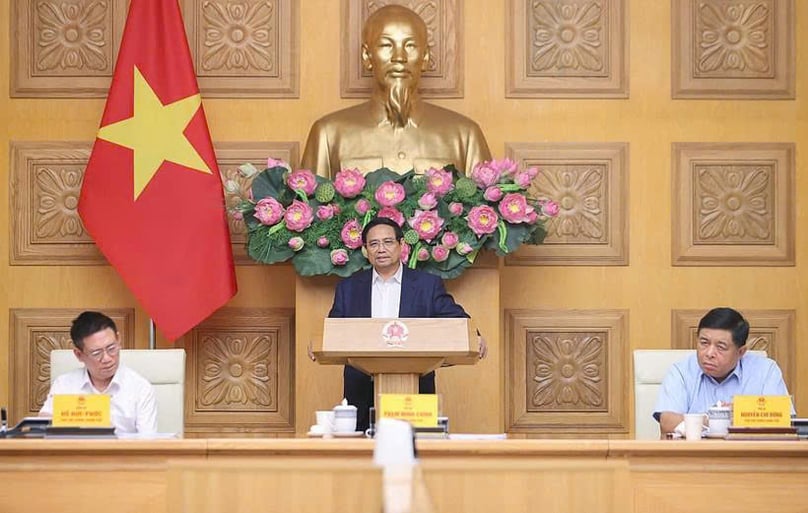
During a working session with Prime Minister Pham Minh Chinh on Sunday, the 13-member council, comprising leading economists and corporate executives, said Vietnam’s target aligns with the historical growth trajectories of economies such as Japan, South Korea, mainland China, and Taiwan during their respective “economic miracle” phases.
It noted that macroeconomic stability remains intact, with credit growth aligned with GDP expansion, capital flows favoring production sectors, and public debt-to-GDP ratio within safe limits.
New growth drivers such as institutional reforms, anti-waste initiatives, improved business climate, increased R&D spending, digital and green transformation, and tech-driven innovation could add 1 to 1.5 percentage points to annual GDP growth, the council noted.
However, it warned of risks in key financial sectors including exchange rates, gold prices, securities, and real estate, urging the government to pair aggressive growth efforts with prudent risk management and a continued focus on growth quality and macroeconomic stability.
Addressing the function, Prime Minister Chinh acknowledged the growth target as an “ambitious but must-do task,” emphasizing the need for expanded fiscal policy, flexible monetary management, and 100% disbursement of public investment capital.
He also called for urgent resolution of delayed public projects and a more rational tax policy framework.
In response to rising tariff pressures from the U.S., the PM stressed market diversification, export restructuring, and improving product quality toward green, digital, and circular economy principles.
He also urged stronger support for domestic production, cost reduction, and enhanced trade promotion and supply-demand linkages.
On exchange rate policy, the cabinet leader emphasized the importance of interest rate stability and boosting exports of goods and services. Regarding the gold market, he reiterated that the central bank has been instructed to increase supply to stabilize market dynamics, while preventing speculation and smuggling.
He agreed that the real estate sector is a growth driver, but it is not yet meeting expectations.
The Prime Minister requested comprehensive solutions regarding supply-demand, fiscal policy, land regulation, and legal frameworks. He also asked for continued efforts to reform administrative procedures, deliver more incentive policies, and increase affordable housing supply.
Vietnam's economic growth rate reached 7.52% in the first six months of the year, a record high in the period 2011-2025, the General Statistics Office reported.
Standard Chartered on July 24 revised its 2025 GDP growth projection for Vietnam to 6.1%, down from 6.7% early this year. The country's economic expansion might slow to 4.9% year-on-year in H2, from 7.5% in H1, the bank said in a release.
One day earlier, the Asian Development Bank (ADB) had also revised down its Vietnam GDP growth projection to 6.3% in 2025 and 6% in 2026, respectively.