
VIETNAM CHAMBER OF COMMERCE AND INDUSTRY
Liên Đoàn Thương Mại Và Công Nghiệp Việt Nam
Tue, Aug 18, 2026, 14:35:00
In fact, after a correction that brought valuations down to lower levels, securities stocks are facing a strong opportunity for recovery in the final months of 2026. The upward push stems not only from macroeconomic stories and market-upgrading expectations but is also backed by a solid earnings foundation from proprietary trading and margin lending activities.
Looking beyond a few short-lived rebounds and pullbacks over a handful of sessions, the stock market has recently undergone a significant discount, falling nearly 10% from its Q2 2026 peak. However, from an in-depth analytical perspective, this correction opens a promising window for short and medium-term trading positions, especially for highly sensitive sectors like securities. A recent strategy report by Rong Viet Securities (VDSC) clearly outlined the profit outlook as well as potential catalysts that could trigger a rally in this sector in the coming period.
.jpg)
After a period when securities stocks became very cheap, the market always enters a recovery cycle. (Photo: Quoc Tuan)
The decline on August 14 wiped out over 175,400 billion VND in market capitalisation on the HoSE, leaving a total value of around 8.3 million billion VND. However, positive long-term factors remain. (Photo: Quoc Tuan)
Market Upgrading Timing Remains
According to VDSC, the market is converging on three important catalysts to enter a new recovery leg. First, margin call pressure across the market has cooled down significantly following the fluctuations of late July, establishing a stable mindset for capital to return.
Second—and the narrative attracting key investor attention—is the push from FTSE's official market upgrading event. Capital from ETF funds tracking the FTSE Emerging basket is projected to begin dispersing starting September 21, right after the official index portfolio announcement on August 21. This element acts as a psychological stimulant to attract front-running capital flows.
Third, VDSC believes the State Bank of Vietnam (SBV) may tilt monetary policy toward supporting growth in the final months of the year. With exchange rates relatively well-controlled (the VND has depreciated only about 0.4% against the USD since the beginning of the year), analysts note that a more accommodating monetary environment consistently serves as a positive launchpad for market liquidity and index performance.
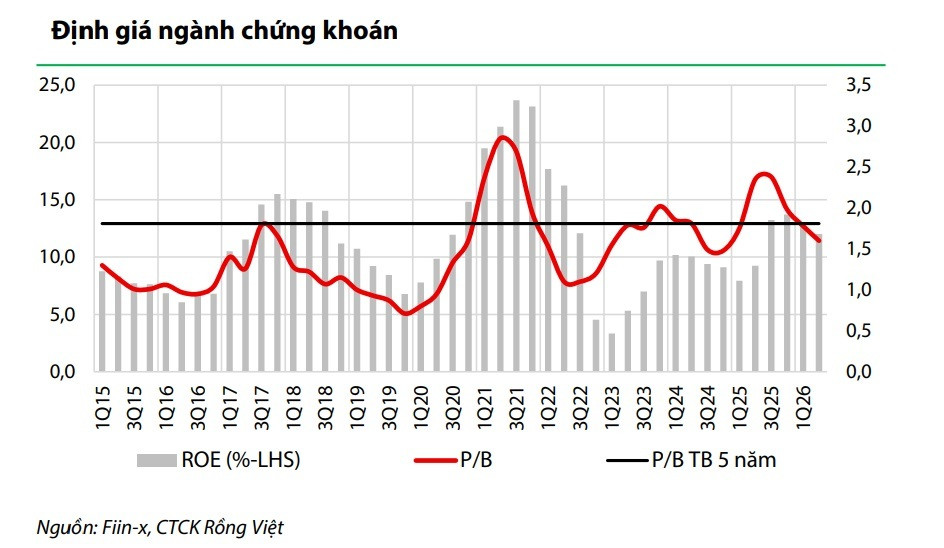
Thanks to the recent correction, securities sector valuations have dipped below their historical average, creating an attractive margin of safety. Specifically, the industry-wide Price-to-Book (P/B) ratio is currently trading at 1.60x, approximately 12% lower than its 5-year average of 1.80x, despite Return on Equity (ROE) declining for a second consecutive quarter to 12.0%. This valuation discount is expected to be a solid anchor for capital deployment.
Internal Momentum from Securities Firms
Looking deeper into financial structures, the profit defence wall of securities companies (CTCKs) today is vastly different from previous cycles. Total Operating Income (TOI) across the entire sector reached 16,300 billion VND in Q2 2026, a 43% increase quarter-on-quarter (QoQ) and 39% year-on-year (YoY).
Notably, proprietary trading contributed more than half of the profits, recovering strongly from the Q1 2026 slump. Net income from proprietary trading reached 8,400 billion VND, up 47% QoQ, representing 51% of TOI. Within this, net income from FVTPL (Fair Value Through Profit or Loss) assets rose 47% QoQ to 5,500 billion VND.
VDSC data shows that margin lending represents the most stable growth engine and is currently at record highs. Net income from margin lending—after deducting interest expenses—reached 4,105 billion VND, up 8% QoQ and 77% YoY, accounting for 25% of TOI. This is the only component to maintain continuous growth throughout the market correction period and remains the sector's most reliable revenue stream, as margin loan balances repeatedly hit new highs regardless of market performance.
Income from Investment Banking (IB) saw a sudden surge. The IB segment generated 3,100 billion VND, over 6 times higher than the previous quarter, accounting for 19% of TOI—an abnormally high level compared to the typical 5–10% range in prior quarters. This spike was driven primarily by a few broking firms with superior customer ecosystem advantages and high corporate bond issuance demand, including VPX (1,170 billion VND), TCX (835 billion VND), HDS (720 billion VND), and LPS (200 billion VND). Consequently, VDSC analysts view this income as event-driven and not representative of the broader sector.
Net brokerage income continues to account for a small share. The brokerage segment generated approximately 420 billion VND in 2Q26, down 62% QoQ and 40% YoY, representing a mere 2.5% of TOI—the lowest level in the last 10 quarters, compared to 9.5% in Q1 2026 and 9.6% during the Q3 2025 peak. This indicates that in the current cycle, market liquidity recovery is no longer the primary driver of securities firm profits as it was in past cycles, given that fee competition has compressed gross profit margins in broking operations to very low levels.
Based on this profit structure, VDSC advises investors to prioritize selecting securities stocks based on two core criteria: (1) high beta combined with a large stock proportion in the FVTPL portfolio to capitalize on short-term upward momentum; and (2) potential for margin lending growth to ensure a sustainable profit foundation.
Filtering through these strict criteria, names like VIX, CTS, SHS, and VPX stand out due to their high stock proportions in FVTPL relative to proprietary trading scale and equity size. Meanwhile, regarding margin lending headroom to capture booming margin liquidity, VIX, SSI, TCX, VPX, and VCK currently hold leading market advantages.
Despite converging bright spots, the road through the second half of the year may still feature "potholes and bumpiness", as humorously noted by General Director Le Anh Tuan when reflecting on the stock market's recent trajectory.
VDSC experts caution investors to closely monitor risks stemming from interest rate and exchange rate movements if they deviate from expectations, as well as scenarios where passive capital flows post-upgrade might remain modest. Therefore, defining position sizing and executing strict risk management remain the "guiding compass" for all investment decisions.