VIETNAM CHAMBER OF COMMERCE AND INDUSTRY
Liên Đoàn Thương Mại Và Công Nghiệp Việt Nam
Mon, Aug 04, 2025, 08:07:00
Purchasing activity also increased, while employment neared stabilization. There were a number of reports of difficulties sourcing raw materials, resulting in supplier delivery delays, lower input stocks, and higher costs for purchases, the company said in a release on Friday.
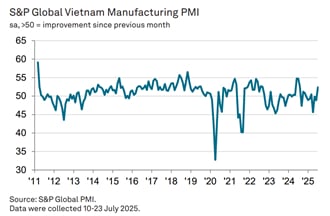
The S&P Global Vietnam Manufacturing Purchasing Managers' Index (PMI) posted 52.4 in July, up from 48.9 in June and back above the 50.0 no-change mark for the first time in four months.
The index pointed to a strengthening in the overall health of the manufacturing sector. In fact, the solid improvement in business conditions was the most marked for almost a year.
Andrew Harker, economics director at S&P Global Market Intelligence, said: "July PMI data suggested that the Vietnamese manufacturing sector is getting back on its feet following the disruption caused to operations by the U.S. tariff announcements in recent months. Although tariffs continued to cause reductions in new export orders, firms were able to secure enough business elsewhere that total new orders returned to growth."
"A key feature of the latest survey was the impact of difficulties sourcing raw materials. Firms linked this to widespread supplier delivery delays, declining stocks of purchases and building cost pressures. If material supplies continue to cause issues in the months ahead then we may see limits to the growth rates that can be achieved by the sector."
The renewed increase in new orders helped to support production growth in July. Output rose for the third month running. Moreover, the pace of expansion was marked and the fastest in 11 months.
Higher output requirements led to a return to growth of purchasing activity. Here too, the pace of expansion was the sharpest since August last year.
Backlogs of work continued to fall, albeit to the smallest extent in the current seven-month sequence of depletion.
Despite renewed growth of input buying, stocks of purchases declined again as panellists reported challenges securing raw materials. That said, the pace of depletion was the weakest since December 2023.
Stocks of finished goods also decreased in July. Material shortages resulted in a further lengthening of suppliers' delivery times. The latest deterioration in vendor performance was solid and only slightly less pronounced than that seen in June.
Difficulties sourcing materials, particularly those from abroad, led to an increase in input costs at the start of the second half of the year. Input prices increased for the second successive month, and at a solid pace that was the fastest in 2025 so far.
The pace of output price inflation also quickened in July as firms passed on higher input costs to customers. Here to, the rise was the sharpest in seven months. That said, the increase in charges was only modest, S&P Global reported.
Although manufacturers remained optimistic that output will increase over the coming year, sentiment dipped to a three month low in July and was well below the series average.
Confidence was linked by panellists to hopes for more stable economic conditions, new product launches and new orders. On the other hand, concerns around the impact of U.S. tariffs weighed on the outlook, it added.
Vietnam's economic growth rate reached 7.52% in the first six months of the year, a record high in the period 2011-2025, the General Statistics Office reported on Saturday.
The figures for H1 in 2021, 2022, 2023, and 2024 were 5.71%, 7.01%, 3.91%, and 6.64%, respectively.
Standard Chartered on July 24 revised its 2025 GDP growth projection for Vietnam to 6.1%, down from 6.7% early this year.
One day earlier, the Asian Development Bank (ADB) also adjusted down its Vietnam GDP growth forecast to 6.3% in 2025 and 6% in 2026, respectively.
The forecasts by Standard Chartered and ADB are much lower than the target of "at least 8%" set by the National Assembly, the country's legislature.
An online dialogue with leaders of localities on economic growth scenarios on July 16, Prime Minister Pham Minh Chinh made it clear that Vietnam needs to achieve a GDP growth rate of about 8.3-8.5% this year, creating momentum to reach a double-digit level in the 2026-2030 period.