VIETNAM CHAMBER OF COMMERCE AND INDUSTRY
Liên Đoàn Thương Mại Và Công Nghiệp Việt Nam
Mon, Aug 04, 2025, 08:44:00
The roadmap was laid out in a newly issued government action plan signed by Prime Minister Pham Minh Chinh for such a center.
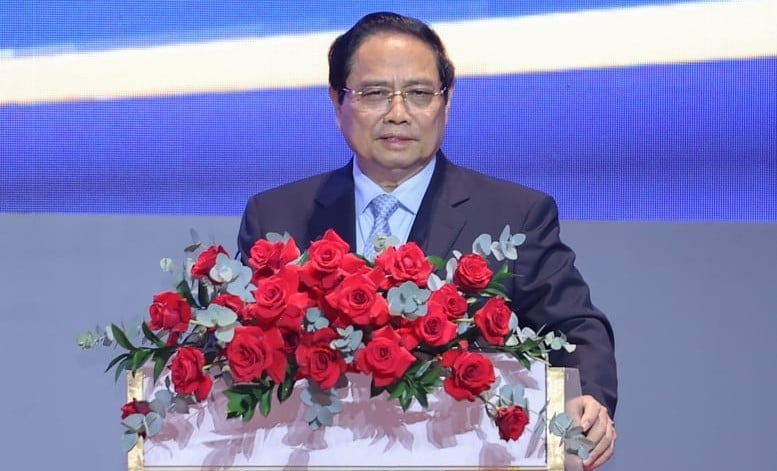 Prime Minister Pham Minh Chinh (standing) and other delegates at a conference on international financial center development in Vietnam, Ho Chi Minh City, August 2, 2025. Photo courtesy of the government's news portal.
Accordingly, the government aims to build a modern financial ecosystem with enhancement of new markets such as commodity and carbon exchanges, high-tech financial services (fintech and digital banking), and high-quality human resources.
The prime ministerial decision was announced by Finance Minister Nguyen Van Thang on Saturday at a conference in HCMC on the implementation of the National Assembly’s resolution on the international financial center in Vietnam.
Initially, a service ecosystem including legal, auditing, and technology support meeting international standards is expected to be formed in the two cites this year.
Relevant authorities will complete a specialized legal framework for the center between now and the year-end, ensuring it is consistent, transparent, and systematic, with tailored mechanisms and policies to attract capital, technology, modern governance methods, and high-quality human resources.
This framework will also ensure national financial and monetary security and safety. By the end of 2025, HCMC and Danang will have developed synchronized infrastructure and vital services such as transportation, telecommunications, and logistics to support the operation of the international financial center.
The government will also accelerate the development of strategic infrastructure in HCMC's key communes of Sai Gon, Ben Thanh, and Thu Thiem, and in Danang. This includes digital infrastructure, 5G coverage, and blockchain platforms to pilot digital assets and non-fungible tokens (NFTs).
The government also aims to ensure a favorable living and business environment for investors.
Local authorities, ministries, and sectors will study international financial center models and establish coordination and oversight mechanisms throughout the implementation process.
The same day, the Steering Committee for International Financial Center Development in Vietnam was officially launched, with Prime Minister Pham Minh Chinh as its head.
The five deputy heads include Standing Deputy Prime Minister Nguyen Hoa Binh, HCMC's Party chief Nguyen Van Nen, Minister of Finance Nguyen Van Thang, Governor of the State Bank of Vietnam Nguyen Thi Hong, and Danang's Party chief Nguyen Van Quang.
Previously, on June 27, the National Assembly passed a resolution on the development of an international financial center in Vietnam. The resolution, effective from September 1, outlines the development of the center located both in HCMC and Danang, with a unified regulatory framework but tailored products based on each city's strengths.
HCMC will focus on capital markets, banking, monetary policy, fintech sandboxes, and specialized exchanges; while Danang will develop green finance, financial technology, digital services, and controlled pilots for digital assets and currencies, aiming to attract investment funds.
The resolution also provides numerous preferential policies regarding taxes, land, and labor. Priority projects may lease land for up to 70 years and enjoy personal income tax exemptions for foreign individuals until 2030.
Businesses investing in the center will benefit from a corporate income tax rate of 10% in 30 years, with up to four years of tax exemption and a 50% reduction for the following nine years. Dispute resolution mechanisms will be expanded, allowing the selection of domestic or international arbitration.
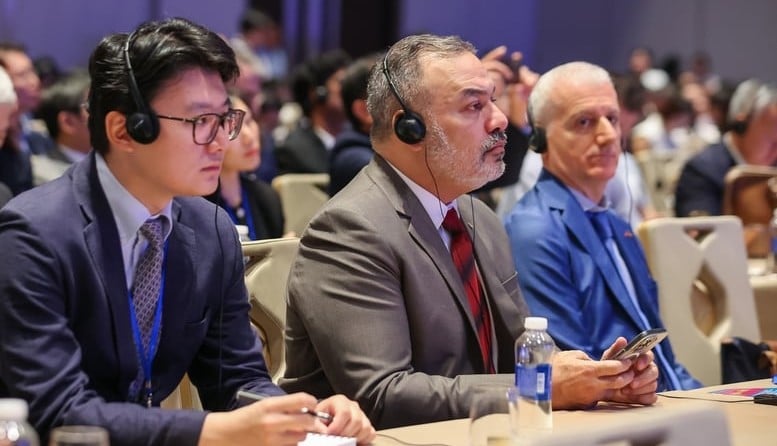 Delegates at a conference on international financial center development in Vietnam, Ho Chi Minh City, August 2, 2025. Photo courtesy of the government's news portal.
Both cities have already prepared infrastructure, workforce, and are actively promoting investment with strategic partners to build the center.
Addressing the conference on Saturday, Prime Minister Chinh said the international financial center is not a special urban zone or a cluster of financial towers, but rather a specially designed mechanism with a relatively defined geographic scope, its own legal framework, and a professional administrative system.
“It will serve as a testing ground for progressive, internationally aligned policies and a legal environment designed for the future,” he stressed.
Starting from September 1, the center must be put into operation, the Prime Minister noted. He instructed ministries and central agencies to urgently draft documents guiding the implementation of the National Assembly resolution, providing a legal basis for HCMC and Danang to establish management and supervisory bodies.
He emphasized that Vietnam’s vision is not merely to attract investors, but to lead the development of new financial models, creating space for digital assets, carbon credits, digital banking, commodity and derivatives exchanges - key pillars of the future finance industry.
Chairman of the HCMC People’s Committee Nguyen Van Duoc told the conference that the city has allocated a 10-hectare land plot at the heart of the Thu Thiem New Urban Area for building the center. While construction is underway over the next two years, the city will use the building at No. 8 Nguyen Hue street as the center's headquarters.
In terms of human resources, the city has prepared a leadership framework and organizational structure consisting of four departments, and is recruiting qualified professionals with experience in finance and securities.
The city is also collaborating with the Vietnamese-German University to train human resources, sending them to international financial centers in the world for study before returning to operate the center in Vietnam.
HCMC is also preparing to sign bilateral and multilateral cooperation agreements with international financial centers in the region and the world, aiming to establish mutually beneficial, long-term relationships.
Meanwhile, Danang has proactively planned and allocated strategic land plots in prime locations within developing urban areas and within a five-kilometer radius of the international airport, said municipal Party chief Nguyen Van Quang.
From 2025 to 2027, Danang will focus on attracting investments in infrastructure development and building the financial center ecosystem on clean land plots totaling 6.17 hectares near the coastline, all meeting international standards, he said.
The city has also proactively developed policies for high-quality workforce development, with special attention to talent tailored for the center.