
VIETNAM CHAMBER OF COMMERCE AND INDUSTRY
Liên Đoàn Thương Mại Và Công Nghiệp Việt Nam
Thu, Aug 07, 2025, 08:20:00
Vietnam’s export earnings grew by 14.8% to $262.44 billion in the first seven months of this year, while its import turnover rose by 17.9% to $252.26 billion, resulting in a trade surplus of $10.18 billion.
The country's total trade turnover reached $514.7 billion in the period, up 16.3% year-on-year, the National Statistics Office (NSO) reported on Wednesday.
The domestic economic sector posted an export growth rate of 6.7% to $67.48 billion, while the figures for the foreign-invested sector, including crude oil, were 17.9% and $194.96 billion, respectively.
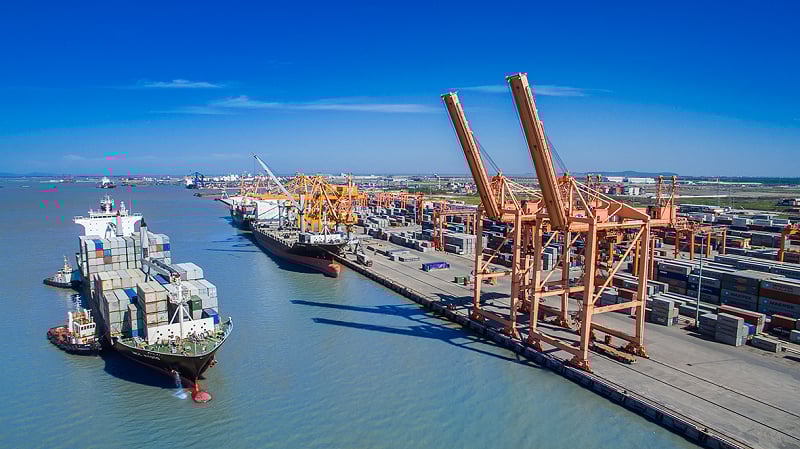 A port in Vietnam. Photo courtesy of VIMC.
Exports of processed industrial goods stood at $232.37 billion, accounting for 88.6% of the total. Agricultural and forestry products reached $22.4 billion, or 8.5%; aquatic products $6.08 billion, or 2.3%; and fuel and mineral products $1.59 billion, making up 0.6%.
Imports of production materials were estimated at $236.57 billion, or 93.8% of the import total. Consumer goods hit $15.69 billion, accounting for 6.2%.
Vietnam ran a trade surplus of $22.3 billion with the EU in the first seven months, marking a 9.9% increase year-on-year, while the surplus with Japan rose 21% to $1.3 billion.
China remained Vietnam’s largest import market in the preriod, with turnover reaching $101.5 billion. Vietnam recorded a trade deficit of $66.5 billion with the neighbouirng country, up 41.1% year-on-year.
The trade deficit with South Korea stood at $17.4 billion, down 0.2%, while the deficit with ASEAN rose sharply by 63% to $8.5 billion.
Vietnam’s consumer price index (CPI) increased 3.26% year-on-year in the first seven months of 2025, while core inflation rose 3.18%.
Rising costs for housing repairs, food, and dining out were the main contributors to a 0.11% month-on-month increase in CPI in July. The index rose 2.13% from December 2024 and 3.19% year-on-year.
CPI rose 0.03% in urban areas and 0.2% in rural areas. Among the 11 main commodity groups, prices increased in nine categories and declined in two.
Key drivers of July CPI included healthcare and medicine prices, which surged 12.81% year-on-year, contributing 0.69 percentage points to CPI, following an increase in medical service prices under a Ministry of Health circular.
The housing, utilities, and building materials group rose 7.07%, adding 1.33 percentage points, due to higher rents and repair costs.
Price hike was also seen in housing maintenance materials (8.53%), rent (7.17%), electricity (8.94%), and water supply (4.89%). Meanwhile, education climbed 3.05%, contributing 0.19 percentage points to the overall index, while food and catering services increased 2.92%, adding 0.98 points.