VIETNAM CHAMBER OF COMMERCE AND INDUSTRY
Liên Đoàn Thương Mại Và Công Nghiệp Việt Nam
Tue, Aug 12, 2025, 04:19:00
Vietnam Container Shipping JSC (Viconship) (HoSE: VSC), based in the northern city of Hai Phong, and its affiliates stood out, all posting net profit growth.
In Q2, Viconship’s net revenue rose 12.55% from a year earlier to VND807 billion ($30.77 million), while net profit surged 62.51% to VND148.7 billion ($5.67 million).
Its H1 revenue climbed 15% to nearly VND1.5 trillion ($57.2 million) and pre-tax profit jumped 55% to VND315 billion ($12.01 million), both marking the company’s highest H1 figures since it began releasing periodic data in 2009.
The results put Viconship at nearly 54% of its full-year revenue target and about 79% of its profit goal.
Its subsidiaries and affiliates also posted strong Q2 earnings. Vip Greenport JSC (UPCoM: VGR), a Viconship unit, reported a 35% jump in Q2 profit to VND125.2 billion ($4.77 million).
Hai An Transport & Stevedoring JSC (HoSE: HAH), in which Viconship holds a 13.5% stake, saw Q2 revenue climb 34% to VND1.27 trillion ($48.42 million) and consolidated net profit surge 227.3% to VND414.3 billion ($15.8 million) - its highest quarterly profit on record.
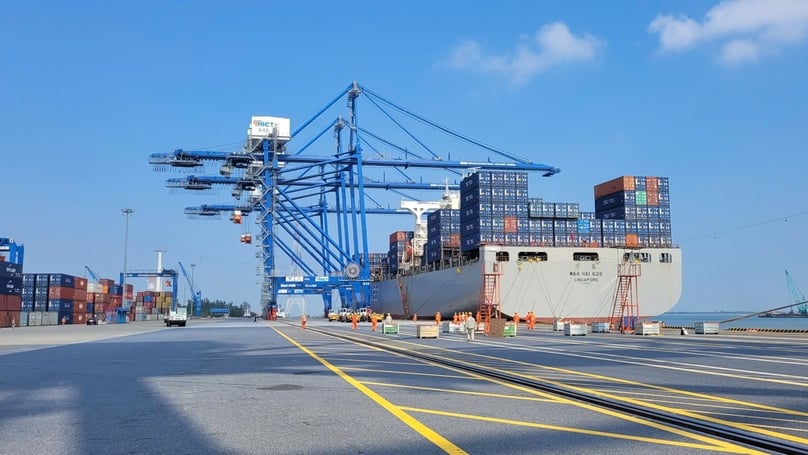
Apart from the Viconship group, Saigon Port JSC (UPCoM: SGP) in Ho Chi Minh City made an outstanding performance, with Q2 net profit up 49.58% to VND106.8 billion ($4.07 million).
SGP said the growth was driven by a VND6 billion ($228,789) increase in bank deposit interest, an VND8.46 billion ($322,593) gain from exchange-rate differences, and a VND38.6 billion ($1.47 million) rise in profit from associates thanks to higher Q2 after-tax profit at SP-SSA International Terminal (SSIT).
The company also booked an additional VND17.6 billion ($671,116) in other profit as late-payment and tax penalties fell by VND17.05 billion ($650,143).
Similarly, HCMC-based Gemadept Corporation (HoSE: GMD) delivered a strong quarter, with revenue rising 26.7% from a year earlier to VND1.5 trillion ($57.2 million) and net profit up 39.1% to VND581.54 billion ($22.17 million).
For H1, revenue reached VND2.77 trillion ($105.62 million) and net profit came in at VND1.11 trillion ($42.32 million). Excluding gains from the divestment of Nam Hai Port in Hai Phong city, net profit rose 44.8% from a year earlier. The company has completed 70% of its registered target and 63% of its stretch goal.
On the flip side, Port of Hai Phong JSC (UPCoM: PHP) and Vietnam Maritime Corporation (UPCoM: MVN) saw Q2 net profit fall 18.22% and 46.76%, respectively. MVN is PHP’s largest shareholder, holding a 92.56% stake.
Steering toward deeper waters of growth
According to the Vietnam Maritime and Waterway Administration, the trend toward deploying larger container vessels is an inevitable course for the global shipping industry, aimed at optimizing operating costs and meeting rising transport demand.
In response, the Ministry of Construction has approved detailed development plans for three key port clusters: Hai Phong, Da Nang in central Vietnam, and HCMC. By 2030, these hubs aim to handle 215 million tons, 29 million tons, and 253 million tons, respectively, representing compound annual growth rates of 12.4%, 13.1%, and 6.1%.
Maximizing Vietnam’s seaport potential hinges on building robust supporting infrastructure. Expressways linking deep-water ports to major industrial and economic zones are vital to clearing transport bottlenecks, cutting costs for clients, and boosting operational efficiency.
Complementary facilities such as free-trade zones and financial centers would further attract capital inflows and secure steady cargo volumes, bolstering port performance and sharpening Vietnam’s competitive edge against regional rivals.
MB Securities said it expects that relentless efforts to expand deep-water ports and upgrade supporting infrastructure will soon elevate Vietnam’s maritime sector, propelling the country to ninth in the Emerging Markets Logistics Index of Agility, a global leader in supply chain services, infrastructure and innovation, by 2026.
With deep-water port capacity expanding and supporting infrastructure improving, the brokerage also sees substantial upside for container handling fees in 2025-2026.
Nguyen Anh Quan, an analyst at another broker, DNSE Securities, said the industry is driven by four growth engines - rising trade flows, increasing FDI inflows, improving infrastructure, and opportunities from tariff shifts.
Data from the National Statistics Office under the Ministry of Finance showed that in July alone, total import and export turnover reached $82.27 billion, up 8% from the previous month and 16.8% from a year earlier.
For the first seven months of 2025, total trade came to $514.7 billion, up 16.3% year-on-year, with exports rising 14.8% and imports 17.9%, generating a trade surplus of $10.18 billion.
This robust growth is directly fueling demand for cargo transshipment through the ports, Quan said.
Moreover, FDI is growing strongly, he said, citing data from the National Statistics Office showing that registered FDI in Vietnam reached $24.09 billion in the first seven months, up 27.3% from a year earlier.
The inflows are highly diversified by source country, enabling Vietnam’s manufacturing and logistics sectors to benefit from participation in international trade agreements.
“This, in turn, is boosting demand for cargo clearance and reinforcing the role of ports,” Quan said.
This trend is also feeding into the third growth driver - increased investment in port infrastructure.
Public investment in transport connectivity, particularly seaports, is increasingly prioritized, with upgrades to the Ha Nam (Hai Phong) and Cai Mep (HCMC) shipping channels set for completion this year. The projects are expected to boost vessel-handling capacity and attract new partners.
Newly operational terminals such as Lach Huyen 36 in Hai Phong and Phuoc An in Dong Nai province, southern Vietnam, have already enhanced operational efficiency and drawn more large vessels, according to DNSE experts.
The final and most crucial driver is tariffs. “Trade tensions have prompted international companies to relocate and diversify supply chains instead of concentrating production in just one or two countries,” Quan said.
“With its major advantages, Southeast Asia will become a new manufacturing hub. Vietnam, backed by political stability and heavy infrastructure investment, will benefit from this trend.”
In addition, global shipping lines such as CMS, CGM and Maersk are expanding port infrastructure investment in Vietnam, cementing the 100-million-strong nation’s role as a key link in global supply chains, he said.