VIETNAM CHAMBER OF COMMERCE AND INDUSTRY
Liên Đoàn Thương Mại Và Công Nghiệp Việt Nam
Tue, Aug 26, 2025, 03:36:00
The Ninh Thuan nuclear power project was revived in late 2024 with completion targeted within five years. It includes two plants - Ninh Thuan 1 and Ninh Thuan 2, both in former Ninh Thuan province (now Khanh Hoa after their merger), central Vietnam.
State-owned giants Vietnam Electricity (EVN) and Petrovietnam have been named as the respective investors.
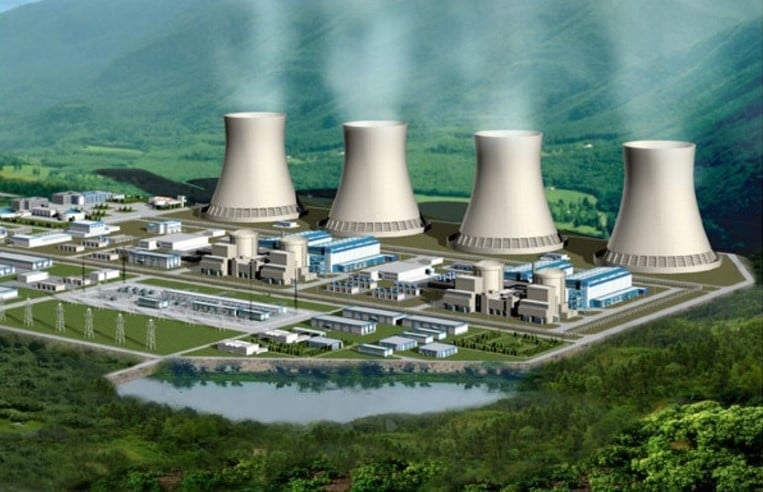
Under Resolution 249 dated August 22 on a plan to implement special investment mechanisms for the Ninh Thuan nuclear power project, the government asked the Ministry of Industry and Trade and relevant agencies to negotiate and sign international agreements with partners on investment cooperation for the two plants, targeting completion in September for Ninh Thuan 1 and in December for Ninh Thuan 2, the government’s news portal reported.
Talks with partners on credit agreements are key to advancing the nuclear power project, as securing financing remains one of the biggest hurdles for the developers.
That’s because building a 2,000 MW nuclear power plant could cost more than $10 billion, far beyond the financial capacity of domestic companies and banks. On top of that, they face the risk of cost overruns - a reality seen in many projects worldwide.
In addition to credit negotiations, the government ordered EVN and Petrovietnam to submit applications to competent authorities for revised investment approvals. The process is expected to be completed during the National Assembly’s October-November 2025 session for Ninh Thuan 1 and no later than May 2026 for Ninh Thuan 2.
Afterward, the state appraisal council, chaired by the Ministry of Finance, will review and submit the investment projects and sites for the Prime Minister’s approval in 2026.
The Ministry of Science and Technology, in coordination with the International Atomic Energy Agency, is tasked with completing an infrastructure assessment report in 2025.
The ministry must also draft and submit for approval a master plan for nuclear power infrastructure development and study Vietnam’s participation in necessary multilateral treaties in the field of atomic energy, with completion targeted in 2026.
In addition, the Ministry of Science and Technology will review and amend decrees and circulars under the Law on Atomic Energy governing nuclear power plants, with completion due this year.
The Khanh Hoa provincial People’s Committee needs to accelerate resettlement and site clearance, according to the resolution.
The Ministry of Education will draft and submit to the Prime Minister a plan for training nuclear power personnel, to be rolled out immediately after approval.
During project development and construction, EVN, Petrovietnam and other agencies are required to manage capital and resources prudently and efficiently, while preventing corruption and wastefulness, and ensuring national defense, security, radiation safety, and environmental protection.
An inter-ministerial task force, including representatives from the ministries of defense, public security, and finance, the Government Inspectorate, and the State Audit Office of Vietnam, is slated to be set up in 2026 to oversee compliance and monitor anti-corruption and anti-wastefulness efforts during implementation.
In 2005, Vietnam’s Party Central Committee greenlighted a plan to build two nuclear power plants in Ninh Thuan. Four years later, the National Assembly approved the plan with an initial investment of VND200 trillion ($7.59 billion).
In November 2016, the parliament decided to halt the 4,000 MW project, citing safety, funding and technology reasons. However, in November 2024, the legislative body agreed to resume the project after an eight-year suspension.
A notice released by the Government Office in June said developing power sources, including nuclear energy, is vital to ensuring energy security and sustaining Vietnam’s projected double-digit economic growth. The country’s 2050 net-zero commitment also demands an accelerated shift toward clean, green, and renewable energy.